
So, your SEO agency is doing pretty well, right? You’ve got a solid roster of SMB clients, you’re delivering results, and things are chugging along. But there’s that itch, isn’t there? That feeling that there’s a bigger game to be played. You see those big logos – the household names, the industry giants – and wonder, “How do I get those clients?” If you’re serious about how to grow an SEO agency into a real powerhouse, shifting your focus towards enterprise clients is the path.
Big Logo Deals
Learn how to close your first big enterprise deal and drive massive business growth.
But here’s the rub: landing and, more importantly, thriving with enterprise clients is a whole different beast. It’s not just about scaling what you do for SMBs. Big companies operate on a different planet, with their own rules, languages, and expectations. Many agencies hit a wall here, not because they lack skill, but because they lack the insider knowledge of how these behemoths tick.
This isn’t just about adding a zero to your contract values; it’s about transforming your agency from the ground up. Ready to peek behind the enterprise curtain?
The Enterprise Leap: It’s More Than Just Size
Think an enterprise client is just a bigger version of your current SMB customers? Think again. The chasm between them can swallow unprepared agencies whole. What makes them so different?
- The Decision Maze (aka “Constellation Decision-Making”): With SMBs, you might talk to the owner or a key manager. Decision made. Enterprise? You’re often navigating a complex web of 8-10+ stakeholders, each with their own agenda, budget cycles, and influence. Who really holds the purse strings? It’s often a mystery.
- Procurement Purgatory: Ever heard of a “supplier portal”? Or an MSA (Master Services Agreement) that’s 60 pages long and written in Elvish? Welcome to enterprise procurement. They have rigid processes, and you need to play by their rules, which can be slow, frustrating, and demand a ton of paperwork.
- Sky-High Expectations (and Scrutiny): These guys are spending serious money, and they expect flawless execution, constant communication, and detailed reporting in their preferred format. Your well-oiled SMB processes? They’ll likely break under enterprise pressure.
- Glacial Pacing (Followed by Panic Sprints): Budget cycles, internal politics, and layers of approval mean things can move at a snail’s pace. Then, suddenly, it’s “all hands on deck” for an urgent deliverable. “Hurry up and wait” is the unofficial motto.
- The “Not Invented Here” Syndrome: Your standard SEO packages that work wonders for SMBs? Enterprise clients often want bespoke solutions, and they’ll want to see how you adapt to their world, not force them into yours.
This isn’t to scare you off. It’s to prepare you. Because cracking the enterprise code is how you truly unlock explosive growth for your SEO agency.
Your Agency’s Enterprise Transformation: Key Areas to Master
1. The Mindset & Presence Upgrade: Look and Act the Part
First things first: your agency needs to project “enterprise-ready.”
- “Calm Confidence” is Your Superpower: Big company execs can smell desperation a mile away. That “thirsty” sales approach? It’s a deal-killer. You need to cultivate an aura of calm confidence. Think: “It makes no difference to my life if you buy this. It might make a difference to yours if you don’t.” Of course, you care, but they shouldn’t see that. Project that you’re the best solution, and they need to realize it.
- “Looking Legit”: That outdated website because “all your business is referral”? It won’t fly. Enterprise buyers will scrutinize your online presence. Your site, your LinkedIn, your materials – they need to scream credibility and professionalism. Simple is fine, but shabby is a no-go. And your core values? If your “About Us” page screams “fun over work,” be mindful of how that lands with a corporate buyer who’s about to drop six figures on you.
- Understanding the Call Types: Not all enterprise calls are created equal. Are you talking to a “Delegated Shopper” (an intern with a checklist), an “Unfunded Mandate” (a frazzled mid-leveler with a problem but no budget), or a genuine “Mid-Level Owner” who could be your internal champion? Knowing who you’re talking to shapes your entire approach.
- Become Their Advocate: Often, your initial contact needs to sell you internally to their boss. Don’t just send a proposal and hope for the best. Offer to help them make the case. Position yourself as their partner in navigating the internal hurdles.
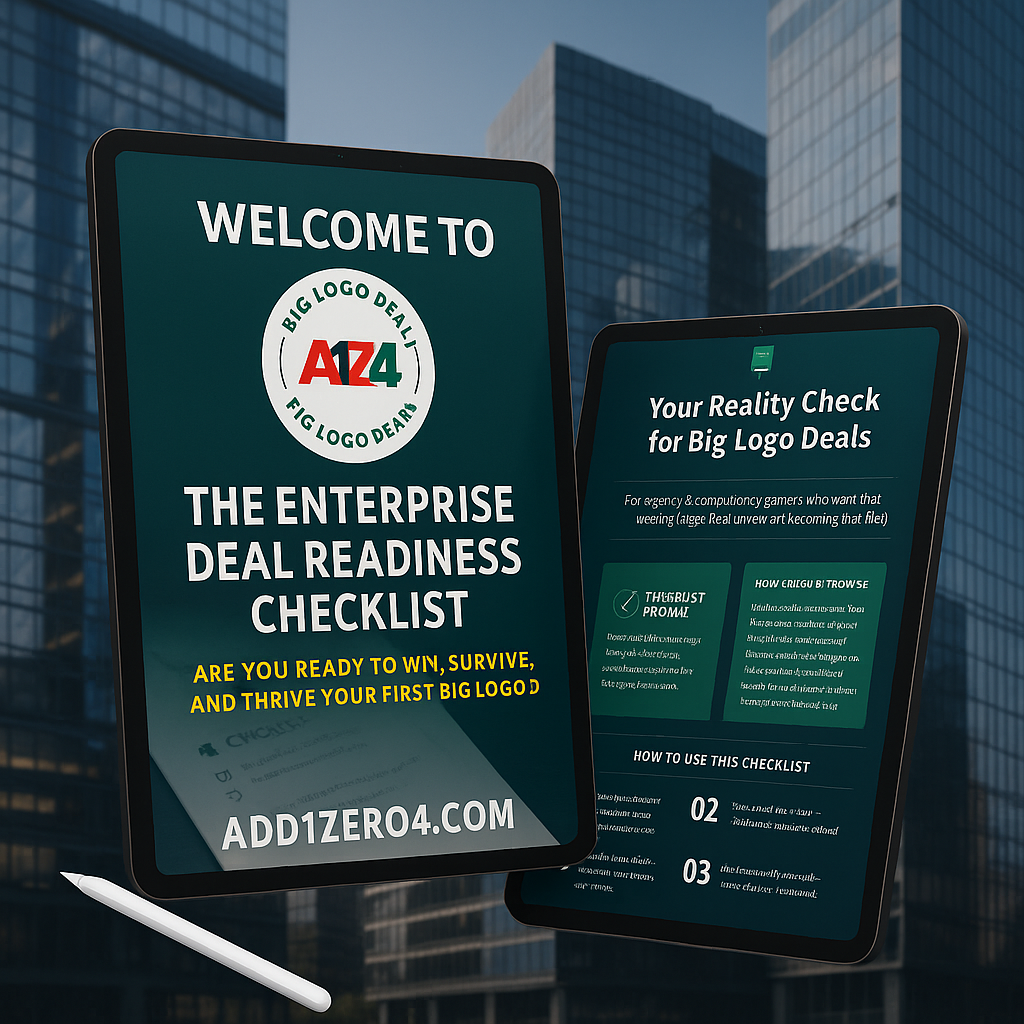
The Enterprise Deal Readiness Checklist
Skip the $100K+ learning curve. This insider’s checklist reveals if your B2B agency can win (and survive) Fortune 500 deals before you risk your stable revenue and best people chasing logos you’re not ready for.
2. Financial Fortitude: Can You Afford to Win Big?
This sounds counterintuitive, but a massive enterprise deal can sink your agency faster than no deals at all if you’re not financially prepared.
- Cash is King (and Queen, and the Entire Royal Court): Enterprise clients often have Net 60, Net 90, or even longer payment terms. That means you’re footing the bill for salaries, tools, and overhead for months before you see a dime. Our rule of thumb: assume you’ll need to float at least half the contract value for six months. Don’t have that cash on hand or a solid credit line? You’re playing with fire.
- COGS Clarity is Crucial: You must know your Cost of Goods Sold (COGS) inside and out. Enterprise clients will want to unbundle your packages and see line-item costs. If you don’t know your true costs (including your own time!), you can easily underprice and torpedo your margins. Aim for at least 40% gross margin, ideally much higher.
- The “Do or Die” Deal is Already Dead: If landing a specific enterprise deal feels like a “do or die” situation for your agency, you’re already in trouble. You need a buffer. Things will go wrong.
- Opportunity Cost: What are you giving up to service this huge client? Will your best team members be pulled off profitable SMB accounts? Will other sales efforts suffer? Factor this in.
3. Operational Overhaul: Getting Your House in Order
Your current operational setup, optimized for SMBs, will likely buckle.
- Expect Processes to Break: From onboarding to reporting, what worked for smaller clients will need a serious re-think. Enterprise clients demand more communication, more project management, more QA. Be prepared to build new, more robust systems.
- Team Readiness: Can your current team handle the 10x demand in attention and output? You might need to hire specialists with enterprise experience or at least prepare your existing team for a significant shift in workload and expectations. Remember, your best people might be consumed 50%+ by a single new enterprise client.
- Sales Enablement that Speaks Enterprise: Those flashy, generic sales decks? Ditch ’em. Enterprise buyers want concise, value-driven materials. Think short videos, one-page case studies with hard ROI, and modular content you can pull up as needed. We’ve found more success with simple Google Docs proposals than overly designed PDFs. The key is to build a library of easily digestible, ROI-focused content.
- Communication Standards: Enterprise clients expect proactive, clear, and consistent communication. They also have their preferred channels and reporting formats. Find out what they are and adapt. And yes, you’ll sometimes have to chase them for approvals – politely but persistently.
Our Probably-Too-Honest Private Podcast
Find out what REALLY happens when agencies land enterprise deals (spoiler warning: one of them lost $100K)
Brought to you by Add1Zero4 and hosted by David “Ledge” Ledgerwood
4. Pricing and Packaging for Premium Paydays
Forget your standard SMB rate card. Enterprise pricing is a different league.
- “Twice the Price, Half the Deliverables”: This is a solid starting point. Why? Because the overhead – the endless meetings, custom reports, internal navigation – is immense. If your SMB package is $5k/month, consider $10k/month for a scaled-down version for an enterprise client.
- Price for Overhead: All that extra time your team spends on calls, custom reports, and navigating their bureaucracy? It’s not billable as a line item. It must be baked into your overall price.
- No More “Freebies”: Doing a little extra “on the house” for an SMB client builds goodwill. With enterprise clients, free work often just becomes an expectation, and the person you did the favor for might not even be the one who can reciprocate with more business. If you do offer something extra, document it clearly as a one-time concession.
- Negotiate Payment Terms: Don’t just accept their standard Net 90. Ask for shorter terms, an upfront percentage, or milestone-based payments. We once negotiated 40% upfront from a $100B+ company whose standard was Net 90 after all work was done. Know your limits and be prepared to walk.
5. Navigating the Corporate Labyrinth: Legal & Procurement
This is where many agencies get bogged down.
- Legal Eagles (Use Them Wisely): Yes, get legal counsel to review contracts, especially their lengthy MSAs. But understand what really matters. Don’t let your lawyer redline every clause if it means months of back-and-forth that kills the deal. Focus on critical items: publicity clauses (can you use their logo?), IP ownership, and genuinely risky terms.
- NDA Nuances: Most enterprise NDAs are standard. Sign them and move on. But watch out for non-competes or overly broad exclusivity clauses that could hamstring your agency’s future growth.
- Procurement Portals & Paperwork: You’ll likely need to register on their supplier portal (SAP Ariba, Coupa, etc.), fill out endless forms, and provide detailed company information, tax docs, insurance certificates, and more. It’s a time-consuming, often frustrating, part of the process. Stay organized and keep copies of everything.
- Insurance: The Right Coverage: They’ll have insurance requirements. Make sure you have professional liability/E&O. Challenge requirements for types of insurance you don’t need (e.g., massive cyber coverage if you’re not handling PII, or auto liability if you’re fully remote).
The Big Logo Deals Course
Created by experts who have closed over $50 million in revenue over the last decade who teach you everything they know about closing deals with the logos you wish were on your client list.
6. Mastering the Marathon: Patience & Timing
Enterprise sales are not quick wins.
- Long Sales Cycles: From initial contact to signed contract can take 6, 9, even 12+ months. Be prepared for the long haul.
- When “Yes” Isn’t “Yes”: A verbal “Okay, we want to do this!” from your contact means very little. The deal isn’t closed until contracts are signed, POs are issued, and you can actually bill. We learned this the hard way – don’t buy champagne on a verbal!
- Follow-Up Finesse: Prospects will go dark for months. Polite persistence is key. Use a follow-up cadence. Connect on LinkedIn. If you got their mobile, a polite text can sometimes work wonders. But know when to let go; you can’t win them all.
- Celebrating Real Wins: Don’t tell the whole team about a “verbal.” It’s demoralizing if it falls through. Celebrate when the ink is dry and the PO is in hand.
The Transformation is Worth It
Remember that SaaS company we helped? They thought they could do a project for a major multinational for $30K. We helped them refine their processes and understand enterprise expectations. They won the job for $300K. That’s the power of knowing how to play the Big Logo game.
Landing that first enterprise client is the hardest. Each subsequent one gets easier. The social proof of a big name on your roster is invaluable, and your team gains the experience and confidence to speak the enterprise language fluently.
Ready to Add a Zero (or Two) to Your Deals?
- Take the first step by diving into the Big Logo Deals course – it’s packed with the practical, no-fluff strategies you need.
- Not sure if your agency is truly enterprise-ready? Download our free Enterprise Deal Readiness Checklist.
- Want to hear more real-world stories and insights? Tune into the Big Logo Deals podcast.
Growing your SEO agency into an enterprise-serving powerhouse isn’t a pipe dream. It’s a strategic shift. It takes work, patience, and the right know-how. But the rewards? They can redefine your agency’s future. Now go out there and make it happen.