
So, you’ve built a successful web design agency. You’re a creative force, a problem-solver, and your team churns out fantastic work for small to medium-sized businesses (SMBs). Referrals are good, clients are happy, and things are ticking along. But there’s a whisper in the back of your mind, a yearning for something… bigger. You see those household names, those “big logo” clients, and you think, “Why not us?”
Big Logo Deals
Learn how to close your first big enterprise deal and drive massive business growth.
If that sounds familiar, you’re in the right place. Many web design, marketing, and advertising agency owners hit a similar point. They’re masters of the SMB world but find the leap to enterprise clients feels like jumping a chasm. The truth is, your current web design agency business model, the one that’s served you so well, likely needs a significant overhaul to play in the big leagues. It’s not just about scaling your services; it’s about transforming how you operate, think, and sell.
The biggest hurdle? Understanding that large companies don’t just operate like bigger SMBs. They’re a different species altogether. Their internal workings, decision-making processes, and expectations can feel like a foreign language if you’re used to the more straightforward SMB landscape.
The Enterprise Enigma: Why Your Current Model Won’t Cut It
Remember those deals where you chatted with the founder, maybe one other key person, and things moved relatively quickly? Forget that with enterprise clients. You’re often dealing with what we call “constellation decision-making.” Imagine a solar system of stakeholders – sometimes 8, 10, or more – each with their own priorities, influence levels, and often, appearing and disappearing throughout a sales cycle that can feel glacial.
Urgency is rarely their middle name. They’re often beholden to strict budget cycles that don’t align with the calendar year, and a “quick chat” can turn into a series of carefully orchestrated presentations. This is a world away from the nimbleness of most SMBs. If your web design agency business model is built solely on speed and direct access to the ultimate decision-maker, you’re in for a rude awakening.
So, how do you adapt? Let’s break down the core shifts your agency needs to make.
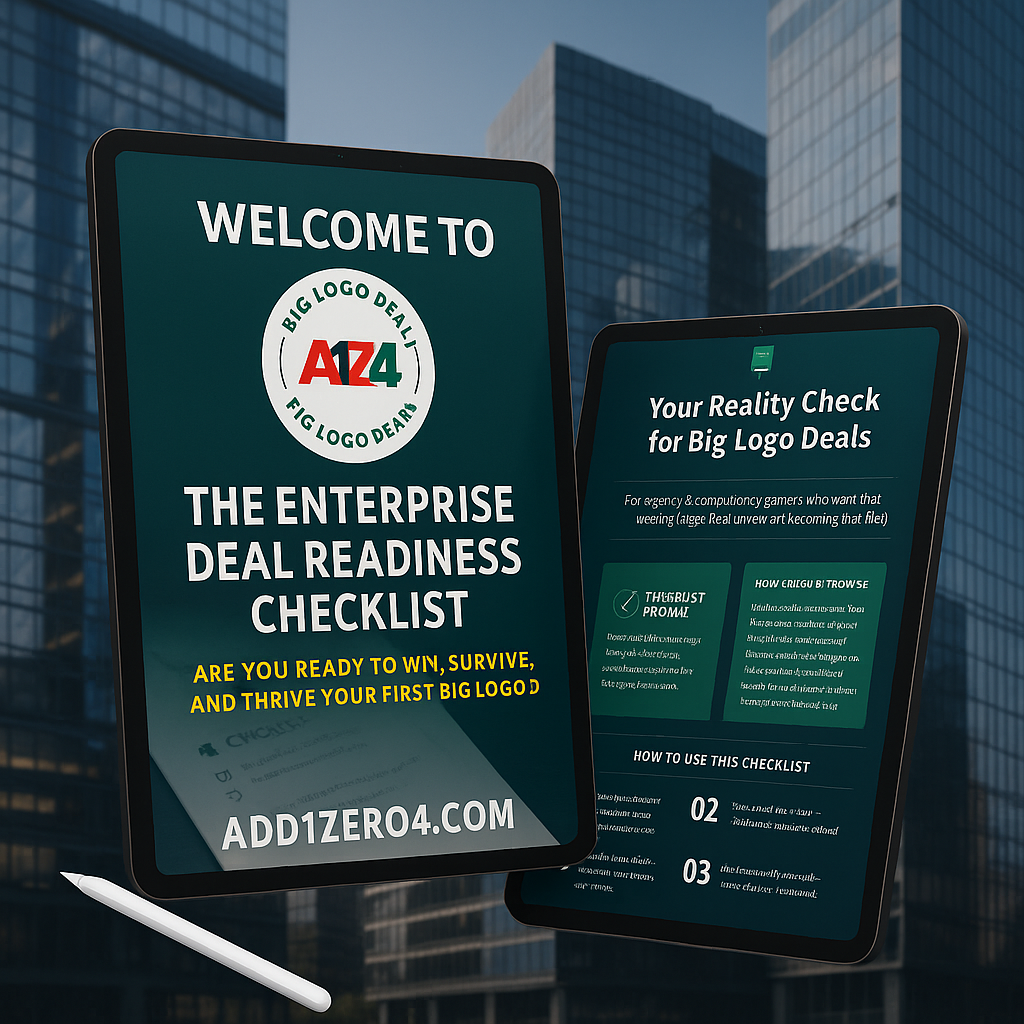
The Enterprise Deal Readiness Checklist
Skip the $100K+ learning curve. This insider’s checklist reveals if your B2B agency can win (and survive) Fortune 500 deals before you risk your stable revenue and best people chasing logos you’re not ready for.
Pillar 1: Supercharging Your Attitude & Deal-Making Mojo
Landing big logos starts with how you present yourself and approach the conversation. It’s less about swagger and more about “calm confidence.”
- Looking Legit from Click One: That website that “gets all its business from referrals anyway”? It needs an enterprise-grade polish. Big companies will scrutinize your online presence. Your site, your messaging, even your stated core values (be careful if “fun over work” is plastered on your About Us page!) need to scream credibility and professionalism. They need to believe you can handle their scale. Your lead funnels also need a rethink. Aggressive, automated funnels that work for SMBs can be an instant turn-off. Think accessible, appointment-focused funnels that make it easy for them to engage on their terms.
- Mastering the Enterprise Call: Not all calls are created equal. You’ll encounter the “Delegated Shopper” (an intern filling a spreadsheet), the “Unfunded Mandate” (a frazzled mid-leveler with a vague task), or even a “Chemistry Call” to see if you’re a cultural fit. Your job is to identify who you’re talking to and adapt. And when they ask about cost after giving you 20% of the info? Or “what makes you different?” You need poised, confident answers. Hint: “We care more” isn’t it.
- The Art of Feigned Indifference (aka Calm Confidence): Desperation stinks, especially to seasoned enterprise buyers. Cultivate the mindset that while you’d love their business, your agency’s survival doesn’t hinge on this one deal. This “calm confidence” allows you to negotiate from strength. It’s about being helpful and informative, not pushy. And when your contact needs to sell your services internally? Offer to help them. Don’t expect a non-expert to pitch your complex offerings effectively to their boss.
- Strategic Deal-Making Levers: A savvy buyer will always ask for a discount. Instead of caving, have a mental list of what you can ask for in return. Shorter payment terms? A longer commitment? A video testimonial? It’s a trade, value for value. And understand their budget cycles! Enterprise fiscal years are often not calendar years. Knowing this allows you to align your proposals with their planning.
- Developing Rhino Skin: You’ll encounter all sorts of personalities and agendas. Scope creep will be a constant companion. Learn to say “no” politely but firmly, sticking to the agreed-upon scope. Remember, doing “favors” for enterprise clients rarely garners the same goodwill it does with SMBs.
Our Probably-Too-Honest Private Podcast
Find out what REALLY happens when agencies land enterprise deals (spoiler warning: one of them lost $100K)
Brought to you by Add1Zero4 and hosted by David “Ledge” Ledgerwood
Pillar 2: Fortifying Your Financial Foundations for Bigger Bets
Big deals mean big money, right? Yes, but they also mean big costs upfront. If your financial house isn’t in order, a “bet the company-sized deal” can, ironically, sink the company.
- The Cash Flow Crunch: Enterprise clients often have long payment terms (Net 60, Net 90 aren’t uncommon). You’ll be paying your team and covering expenses long before their check clears. A rule of thumb: have at least half the value of the first six months of the contract in unallocated cash before you start. If you’re thinking, “If we don’t deliver this, we’re screwed,” you’re already in trouble.
- Decoding Your True Costs (COGS): That gut-check COGS calculation that worked for SMBs? It won’t fly. You need to meticulously understand the cost of delivering every single item or service for an enterprise client, factoring in increased project management, communication overhead, and quality assurance. Enterprise clients will want to see services unbundled, and if you don’t know your true costs, you’ll underprice and kill your margins.
- Speaking Their Financial Language (KPIs & ROI): Enterprise clients, and especially their bosses, are hyper-focused on ROI. Soft metrics are nice, but hard numbers rule. Understand how your direct contacts are measured and what KPIs their leadership cares about. Frame your value and testimonials in these terms. Want to really impress? Start collecting ROI stats during client delivery by benchmarking at the outset.
- Taming the Accounts Receivable Beast: Getting paid by large organizations is an art form. Invoices need to be meticulous, often requiring specific PO numbers and submission through clunky vendor portals. Your Net terms start when the invoice is received, so don’t delay. Be prepared to chase payments politely but persistently.
- Scaling Up Wisely: That massive deal will consume your best people. Assume key team members will be at least 50% dedicated to this new client. Can your existing team handle their current workload and this new behemoth? You might need to hire or bring in experienced contractors who understand the enterprise world.
Ready to dive deeper into structuring your agency for these massive opportunities? The Big Logo Deals course lays out the complete playbook.
The Big Logo Deals Course
Created by experts who have closed over $50 million in revenue over the last decade who teach you everything they know about closing deals with the logos you wish were on your client list.
Pillar 3: Elevating Your Operational Game for Flawless Execution
Winning the deal is one thing; delivering flawlessly is another. Your operations need to be enterprise-ready.
- Show Up Like the Undisputed Expert: Enterprise clients expect you to have done your homework. Deeply research their company, industry, and the specific team you’re engaging with before the first call. Record all sales calls (with tools like Fathom for Zoom) and make these recordings available to your delivery team. This ensures everyone is on the same page.
- Sales Enablement That Actually Enables Sales: Forget massive, over-designed sales decks. Enterprise buyers want concise, value-packed materials that address their specific needs. Think modular content: short videos, one-page case studies (with hard ROI), clear process flowcharts. Build a library of these “middle-of-funnel” assets that your sales team can deploy strategically.
- Meeting (and Exceeding) Enterprise Standards: Communication, delivery, and reporting expectations are sky-high. They might move slowly on approvals but expect you to be hyper-responsive. Be prepared for processes to break. What worked for SMBs (like a standard 6-week onboarding) might take months with an enterprise client due to layers of approvals. Be agile, communicate constantly, and reconfirm everything. And yes, sometimes you’ll be reformatting a 65-slide deck into a Word document because that’s what leadership wants.
- Proactive Customer Success & Scope Creep Containment: That big new logo will inevitably strain resources for your existing SMB clients. Be upfront with them. Explain the situation and provide a clear escalation path (a “Bat Phone”) if they feel service is slipping. Internally, train your team on the signed scope for the enterprise client and how to escalate scope creep requests artfully. “Helpful” over-delivery that SMBs love can become an expectation of free work with enterprises.
Pillar 4: Reimagining Your Pricing & Packaging for Enterprise Value
Your SMB packages, no matter how refined, likely won’t appeal to enterprise buyers. They want custom solutions, and they expect to pay premium prices for them.
- Ditch the Standard Rate Card (Mostly): While your SMB offerings provide a foundation, enterprise clients will want bespoke proposals. They don’t want to be forced into a pre-defined package. This is actually a good thing – it’s your opportunity to price for the immense value (and complexity) you’re delivering.
- “Twice the Price, Half the Deliverables” Revisited: This isn’t just a catchy phrase. Enterprise clients demand significantly more overhead – more meetings, more reporting, more hand-holding. Your pricing must reflect this. If your SMB retainer is $5K/month for a certain scope, consider $10K/month for half that scope as a starting point for an enterprise deal. This helps cover that invisible overhead.
- No More “Free Stuff”: Doing favors for SMBs builds goodwill. With enterprise clients, free work often just sets an expectation for more free work. The person you’re “helping” might not even be the one who can reciprocate with future business. If you do offer something extra, be explicit that it’s a one-time accommodation and document it clearly on invoices (full price, then a credit line).
- Navigating Complex Payment Cadences: Credit card on file and monthly billing? Unlikely. Expect longer Net terms (Net 30, 60, 90). But remember, these are negotiable. Don’t be afraid to ask for shorter terms or upfront payments, especially if you need to finance the initial delivery. Know your cash flow needs and be prepared to walk if their terms are untenable. Milestone billing, aligned with clear deliverables, is often a good compromise.
Pillar 5: Conquering the Labyrinth of Legal & Procurement
This is where many agencies get bogged down. Enterprise contracts and procurement processes can be daunting.
- Legal Counsel – Your Guide, Not Just Your Redliner: While you don’t need a lawyer to review every comma, expert legal counsel is vital for understanding the risks in those lengthy MSAs (Master Service Agreements) that big companies will make you sign. Focus on what actually matters: publicity clauses (can you use their logo?), intellectual property, and genuinely harmful non-competes or exclusivity clauses. Don’t let fear of obscure risks block business growth.
- NDAs: Necessary Hurdles: Non-Disclosure Agreements are standard. Review them for red flags (like overly broad non-competes or unlimited timeframes), but generally, they’re a cost of doing business. Just make sure they’re mutual if possible.
- Contract Language Pitfalls: Watch out for clauses that prevent you from using the client’s logo in your marketing – this significantly diminishes the value of landing a big name. Insurance requirements are common; ensure they’re reasonable for your type of business and not an overly broad template. Data security and IT audits can be painful; leveraging major cloud providers can help, as they often have robust security policies you can point to.
- Procurement: The Gatekeepers: Understand that procurement’s job is to standardize and manage vendor relationships. You’ll be filling out forms, registering on supplier portals (some are user-friendly, many are not), and providing detailed company and banking information. Keep meticulous records.
Feeling overwhelmed by the enterprise maze? Our Enterprise Deal Readiness Checklist can help you assess where you stand.
Pillar 6: The Fine Art of Patience & Perfect Timing
Perhaps the most crucial shift is mental: embracing the long game.
- Embrace “Hurry Up and Wait”: As mentioned, enterprise decision-making involves many stakeholders and can be incredibly slow. Your contact might be enthusiastic, but they’re navigating a complex internal landscape. What’s urgent for you is rarely urgent for them.
- Follow-Up Finesse: Polite persistence is key. Set reminders, touch base, offer value, but don’t be a pest. Connect on LinkedIn. If you have their mobile (from a well-designed lead form!), use text sparingly and professionally. Sometimes a deal disappears for months, only to resurface.
- Knowing When a Deal is Truly Closed: A verbal “yes” from your main contact? Great sign, but it means nothing until paperwork is signed, POs are issued, and you’re through procurement. Don’t celebrate (or make staffing decisions) based on a verbal. The deal is closed when you can confidently bill for it.
- When to Walk Away (and Celebrate Real Wins): You won’t win them all. Use lost deals as learning experiences. And when you do land that big logo and the ink is dry? Celebrate with your team! Analyze what worked and how you can replicate that success.
Is Your Web Design Agency Business Model Ready for the Big Leagues?
Transforming your web design agency business model to attract and serve enterprise clients is a marathon, not a sprint. It requires fundamental shifts in your mindset, operations, finances, and sales approach. It’s about building new muscles: patience, meticulousness, strategic negotiation, and an unwavering focus on delivering demonstrable value in a way these giants understand and appreciate.
The journey is challenging, but the rewards – larger contracts, higher margins, and the prestige of working with iconic brands – are immense. Every big logo you successfully serve makes landing the next one easier.
Ready to stop chasing small wins and start building an agency that commands the attention of enterprise clients? The Big Logo Deals course provides the in-depth strategies and frameworks you need. For more ongoing insights and stories from the front lines, tune into the Big Logo Deals podcast. The big leagues are waiting.