
So, you’ve built your B2B service agency from the ground up. You’re smart, you’re scrappy, and you’ve got a solid roster of small to medium-sized business (SMB) clients who love your work. But lately, you’ve been eyeing the bigger leagues – those enterprise clients, the household names, the “big logos” that could transform your agency. It’s a natural ambition. Landing these giants can mean bigger budgets, more impactful projects, and a serious boost to your agency’s reputation. You’re not just chasing bigger contracts; you’re building the futur of your agency, a more resilient and impactful version of what you’ve already created.
Big Logo Deals
Learn how to close your first big enterprise deal and drive massive business growth.
But here’s the rub, and maybe you’re already feeling it: enterprise clients are a different beast altogether. The strategies and processes that work wonders with your SMB clients? They often fall flat, or worse, actively work against you when you’re trying to woo a billion-dollar company. It’s like going from local league baseball to the World Series – the game is the same, but the players, the rules, and the stakes are worlds apart.
Many agency owners hit this wall. They’re brilliant at what they do, but they lack the insider knowledge of how these behemoths operate. If this sounds familiar, you’re in the right place. Let’s pull back the curtain on what it really takes to not just land, but thrive, with big logo clients.
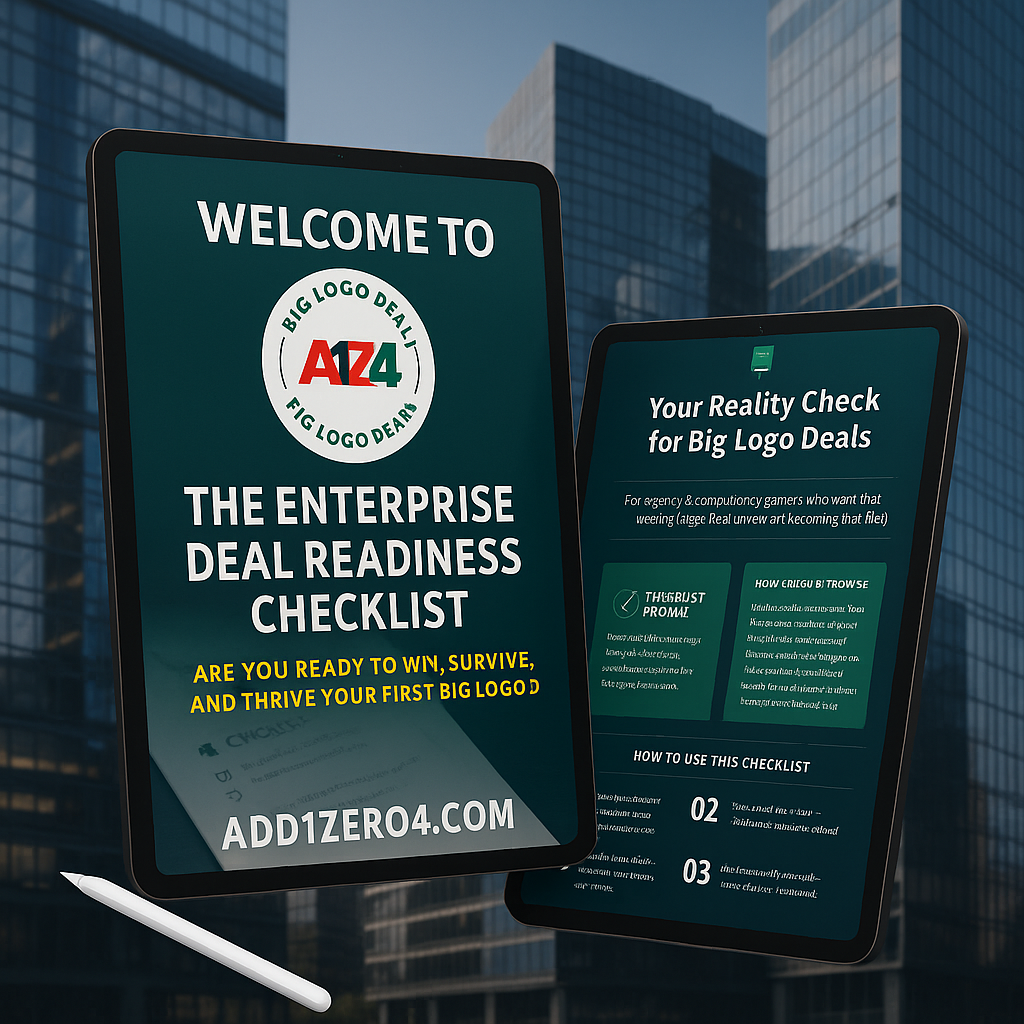
The Enterprise Deal Readiness Checklist
Skip the $100K+ learning curve. This insider’s checklist reveals if your B2B agency can win (and survive) Fortune 500 deals before you risk your stable revenue and best people chasing logos you’re not ready for.
The Enterprise Enigma: Why What Worked Before Won’t Work Now
The allure of enterprise clients is strong. Who wouldn’t want to see their agency’s name associated with Meta, AWS, or Siemens? Closing that first major logo acts as a powerful catalyst, signaling to the market: “If they trust this agency, we should too.” Each big win increases the probability of the next. But before you can pop the champagne (and trust me, hold off on that until the ink is truly dry – more on that later), you need to understand the fundamental shifts required.
Enterprise companies don’t just have more departments; they have entirely different mindsets, processes, and expectations. What you’re used to with SMBs – quick decisions, direct access to founders, simpler contracts – gets thrown out the window.
1. Attitude Adjustment: More Than Just Swagger
Remember that CMO who said an inexperienced sales team lacked “that little swagger”? It’s not about being arrogant. It’s about Calm Confidence. Enterprise buyers can smell desperation a mile away. They want to partner with firms that are assured, knowledgeable, and don’t need their business (even if, deep down, you really, really want it).
- Looking Legit: Your website that’s “good enough” for referrals? It needs an enterprise-level polish. Big companies will scrutinize your online presence. Even your company’s core values, if plastered too casually (e.g., “We value fun over work!”), might raise eyebrows in a corporate boardroom that operates on a different wavelength. Simple is fine, but it must exude credibility.
- Decoding the Call: You’re not always talking to the decision-maker. You’ll encounter the “Delegated Shopper” (an intern filling a spreadsheet), the “Unfunded Mandate” (a frazzled mid-level trying to solve a problem they’ve been handed), or the “Mid-Level Owner” (has some budget, but still needs boss’s approval). Each requires a different approach. Your job is often to turn these contacts into internal advocates.
- Mastering Deal Levers: It’s not always about dropping your price. Savvy enterprise buyers will ask for discounts. Your levers? Think payment timing (upfront for a discount?), length of commitment, or even non-contract promises like introductions to other departments. And understand their budget cycles – they’re rarely calendar year! You need to ask, “What’s your budget cycle?” and “When are budgets submitted for next quarter?”
- Developing Thick Skin: You’ll encounter prickly personalities and bureaucratic hurdles. It’s rarely personal. Stay focused on collaboration, understand their motivations, and know when to politely push back. Scope creep with enterprise clients isn’t a “favor”; it’s often unrewarded, free work.
2. Financial X-Ray: Can You Really Afford That Big Deal?
This is where many agencies stumble. A massive deal can, paradoxically, kill your company faster than no deals at all if you’re not financially prepared.
- Cash is King (Kong): Enterprise clients often have long payment terms (Net 60, Net 90, or even more complex). You’ll be fronting payroll and expenses for months before seeing a dime. A good rule of thumb: can you float at least half the contract value for six months? If not, you’re at risk. We helped one client turn a $30k project into a $300k win with a multinational, but it came with understanding these financial realities.
- COGS Clarity: Your “gut feel” for Cost of Goods Sold won’t cut it. Enterprises may ask you to “unwind” your packages into component parts, often demanding hours/rates instead of value-based pricing. If you don’t know your true costs (including founder time and productivity losses from context switching), you can underprice and torpedo your margins. Aim for at least 40% gross margin, ideally much higher.
- Their Metrics, Your Problem: Enterprise clients are hyper-focused on ROI, and it might not be the ROI your SMB clients cared about. Understand how their bosses measure success. Even if your direct contact talks about “brand awareness,” their CMO is likely judged on sales and revenue.
- The AR Tightrope: Chasing payments from a massive corporation is an art form. Their Accounts Payable department is a fortress. You need robust systems, and you can’t be shy about follow-up. Getting paid is your responsibility.
3. Operational Overhaul: Your Processes Will Break
The well-oiled machine you’ve built for SMBs? Expect it to sputter and seize when an enterprise client comes on board.
- Expert Mode Engaged: They expect you to know their business, their industry, and their challenges before the first onboarding call. This means deep research – press, annual reports, social media, industry trends. Record all your sales calls; those nuances are gold for the delivery team.
- Sales Enablement That Speaks Enterprise: Forget generic pitch decks. You need materials that demonstrate specific expertise and ROI, tailored to their world. Think modular content – case studies, process flowcharts, ROI calculators – that you can deploy as needed. Simple, clean, and number-focused is often best.
- Enterprise-Grade Standards: Communication, delivery, and reporting expectations are sky-high. They might want weekly spreadsheet uploads for their BI system, not your standard quarterly PDF. Be prepared to adapt. We once had to convert a 65-slide deck into a Word document by hand because that’s what their leadership preferred. That’s the kind of overhead you need to price in.
- The SMB Squeeze: When your best people are consumed by a new enterprise client, your existing SMB accounts can suffer. Communicate proactively with your SMB clients. Let them know about the new win and provide a clear escalation path if they feel service is slipping.
Our Probably-Too-Honest Private Podcast
Find out what REALLY happens when agencies land enterprise deals (spoiler warning: one of them lost $100K)
Brought to you by Add1Zero4 and hosted by David “Ledge” Ledgerwood
4. Pricing and Packaging: It’s a Whole New Ballgame
Your carefully crafted SMB packages and rate cards? They’re likely irrelevant.
- Custom is the New Standard: Big companies don’t buy off-the-shelf. They want solutions tailored to their massive, complex needs. This is good – it means higher prices – but it also means more work upfront.
- “Twice the Price, Half the Deliverables”: This isn’t a joke. It’s a starting point. Why? Because of the immense overhead. All those extra meetings, custom reports, and hand-holding add up. If your SMB retainer is $5k/month, think $10k/month for enterprise for a reduced scope.
- No More “Freebies”: Doing a “favor” for an SMB client often builds goodwill. With enterprises, it just sets an expectation for free work. If you throw something in, document it explicitly as a one-time concession with its actual value, and make sure it’s noted on the invoice as a credit.
- Payment Rhythms: Forget easy credit card billing on the 1st. You’ll navigate Purchase Orders (POs), vendor portals (some delightful, some soul-crushing like SAP Ariba or Coupa), and various Net terms. Negotiate these! If they demand Net 90, push for a percentage upfront or shorter terms. We once told a $135B firm we needed 40% upfront on a Net 90 deal, or we’d walk. They budged.
5. The Legal & Procurement Labyrinth
Welcome to a world of Master Service Agreements (MSAs), Non-Disclosure Agreements (NDAs), and procurement processes that can make your head spin.
- Lawyer Up (Wisely): You’ll be signing their paper, not yours. While you can’t redline everything, get counsel to help you understand critical clauses – especially around publicity (can you use their logo?), intellectual property, insurance requirements (they’ll often ask for too much or irrelevant types), and data security.
- NDA Nuances: Most NDAs are standard. Watch for non-competes or overly broad exclusivity clauses that could cripple your ability to work with others in their industry. It’s reasonable for them to ask how you handle working with competitors; it’s not reasonable for them to forbid it without massive compensation.
- Procurement Portals & Paperwork: You’ll fill out endless forms and navigate clunky online systems. Keep meticulous records of everything. This is frictional work that needs to be factored into your costs and timelines.
6. The Long Game: Patience & Timing are Virtues
If you’re used to quick SMB sales cycles, recalibrate your expectations.
- Constellation Decision-Making: You’re rarely dealing with one decision-maker. It’s a constellation of seen and unseen stakeholders, each with their own agenda. A $35,000 deal with an $80B conglomerate might take four calls, three proposal revisions, and four levels of approval, while a $12,000/month deal with a $50M company gets signed off by one manager.
- The Art of the Follow-Up: Prospects will go dark for months. Polite persistence is key. Use a mix of email, LinkedIn, and even selective, polite texting (if you’ve got their mobile). Your “Calm Confidence” here is crucial.
- When is a Deal Really a Deal?: A verbal “yes”? Means almost nothing. Don’t break out the champagne until agreements are signed and POs are issued. We learned this the hard way after buying bubbly for the team based on a VP’s verbal, only for the deal to get axed a month later. Painful lesson: loose lips (and premature celebrations) sink ships.
The Big Logo Deals Course
Created by experts who have closed over $50 million in revenue over the last decade who teach you everything they know about closing deals with the logos you wish were on your client list.
Are You Ready to Make the Leap?
Reading all this, you might feel overwhelmed. That’s normal. Transitioning to enterprise clients is a significant undertaking. It’s not just about scaling your current operations; it’s about evolving your entire agency.
The good news? It’s absolutely achievable with the right knowledge and strategy. Understanding these differences is the critical first step. Instead of stumbling through, learning painful lessons and wasting precious time, you can equip yourself with a proven roadmap.
If you’re serious about adding zeroes to your revenue by working with the world’s biggest companies, it’s time to get strategic. Stop guessing and start building the capabilities that attract and retain enterprise clients.
Ready to systematically prepare your agency for these game-changing deals?
- Dive deeper with the Big Logo Deals course and get the comprehensive framework.
- Assess your current state with the Enterprise Deal Readiness Checklist.
- Tune in to the Big Logo Deals podcast for ongoing insights and stories from the trenches.
The future of your agency can be bigger and bolder. It’s time to play in the big leagues.