
So, you’re running your agency – maybe it’s a crack-shot advertising firm, a marketing agency that gets killer results for local businesses, or a design studio with a portfolio that turns heads. You’ve mastered the art of B2B sales with small to medium-sized businesses (SMBs). You know how to connect, pitch, and close. But there’s that itch, right? That dream of landing a major client, a “big logo” that doesn’t just pay the bills but transforms your agency’s reputation and bottom line.
Big Logo Deals
Learn how to close your first big enterprise deal and drive massive business growth.
You might think, “B2B sales is B2B sales.” And you’re partly right. It’s still about businesses selling services to other businesses. But when you step out of the SMB pond and try to reel in an enterprise-level client, you quickly discover that what is B2B sales takes on a whole new dimension. It’s like going from playing checkers to 3D chess, blindfolded, on a unicycle. Many agency owners hit a wall here, not because their services aren’t top-notch, but because they simply don’t grasp how these corporate giants operate compared to the nimble SMBs they’re used to.
If you’re ready to level up and stop feeling like you’re just throwing darts in the dark when a big prospect appears, let’s unpack the real world of enterprise B2B sales.
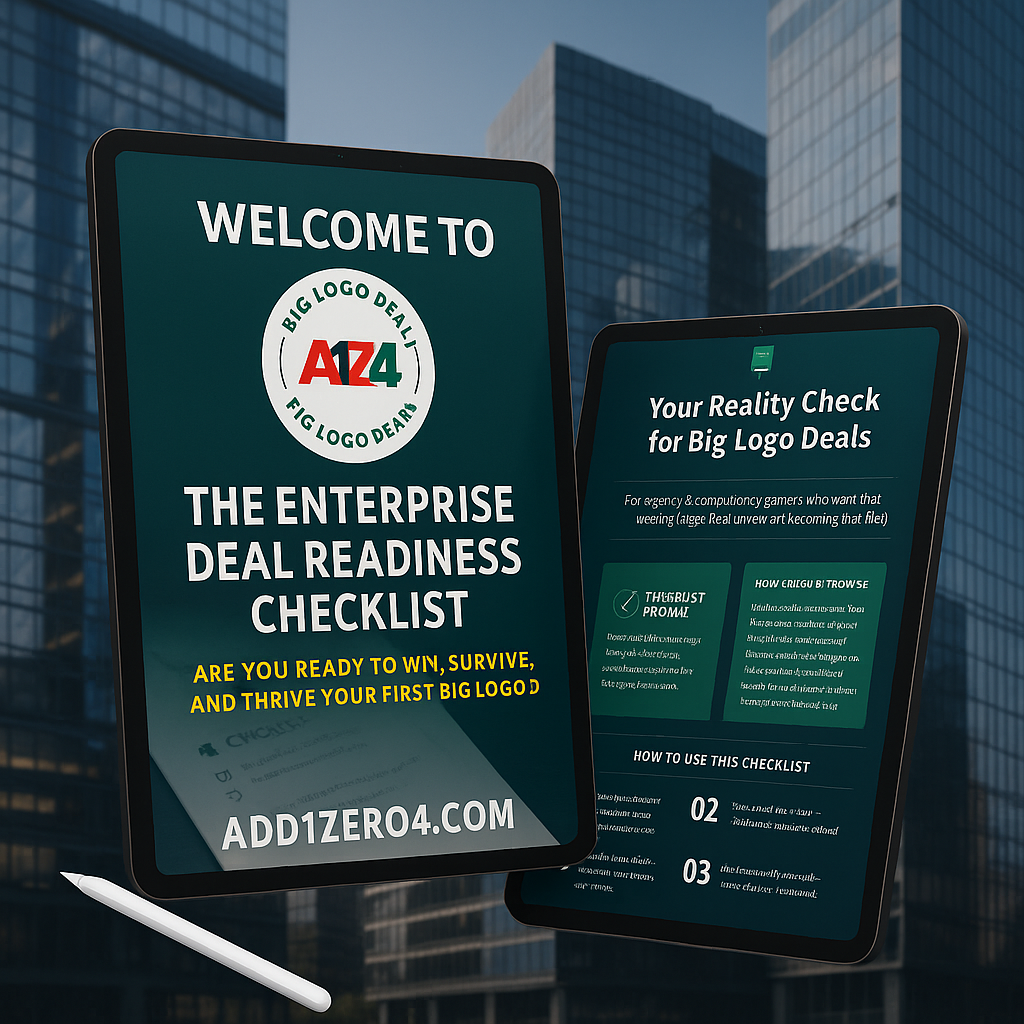
The Enterprise Deal Readiness Checklist
Skip the $100K+ learning curve. This insider’s checklist reveals if your B2B agency can win (and survive) Fortune 500 deals before you risk your stable revenue and best people chasing logos you’re not ready for.
The SMB Comfort Zone vs. The Enterprise Gauntlet
With SMB clients, B2B sales often feels straightforward. You might talk to the owner or a small team. Decisions can be made relatively quickly. You build rapport, show your value, agree on a price, and get started. It’s a dance you know well.
Enterprise sales? That’s a different beast entirely. Forget one or two decision-makers. You’re often navigating a complex web of stakeholders – sometimes eight, ten, or even more people, each with their own agenda, influence, and level of understanding about what you do. As we often see, some of these folks might be “delegated shoppers,” just filling out a spreadsheet for their boss, while others might be genuinely excited “unfunded mandates” who have passion but no budget. Identifying who actually holds the purse strings and who can champion your cause internally is an art form in itself.
The sales cycle, which might be weeks with an SMB, can stretch into many months, even a year or more, with an enterprise client. They operate on different budget cycles (and no, it’s not always the calendar year!), have near-zero urgency on your timeline, and are often evaluating you against numerous other (often larger) agencies. Inertia is a powerful force in big companies.
“Looking Legit”: Why Your SMB Playbook Needs a Rewrite
What worked to attract and close SMBs might make enterprise prospects cringe. That high-converting, automated funnel with long-form sales pages? It can come across as amateurish or overly aggressive to a corporate buyer. They expect a different level of professionalism and accessibility.
Your Online Presence:
Remember that website you “get all your business from referrals anyway” so it’s a bit outdated? Enterprise clients will look. And they’re not just glancing. They’re assessing your credibility. Does your site look like it belongs to a firm that can handle a multi-million dollar brand? Simple is fine, but it needs to be tight, professional, and instill confidence. Your LinkedIn presence, case studies, and even your team’s profiles will be scrutinized.
Core Values & Messaging:
Even your agency’s core values, proudly displayed on your “About Us” page, can be a factor. If your messaging screams “fun-loving small team that prioritizes work-life balance above all,” while admirable, it might not resonate with a corporate procurement officer looking for a vendor they can rely on for mission-critical projects with tight deadlines. It’s about aligning your external presentation with their expectations, without necessarily changing your internal culture.
Lead Funnels:
Big companies expect to engage on their terms. Consider an “Appointment-Focused Funnel.” The goal isn’t to push them through a rigid sequence, but to make it easy for the right people to connect with you. This might mean having a clear path for enterprise inquiries, perhaps even a dedicated contact or form that bypasses some of the SMB-focused qualification steps.
Our Probably-Too-Honest Private Podcast
Find out what REALLY happens when agencies land enterprise deals (spoiler warning: one of them lost $100K)
Brought to you by Add1Zero4 and hosted by David “Ledge” Ledgerwood
The Enterprise Labyrinth: Peeling Back the Layers
Landing a big logo isn’t just about a better sales pitch. It’s about understanding the intricate machinery of a large corporation.
1. Financial Realities & Readiness:
This is where many agencies stumble, sometimes fatally. Big deals mean big money, but they also often mean spending big money before you see a dime.
* Cash Flow is King: Enterprise clients often have Net 60, Net 90, or even longer payment terms. Can your agency float payroll and operational costs for months while waiting for that first invoice to clear? That “bet the company-sized deal” can literally sink you if you’re not financially prepared. A good rule of thumb? Assume you’ll need to float at least half the contract value for six months.
* Pricing & COGS: You can’t just slap your SMB rates on an enterprise proposal. They’ll often want to “unwind” your packages into component parts. If you don’t truly understand your Cost of Goods Sold (COGS) for each service, you can underprice yourself into oblivion. We often advise clients to think “twice the price for half the deliverables” as a starting point, because the overhead and attention required are significantly higher.
* Metrics That Matter to Them: SMBs might be happy with general brand uplift. Enterprises, especially the bosses of your direct contact, will want to see hard ROI. You need to understand their KPIs and be prepared to demonstrate tangible value aligned with their global business objectives, not just the pet project of one department.
2. Operational Earthquake:
Your well-oiled SMB machine? Expect it to break, or at least need significant re-tooling.
* Exacting Standards: Enterprise clients demand a higher level of communication, project management, quality assurance, and reporting. Errors or missed deadlines that an SMB might forgive can be deal-breakers here.
* Scope Creep on Steroids: They will ask for more. And “favors” don’t build the same kind of equity as they do with SMBs. If you do free work, you’re just doing free work. Clear SOWs and the confidence to enforce them are critical.
* Team Bandwidth: Don’t assume your current team can absorb an enterprise client on top of their existing workload. You might need to dedicate senior staff or even hire specialists with enterprise experience. Remember, landing that big logo often means your existing SMB accounts will feel a strain. Communicate proactively with them!
3. The Legal & Procurement Maze:
This is often the biggest shock for agencies new to enterprise sales.
* Contracts, Contracts, Contracts: Forget your standard two-pager. You’ll likely be presented with their Master Services Agreement (MSA) – a lengthy, complex document. Having legal counsel who understands corporate contracts (and can tell you what actually matters versus what’s just noise) is invaluable.
* NDAs: Non-Disclosure Agreements are standard. Mostly harmless, but watch out for hidden non-competes or overly broad exclusivity clauses that could cripple your agency’s ability to work with others in their industry.
* Procurement Portals & Paperwork: Get ready to navigate clunky supplier portals, fill out endless forms, and provide detailed information about your business, from tax IDs to insurance certificates (yes, they’ll have specific requirements, often more than you currently carry). This isn’t a “send an invoice” situation; it’s a process.
4. The People Puzzle: Constellation Decision-Making:
As mentioned, you’re not selling to one person. You’re selling to a “constellation.”
* Identifying the Real Buyer: The enthusiastic manager who loves your ideas might have zero purchasing power. Your job is to turn them into an internal advocate and help them sell your services up the chain. Ask them: “How can we work together to get this done?”
* Patience & Follow-Up: Decisions take time. People go on vacation. Priorities shift. Budgets get frozen. Polite persistence is key. Don’t be afraid to follow up, but add value when you do. And know when to let a dead-end go – you won’t win them all.
* A Verbal “Yes” Means Almost Nothing: That exciting email saying “We want to move forward!” is great. But it’s not a closed deal. Don’t pop the champagne (we’ve learned this the hard way!) until contracts are signed, POs are issued, and you know you can actually bill for the work.
The Big Logo Deals Course
Created by experts who have closed over $50 million in revenue over the last decade who teach you everything they know about closing deals with the logos you wish were on your client list.
Making the Shift: It’s More Than Just Sales Tactics
Transitioning from SMB success to landing big logo deals requires a fundamental shift in your agency’s mindset, operations, and financial planning. It’s about:
- Attitude & Deal-Making: Cultivating “calm confidence,” knowing your walk-away points, and learning to negotiate like a partner, not just a vendor.
- Financial Readiness: Truly understanding your numbers, building cash reserves, and pricing for the enterprise reality.
- Operational Readiness: Professionalizing your delivery, developing sales enablement materials tailored for corporate buyers, and ensuring your team can meet higher standards.
- Pricing & Packaging: Moving beyond standard packages to offer customized solutions that speak the enterprise’s language.
- Legal & Procurement Savvy: Understanding the paperwork game and protecting your agency.
- Patience & Timing: Embracing the long game and navigating complex decision-making processes.
This isn’t just about tweaking your sales script. It’s about transforming your agency to be enterprise-ready from the inside out. The landscape of what is B2B sales changes dramatically when you target these larger organizations, and being unprepared is a recipe for frustration and wasted effort.
Ready to Stop Guessing and Start Winning Big?
If this sounds like a mountain to climb, you’re not wrong. But the view from the top – the prestige, the revenue, the transformative impact of landing household names as clients – is worth the effort. The key is having a map and a guide.
You don’t have to figure this out through painful trial and error. The Big Logo Deals course is designed specifically for B2B service agency owners like you, providing the mindset, tactics, and execution framework necessary to close and thrive with your first (and next) big enterprise logo.
Wondering if your agency is truly prepared for the enterprise arena? Take the first step and download our free Enterprise Deal Readiness Checklist. It’ll help you identify crucial gaps and areas for improvement.
And for ongoing insights, strategies, and stories from the front lines of enterprise sales, be sure to tune into the Big Logo Deals podcast.
Landing those dream clients isn’t a pipe dream. It’s a process. And understanding the real definition of B2B sales at the enterprise level is the first, most crucial step. Now, go make it happen!