
Ever find yourself staring at your agency’s client roster, proud of the SMBs you’ve helped, but dreaming of those whale-sized, big-logo clients? You know, the ones that not only transform your revenue but also your agency’s reputation overnight. Many agency owners hit a wall here. They’re masters at serving small to medium businesses, but the leap to enterprise feels like jumping into a different universe. The truth is, it is different, and truly understanding the shift from SMB to enterprise sales is critical. If you’re looking for b2b sales examples that bridge this gap, you’re in the right place. Cracking the enterprise code isn’t just about scaling your current tactics; it’s about learning a new language and a new game.
Big Logo Deals
Learn how to close your first big enterprise deal and drive massive business growth.
My name is David Ledgerwood, but friends and colleagues call me Ledge. Over the last decade, I’ve closed around $50M in high-ticket B2B deals, and in 2022, my close rate with companies over $1B in revenue was just under 80%. I’ve seen firsthand what it takes for agencies like yours to make that leap. It’s not magic; it’s about understanding the field.
The Mindset Shift: Looking and Acting the Part for Enterprise Deals
The first hurdle? It’s often internal. If your agency was born from an entrepreneurial spirit that chafed at big corporate life, your core values might reflect that. Phrases like “Fun over work” or “Family always first” are fantastic for culture and attracting like-minded talent. But be mindful of how these read to an enterprise client browsing your “About Us” page. They might not share those overt work-life balance values, and it could, unintentionally, make them pause. It’s about finding a balance – stay true to your internal culture, but project professionalism and readiness externally.
Speaking of your external projection, let’s talk marketing. I can’t count the number of agencies I’ve met who say, “Yeah, our website’s outdated. We get all our business from referrals anyway.” That works until referrals dry up or you’re ready for bigger fish. Enterprise clients do use Google. They will check your LinkedIn. If your online presence looks shabby or screams “small-time,” they’ll click away faster than you can say “missed opportunity.” You don’t need flashy, but you do need tight, credible, and professional. Before you even think about your sales pitch, it’s worth doing an enterprise-ready agency brand vibe check. Does your site pass the smell test for someone about to drop six figures with you?
Then there’s the sales approach itself. The highly automated, direct-response funnels that work for SMBs? Often an instant turn-off for enterprise. They expect accessibility on their terms. We’re huge advocates for what we call an “Appointment-Focused Funnel.” Turn your homepage into a lean, mean, appointment-generating machine. Sure, have your blog and other content, but drive traffic there strategically, not from your prime homepage real estate. The goal of that page is one thing: get them on a call.
Once you get them on a call, your demeanor is critical. I once worked at a company where I grew sales from $300k to $5M. When I left, they hired inexperienced reps, and sales tanked. The CMO later told me the new team just didn’t have “that little swagger.” It wasn’t arrogance; it was what we call “Calm Confidence.” It’s the vibe that says, “It makes no difference to my life if you buy this. It might make a difference to yours if you don’t.” No one likes a thirsty salesperson. You’re there to offer the best solution, and they need to see that value themselves.
You’ll also encounter different buyer personas. Forget the 2-3 stakeholder deals of the SMB world. Enterprise can mean 8-10 stakeholders, many appearing and disappearing. You might deal with the “Delegated Shopper” (an intern filling a spreadsheet), the “Unfunded Mandate” (a frazzled mid-leveler given a vague task), or the “Mid-Level Owner” (has some budget, needs boss’s approval). Your job is to turn these contacts into internal advocates. Help them look good to their boss, and they’ll help you. To do that, you first need to understand who’s who in the enterprise sales cycle. One of the best b2b sales examples here is to position yourself as their advocate internally. Don’t just send a proposal and hope they can sell it up the chain; offer to help them present it.
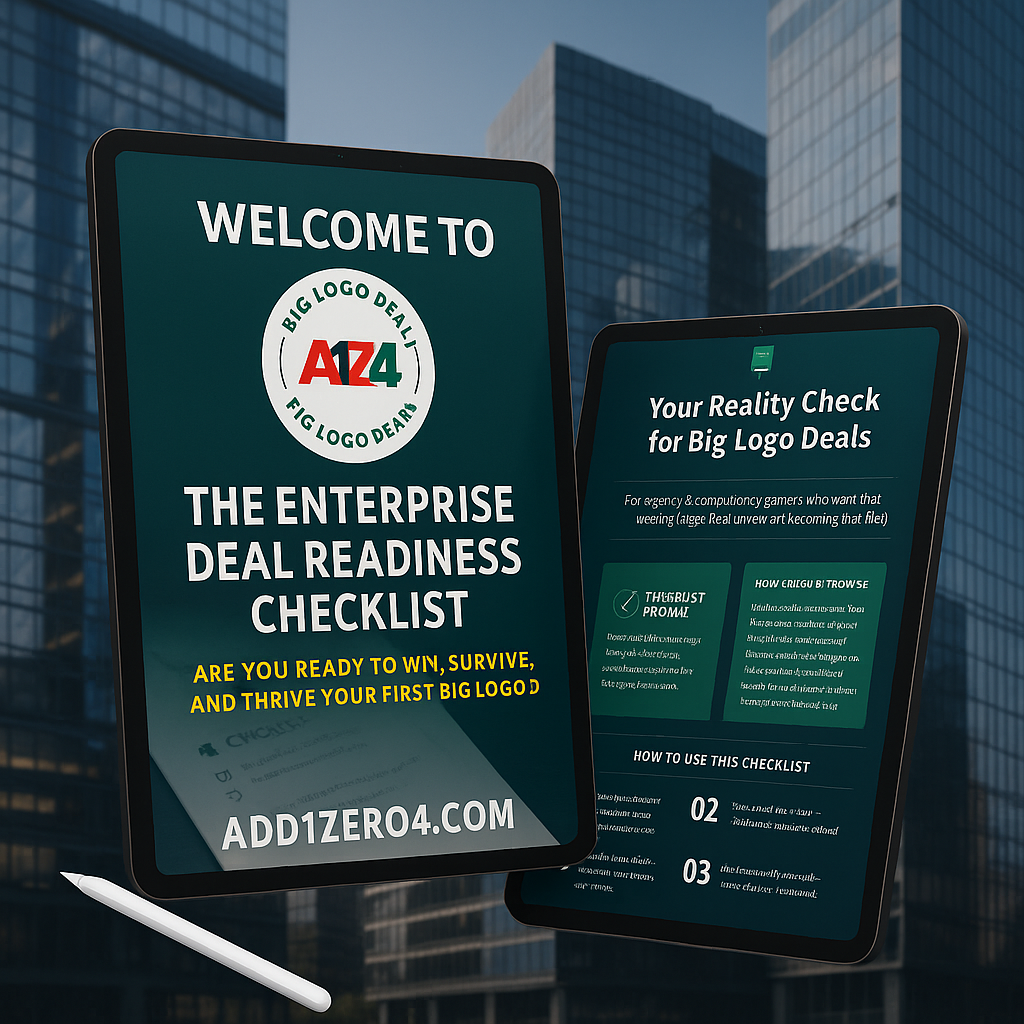
The Enterprise Deal Readiness Checklist
Skip the $100K+ learning curve. This insider’s checklist reveals if your B2B agency can win (and survive) Fortune 500 deals before you risk your stable revenue and best people chasing logos you’re not ready for.
Are You Really Ready? The Nitty-Gritty of Enterprise Operations & Finance
Landing a big logo is exhilarating. But before you get there, you must enterprise-proof your agency’s business model, because a massive deal can kill an unprepared company faster than no deal. Enterprise clients have exacting standards. They demand 10x the attention, management, and operational rigor. Miss a deadline or deliver shoddy work? They’ll call you out, and your contract will likely state corrections are on your dime.
The biggest killer? Cash flow. You’ll often pay your team and cover delivery costs months before that big enterprise check clears. We had a client who closed a $120K deal with a global engineering firm. Terms were Net 60, but it took nearly five months of chasing AP to get the first payment. If they hadn’t been prepared to float those costs, it could have sunk them. Our rule of thumb: whatever your total contract value, assume you’ll need to float at least half that amount in cash for six months. If that sentence makes you sweat, you’re not ready.
This isn’t just about cash on hand; it’s about truly understanding your Cost of Goods Sold (COGS). Gut-check COGS that worked for SMBs won’t cut it. You need to know precisely what it costs to deliver every single item or service, factoring in everything, including often-forgotten founder time on delivery and realistic team utilization (hint: it’s never 100% of a 40-hour week). Why? Because enterprise clients will want to unbundle your packages and may force you into hours/rates pricing. If you don’t know your COGS for each component, you can easily underprice and destroy your margins. Aim for at least 40% gross margin; a good sales approach can push it higher. Know your walk-away price and stick to it, no matter how sexy the logo.
Operationally, be prepared for all your beautifully-oiled SMB processes to break. Enterprise clients are different beasts. You might need to treat your enterprise work almost as a separate practice within your agency, at least initially. Don’t assume your current staff can absorb a massive new client on top of their existing workload. You might even need to hire or contract specialists with enterprise experience. This journey of adapting and learning is ongoing; for more insights and real-world stories on this, tuning into resources like the Big Logo Deals podcast can provide continuous value.
Our Probably-Too-Honest Private Podcast
Find out what REALLY happens when agencies land enterprise deals (spoiler warning: one of them lost $100K)
Brought to you by Add1Zero4 and hosted by David “Ledge” Ledgerwood
Playing the Money Game: Pricing, Packaging, and Payments
You’ve worked hard to standardize your SMB offerings. Kiss that goodbye for enterprise. They don’t want your standard packages. They want bespoke solutions tailored to their massive scale. This is actually a good thing – it’s where you make more money. But it’s painful at first.
A pricing concept we’ve used successfully is “twice the price for half the deliverables.” Why? Enterprise clients often don’t need the same volume as SMBs initially, but the overhead (meetings, reports, hand-holding) is significantly higher. So, if your SMB retainer is $5k/month, ballpark $10k/month for enterprise but halve the core deliverables. That extra margin covers the inevitable “corporate minutiae.” We once created a 65-slide deck for a $30B company; they loved it but then asked for it to be manually reformatted into a Word document for their leadership. That’s unpaid overhead you must price for.
Avoid “free stuff.” With SMBs, doing a favor can build goodwill. With big companies, that favor for one contact (who might not even have budget authority) often just sets an expectation for free work without any reciprocal benefit. If you do offer something extra, be explicit that it’s a one-time concession and document it clearly, perhaps even invoicing for the full amount and then crediting the freebie.
Then there’s payments. SMBs might pay upfront via credit card. Enterprise? Expect longer Net terms (Net 30, 60, even 90). This is negotiable. We helped a client close a deal with a $135B Chinese firm whose standard was Net 90 after all work was done. We couldn’t float that. We pushed back and got 40% upfront. Always ask for better terms: shorter Net periods, milestone payments, or an upfront portion. Knowing your financial readiness is key, and tools like our Enterprise Deal Readiness Checklist can help you assess if you’re truly prepared to play this game.
You’ll also become intimately familiar with SOWs (Statements of Work) and POs (Purchase Orders). Big companies often have their own templates. You’ll need a PO number on your invoice. And get ready for supplier portals – SAP Ariba, Coupa, Oracle Procurement Cloud – some are okay, some are UX nightmares. It’s just part of the cost of doing business.
The Big Logo Deals Course
Created by experts who have closed over $50 million in revenue over the last decade who teach you everything they know about closing deals with the logos you wish were on your client list.
Navigating the Corporate Maze: Legal, Procurement, and the Long Game
Welcome to the land of MSAs (Master Service Agreements), NDAs (Non-Disclosure Agreements), and procurement hoops. Some large companies have surprisingly vendor-friendly contracts. Others… well, let’s just say a 60-page, 9-point font MSA can melt your brain. There’s no standard, so agility is key.
For your standard SMB contracts, hopefully, you’ve had a lawyer look them over. With enterprise deals, they’ll almost always make you sign their paper. This is where legal counsel (or an expert with deep contract experience) is vital, especially early on. Don’t just pay them to redline; pay them to teach you what actually matters. What are the real risks versus things that just block business growth? Watch out for NDA pitfalls like non-competes or overly broad exclusivity clauses. We once walked from a deal with the world’s largest healthcare company because their NDA would have hamstrung our client from working with any other healthcare firms.
A crucial contract clause to scrutinize is “Publicity.” Can you use their logo in your marketing? Some forbid it; others require written approval. If you can’t use the logo, the deal’s value diminishes significantly, and you should price accordingly. Pro tip: many agencies, after the work is done and the client is happy, will add the logo to their site. A video testimonial is an even better ask.
Insurance requirements will pop up. You’ll likely need professional liability/E&O. Contracts often list unnecessary coverage types or excessive amounts. Challenge these and get them amended. Data security and IT audits can also be hurdles. Using major cloud providers helps, as you can often point to their certifications.
Finally, understand “constellation decision-making.” Unlike SMBs where you might talk to one or two decision-makers, enterprise involves many stakeholders with varying agendas and approval layers. The entire enterprise sales process has more steps, and a “verbal yes” from one manager means very little. I learned this the hard way early in my career. I scored a $40k verbal commitment from a VP at a huge IT firm. I bought champagne for my team. A month later: “Sorry, couldn’t get approval.” Crushing. The deal isn’t closed until agreements are signed, POs are issued, and sometimes, vendor approval is complete. Polite persistence, strategic follow-up, and avoiding common mistakes that sabotage the sales cycle are paramount. This is a long game; every interaction is a learning experience.
Your Agency’s Next Chapter: Big Logos Await
Landing those big logo deals is more than just a sales strategy; it’s a total business transformation. It demands a shift in mindset, a solid grasp of your financials, operational agility, and a ton of patience. The journey from serving SMBs to thriving with enterprise clients is challenging, no doubt. But the rewards – the game-changing revenue, the marquee names on your client list, the ‘we made it’ feeling – are immense. These b2b sales examples and insights are just the beginning.
Ready to stop dreaming and start doing? If you’re serious about adding a zero (or two!) to your agency’s revenue by landing those big logo clients, it’s time to get equipped with the right playbook.
Dive deeper into what it takes to win with enterprise clients with the Big Logo Deals course. And while you’re at it, grab our Enterprise Deal Readiness Checklist to see where you stand, and tune into the Big Logo Deals podcast for more insights on your journey. Now go out there and make some money!