
Ever dream of seeing your agency’s name next to those “big logo” clients? The ones that not only transform your revenue but also catapult your reputation into a whole new league? It’s the ambition of many a founder in the marketing, design, and advertising world. But here’s the rub: while your agency might be a creative powerhouse, a rockstar with small to medium-sized businesses (SMBs), landing and thriving with enterprise clients is a completely different ballgame. They operate differently, buy differently, and frankly, are different.
Big Logo Deals
Learn how to close your first big enterprise deal and drive massive business growth.
Many agencies, armed with a playbook perfected in the SMB arena, charge into the enterprise world only to find their strategies fall flat. The processes that brought them success now seem to creak and groan under new pressures. It’s like trying to win a Formula 1 race with a go-kart – both are vehicles, but built for vastly different tracks and speeds.
So, where do you find the blueprint for this kind of step-change? Surprisingly, some of the most valuable lessons can be drawn from an unexpected source: the staffing agency business model. Now, before you picture rows of cubicles and temp placements, hear me out. We’re not talking about becoming a recruiting firm. We’re talking about understanding the principles behind how successful, large-scale staffing operations are structured to handle complexity, manage massive projects, meet exacting client demands, and navigate intricate financial and legal landscapes. These are the very same capabilities your creative agency needs to cultivate if you’re serious about adding those big logos to your roster. This is about evolving your agency’s operational DNA for serious growth.
The SMB vs. Enterprise Arena: Why Your Current “Staffing” Approach Won’t Cut It
If your agency is like most, you’ve built a lean, mean machine for serving SMBs. You’re agile, responsive, and probably work directly with one or two key decision-makers who can greenlight a project over a quick coffee. Your internal “staffing model”—how you deploy your talented team and resources—is likely optimized for this kind of speed and simplicity.
Enter the enterprise client. Suddenly, you’re not dealing with a single point of contact, but what feels like a “constellation” of stakeholders, each with their own agenda, spread across departments, often with layers of approval, rigid budget cycles, and a sense of urgency that can best be described as “glacial.” The informal nod that sealed an SMB deal now means nothing.
This is where your current model starts to show cracks. Enterprise clients have a different set of expectations, and your agency needs to reflect that from the first interaction.
Enterprise Expectation #1: You Need to Look Legit.
Your website, your proposals, your communication style, your very presence – every touchpoint needs to convey “credible enterprise partner,” not “scrappy SMB specialist.” Those fun, quirky core values like “Family always comes first” or “We value fun over work,” while awesome for your internal culture, might not resonate with a corporate buyer scanning your About Us page. They’re looking for signals of stability, professionalism, and an understanding of corporate realities. It’s about projecting an image of a firm that can handle their scale and complexity. Simple is fine, but it must pass the enterprise “smell test.”
Enterprise Expectation #2: They Expect You to Understand Them.
Forget trying to shoehorn them into your standard packages. Big companies don’t buy that way. They won’t adapt to your neatly bundled SMB offerings. They expect bespoke solutions, a deep understanding of their unique (and often labyrinthine) internal workings, and a willingness to customize your approach. Think of the difference between a local temp agency filling general office roles and a high-end executive search firm placing C-suite leaders. Their operational models, their “staffing” approaches, are worlds apart because their client needs are vastly different. You need to be prepared to “unwind” your services and present them in a way that aligns with their internal structures and buying processes.
The painful truth is clear: what got your agency to its current level of success with SMBs won’t get you into the enterprise big leagues. Your existing processes, from sales to delivery to finance, are likely to break under the strain. It’s time to re-evaluate and re-engineer your agency’s staffing agency business model—your fundamental way of operating—for a much bigger stage.
Building Your Enterprise-Grade “Staffing Agency Business Model”
To successfully transition and thrive with enterprise clients, your agency needs to evolve. Think of it as upgrading your internal operating system. Drawing parallels from how a sophisticated staffing agency business model handles complexity can provide a powerful framework.
A. Mastering the Enterprise Mindset & Deal-Making Dance
Landing big deals isn’t just about having a great portfolio; it’s a mental game and a strategic dance.
- Cultivate “Calm Confidence”: Forget the desperate “please pick us” vibe. Enterprise buyers can smell thirst a mile away. You need to project an aura of calm confidence – you’re the expert, the partner they need, not just another vendor scrambling for a contract. It’s the mindset that says, “It makes no difference to my life if you buy this. It might make a difference to yours if you don’t.”
- Understand the Players: Who are you really talking to on those initial calls? Is it a “delegated shopper” just filling a spreadsheet? An enthusiastic mid-level manager with an “unfunded mandate”? Or someone with actual budget and authority? Just like a top-tier staffing firm qualifies its candidates and clients rigorously, you need to map the account and understand the decision-making hierarchy.
- Leverage Deal-Making Levers: It’s rarely just about the price. Savvy enterprise buyers will always ask for a discount. Instead of caving, think about what you can trade. Can they offer better payment terms (shorter Net days, upfront payments)? A longer commitment? A powerful video testimonial? Reducing onerous contract clauses? Be prepared to negotiate on multiple fronts, always aiming for a value-for-value exchange.
- Become Their Internal Advocate: Often, your primary contact within the enterprise is excited about your services but needs help “selling it internally” to their bosses and budget holders. Position yourself as their partner in this. Offer to help them make the case, provide materials tailored for their leadership, and even join calls to support their pitch. Making them look good is a powerful way to win.
- Develop Thick Skin: You’ll encounter bureaucracy, shifting priorities, and individuals who might seem prickly or aloof. It’s rarely personal. People in large companies are juggling numerous pressures. Stay focused on collaboration, understand their motivations, and don’t let setbacks derail your professionalism.
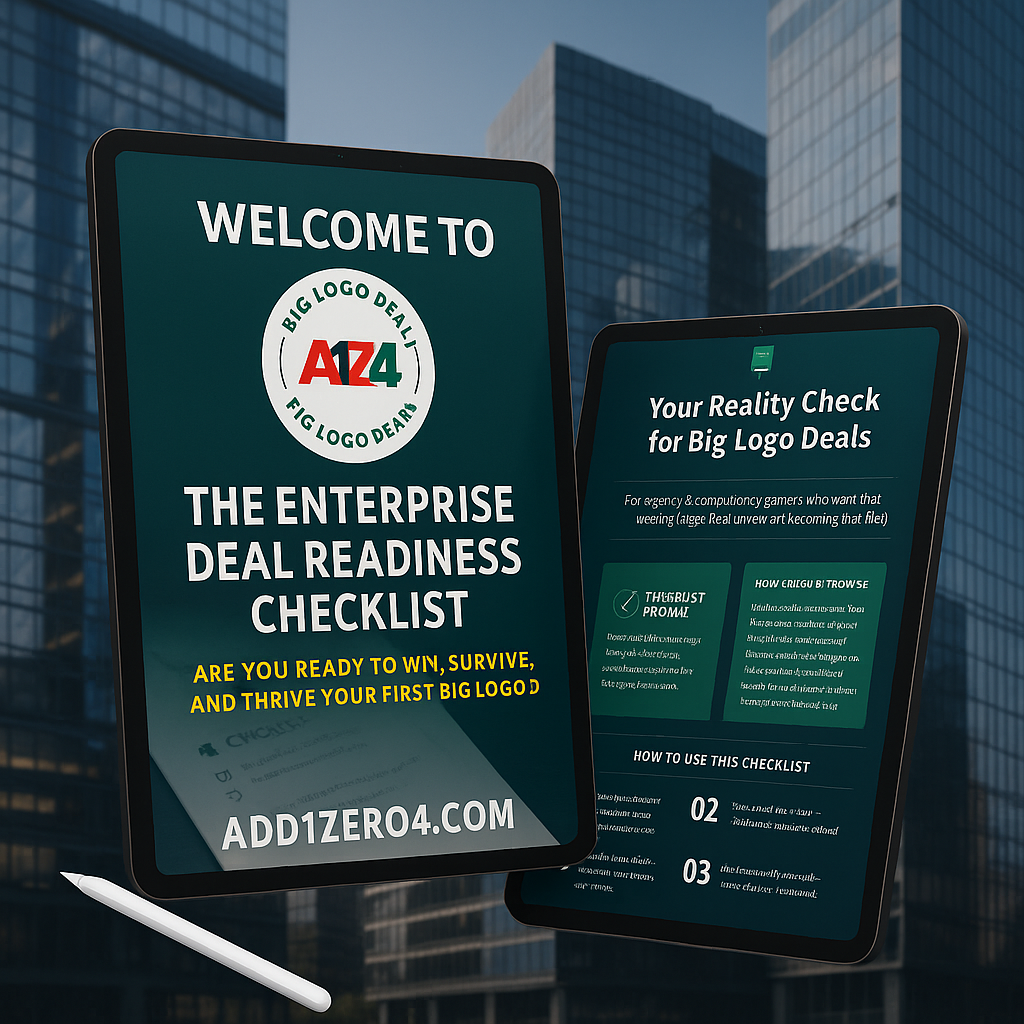
The Enterprise Deal Readiness Checklist
Skip the $100K+ learning curve. This insider’s checklist reveals if your B2B agency can win (and survive) Fortune 500 deals before you risk your stable revenue and best people chasing logos you’re not ready for.
B. Financial Fortitude: Can Your Agency “Bankroll” Big Wins?
The allure of a six or seven-figure contract is strong, but big money comes with big financial responsibilities.
- The Stark Reality: Landing a massive deal before you’re financially ready can, paradoxically, kill your agency faster than having no deals at all. Think of a staffing firm that wins a contract to supply 1000 workers overnight but doesn’t have the cash flow to cover payroll before the first invoice is paid. Disaster.
- COGS Isn’t Just for Widgets: You need to understand the true Cost of Goods Sold for delivering complex, bespoke services to an enterprise client. This includes not just direct labor, but all the extra project management, endless meetings, revisions, and general hand-holding that these accounts demand. Your SMB margins won’t translate directly.
- The Accounts Receivable Rollercoaster: Net 30 was a luxury. Welcome to Net 60, Net 90, or even longer. Your cash flow projections need to be incredibly robust. Can you afford to float significant labor and operational costs for months before seeing a dime? You’ll need substantial cash on hand – assume you’ll have to float at least half the contract value for six months just to be safe.
- “Do or Die” is a Death Knell: If your agency is banking its entire future on landing one specific enterprise deal, your underlying business model is already broken. You need a sustainable pipeline and the financial stability to walk away from deals with unfavorable terms.
C. Operational Overhaul: From SMB Shop to Enterprise Powerhouse
What works for a five-person team serving local businesses will buckle under the demands of a Fortune 500 client.
- Show Up as THE Expert: No winging it. Before you even think about the first call, your team needs to have done deep research on the prospect’s company, their industry, their challenges, their leadership, and their recent news. Enterprise clients expect you to arrive informed. And record your sales calls – they are goldmines of information for the entire team post-sale.
- Sales Enablement That Actually Enables: Ditch the fluffy, generic brochures. Enterprise prospects need targeted, value-packed materials that speak directly to their pain points and demonstrate clear ROI. Think concise case studies (ideally with other enterprise logos), clear process diagrams, and data-backed results. Simple, clean, and numbers-focused is the way to go. An information designer can be invaluable here, translating complex value into easily digestible visuals.
- Embrace Enterprise Customer Standards: They expect near-flawless execution, proactive and professional communication (often in their preferred channels and formats), and robust reporting. Your casual SMB check-ins will need to evolve into structured updates and formal reviews. Be prepared for all your existing processes to be challenged and likely broken.
- Scope Creep – The Inevitable Guest: It’s not a question of if they’ll ask for “just one more thing,” but when and how often. How will your agency’s “staffing model”—your project management and client service framework—handle this? Crystal-clear Statements of Work (SOWs), meticulous tracking, and a defined change order process are non-negotiable.
Our Probably-Too-Honest Private Podcast
Find out what REALLY happens when agencies land enterprise deals (spoiler warning: one of them lost $100K)
Brought to you by Add1Zero4 and hosted by David “Ledge” Ledgerwood
D. Pricing & Packaging: Value, Not Just Hours
Your SMB pricing model is probably a distant memory by now.
- “Twice the Price, Half the Deliverables”: This isn’t a joke; it’s often your starting point for enterprise pricing. Why? The immense overhead, the increased complexity, the longer sales cycles, the risk, and, let’s be honest, the sheer PITA (Pain In The A**) factor of navigating their systems.
- No More Standard Packages: Enterprise clients rarely buy off-the-shelf. Be prepared to unbundle your services, customize your offerings extensively, and justify every single line item. They’ll want to understand the “how” and “why” behind your costs.
- The Perils of “Free Stuff”: Doing a small favor for a long-term SMB client can build goodwill. Doing “free work” for an enterprise client often just sets a precedent for them to expect more free work. The person you did the favor for might not even be there in six months. If you do offer something extra, document it clearly as a one-time accommodation with its full value noted.
- Flexible Payment Cadences: You’re used to monthly retainers via credit card. Enterprise payments are a different beast. Think upfront payments for project initiation, milestone-based billing, or even carefully structured retainers (though these can be tricky if their internal delays stall progress). Negotiate hard for payment terms that don’t cripple your cash flow. Understand their SOWs, POs, and often clunky payment portals.
E. Navigating the Legal & Procurement Labyrinth
This is where many an agency founder’s eyes glaze over, but it’s critical.
- Their Paper, Their Rules: More often than not, you’ll be signing their Master Services Agreement (MSA), which can be a dense, lengthy document. Get good legal counsel, not to redline every clause (which they’ll rarely change), but to help you understand the actual risks and what truly matters for your business.
- NDAs – The Necessary Gatekeepers: Non-Disclosure Agreements are standard. Most are harmless boilerplate. Review them carefully for overreach, especially non-compete clauses or terms that are too broad or last indefinitely. Your goal is to protect confidential information, not to sign away your right to work with other clients in their industry.
- Contract Language Pitfalls:
- Publicity Clauses: Can you actually use their prestigious logo on your website after all this hard work? Negotiate this upfront.
- Insurance Requirements: Enterprise contracts often demand high levels of insurance, some of which may be irrelevant to your specific services (e.g., auto liability if you’re fully remote). Push back reasonably to align coverage with actual risk.
- Data Security & IT Audits: Be prepared. Using major cloud providers for your data can help, as they often have robust security certifications you can point to.
- Procurement Portals & Paperwork Overload: You’ll likely need to register as a vendor through their online procurement system, fill out numerous forms, and provide tax information. Stay organized, keep meticulous records, and understand that this administrative overhead is part of the cost of doing business with large organizations.
The Big Logo Deals Course
Created by experts who have closed over $50 million in revenue over the last decade who teach you everything they know about closing deals with the logos you wish were on your client list.
It’s About Evolution, Not Revolution
Let’s be clear: the goal here isn’t to transform your dynamic creative agency into a bureaucratic staffing firm. It’s about strategically adopting the principles that make a sophisticated, enterprise-focused staffing agency business model successful: robust systems, specialized expertise (potentially), meticulous financial management, and an unshakeable understanding of complex client environments.
This evolution focuses on:
- Systemization: Moving from ad-hoc, founder-driven processes to more defined, scalable workflows that anyone on your (growing) team can follow.
- Specialization (Potentially): As you grow, you might develop a dedicated team or practice area that truly understands the nuances of enterprise client needs, communication styles, and project management requirements.
- Patience & Timing: This is paramount. Enterprise sales cycles are marathons, not sprints. “Hurry up and wait” will become your new mantra. Understand that a verbal “yes” from one contact means very little until all the internal approvals are secured and the ink is dry on a contract or a Purchase Order is issued. As you navigate these longer timelines, keep learning. The Big Logo Deals podcast is a great resource for ongoing insights and stories from agency leaders who’ve successfully made this leap.
This journey is about transforming your agency from a skilled service provider into a trusted, strategic partner capable of delivering immense value to the world’s biggest companies.
Are You Really Ready to Play in the Big Leagues?
Before you dive headfirst into pursuing those giant accounts, take an honest look in the mirror.
- Is your mindset truly geared for the unique challenges and pressures of the enterprise world?
- Are your financials robust enough to absorb the longer payment cycles and higher upfront investment these deals often require?
- Are your operations and team genuinely prepared for what can feel like 10x the demands in communication, project management, and reporting?
- Do you have a grasp of the legal and procurement game, or are you walking in blind?
It’s a lot to consider, and understanding where your agency currently stands is the critical first step. To help you gauge your preparedness, the Enterprise Deal Readiness Checklist offers a practical way to assess your strengths and identify areas that need attention before you start knocking on those enterprise doors.
Your Agency’s Next Chapter: Enterprise Success
Landing those coveted big logo clients can be a truly transformative milestone for any B2B service agency. It’s a testament to your talent, hard work, and ambition. But achieving sustainable success in the enterprise arena requires more than just brilliant creative work; it demands a fundamental shift in your agency’s staffing agency business model – how you structure your operations, manage your finances, engage with clients, and protect your interests. It’s about building an agency that’s not just creative, but also incredibly resilient, scalable, and enterprise-savvy.
Ready to stop just dreaming about those big logos and start strategically building the agency that can win them? It’s a challenging journey, but with the right framework, mindset, and operational upgrades, it’s absolutely achievable.
Level up your agency. Check out the Big Logo Deals course today and learn the comprehensive framework to evolve your business model for enterprise wins!