
So, you’re running a recruiting agency. You’re good at what you do. You’ve built a solid base of small to medium-sized business (SMB) clients, and your team is hitting its stride. But there’s that itch, isn’t there? The allure of the “big logo” clients – those enterprise-level companies that can transform your agency’s trajectory, revenue, and reputation. Landing one feels like the ultimate validation.
Big Logo Deals
Learn how to close your first big enterprise deal and drive massive business growth.
But here’s the kicker: the recruiting agency business model that got you here, serving SMBs efficiently, often won’t get you there, into the enterprise arena. Many agency owners hit a wall, finding that what works with smaller companies falls flat, or worse, backfires spectacularly, when pitching the giants. These enterprise clients operate on a different wavelength, with unique expectations, complex processes, and a decision-making matrix that can feel like navigating a maze blindfolded.
If you’re serious about evolving your recruiting agency business model to consistently win and thrive with enterprise clients, it’s time for a strategic overhaul. It’s not just about tweaking your pitch; it’s about fundamentally re-engineering how your agency thinks, operates, and presents itself. Let’s dive into what that transformation looks like.
The Enterprise Mindset: More Than Just a Bigger Paycheck
Stepping up to enterprise-level recruiting means adopting a new perspective. It’s about understanding that these clients aren’t just scaled-up versions of your SMB accounts.
Looking Legit: First Impressions Count, Big Time
Remember that website you haven’t updated in a while because referrals kept you busy? Enterprise decision-makers will scrutinize your online presence. Your website, your LinkedIn profiles, even the way you conduct initial video calls, all need to scream “credible partner,” not “scrappy startup.”
Think about it: they’re entrusting you with critical talent acquisition, often for high-stakes roles or large-scale hiring initiatives. If your digital storefront looks amateurish, they’ll assume your service delivery is too. Simple and professional is fine, but it must pass the enterprise sniff test. Are your core values plastered online in a way that might seem too casual for a corporate giant? Re-evaluate. “Fun over work” might be great for your internal culture, but it might not resonate with a VP of HR looking for a deadly serious recruitment partner.
And those automated, high-pressure sales funnels you used for SMBs? Ditch them. Enterprise clients expect accessibility on their terms, not to be herded through a generic sequence. Consider a dedicated, easy-to-find contact path for larger inquiries.
Deciphering the Enterprise Code: Who Are You Really Talking To?
With SMBs, you often deal directly with the decision-maker, or someone very close. Enterprise deals? You’re entering a world of “constellation decision-making.” You might interact with:
- The Delegated Shopper: An entry-level employee or intern tasked with “researching recruiting firms” and filling out a spreadsheet. They stick to their script.
- The Unfunded Mandate: A frazzled mid-level manager told to “solve this hiring problem” with little budget or authority, but keen to find a solution. Your goal is to make them look good to their boss.
- The Mid-Level Owner: Has some budget and understanding but still needs to pitch upwards. This is often where the real work begins.
- The Chemistry Call: A screening to see if your agency is a cultural and project fit before you get to more serious proposal stages.
- The Leadership Presentation: Your shot with the “right people,” but be prepared to re-explain everything. Many won’t have read your meticulously crafted proposal.
Understanding these personas is crucial. Your approach needs to adapt to who’s on the other end of the call and what their actual influence is. Don’t mistake an enthusiastic internal advocate for the ultimate decision-maker.
Projecting Calm Confidence: Ditch the Desperation
Enterprise buyers can smell desperation a mile away. If you sound “thirsty” for the deal, you’ve already lost leverage. Cultivate an attitude of “calm confidence.” The vibe should be: “We’re the best solution for your complex recruiting challenges, and we’re here to help you understand why, at your own pace.”
This doesn’t mean being aloof; it means being secure in your agency’s value. Practice asking for those bigger numbers without flinching. Be prepared to walk away if the terms aren’t right. This confidence often comes from truly knowing your niche and your numbers. And if you don’t believe there’s always another lead, you have a marketing problem, not a sales problem.
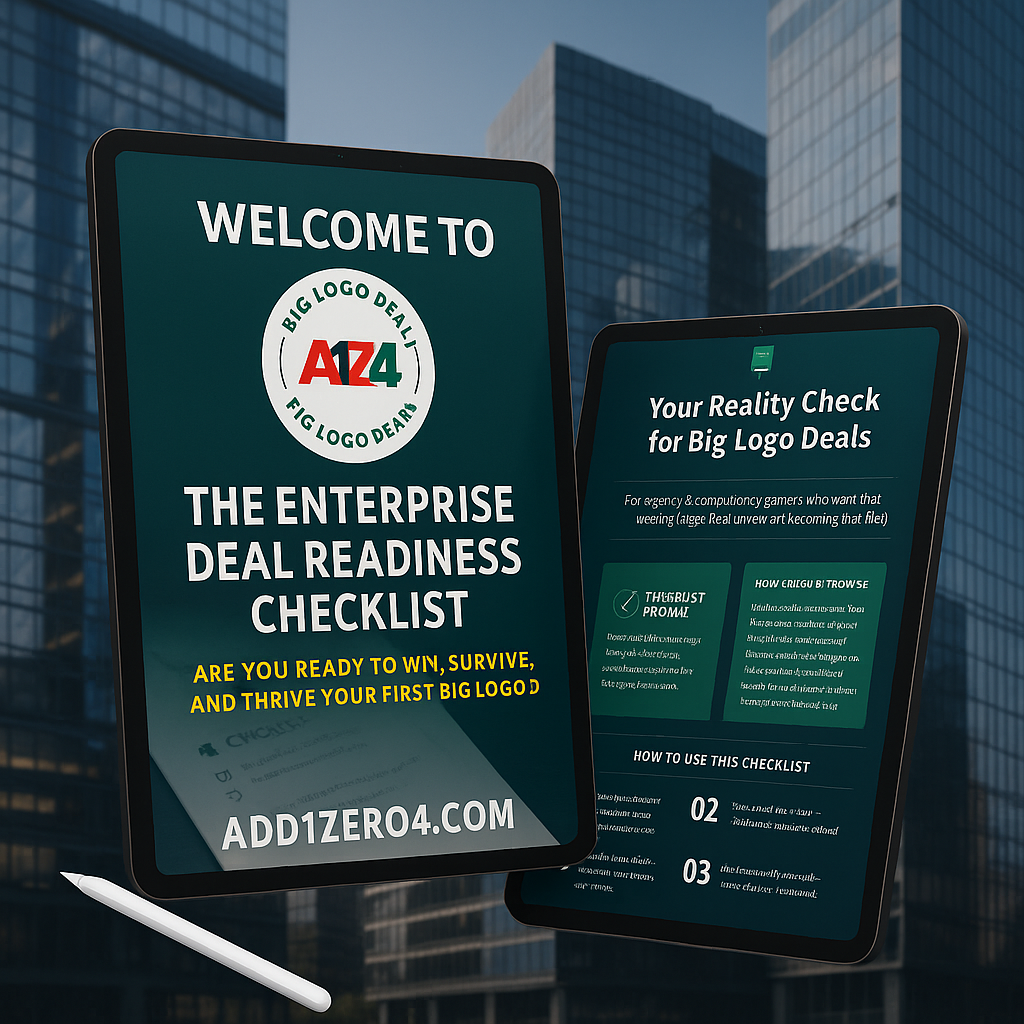
The Enterprise Deal Readiness Checklist
Skip the $100K+ learning curve. This insider’s checklist reveals if your B2B agency can win (and survive) Fortune 500 deals before you risk your stable revenue and best people chasing logos you’re not ready for.
Fortifying Your Financial Foundations: Enterprise Deals Demand Deep Pockets
Landing a big logo is exhilarating, but it can also be financially perilous if your recruiting agency business model isn’t built for it.
The Cash Flow Conundrum: Floating the Enterprise
Here’s a hard truth: massive deals can kill agencies faster than no deals. Enterprise clients often have exacting standards, demand more of your team’s time (think endless meetings and reports), and, crucially, pay slowly. Net 60 or Net 90 payment terms are common.
Can your current cash flow sustain paying your recruiters, sourcers, and operational costs for months while you wait for that first enterprise check? As a rule of thumb, assume you’ll need to float at least half the contract value for six months. If you don’t have adequate cash reserves or a solid credit line, you risk insolvency chasing that “dream client.” This isn’t a “bet the company” moment you want to stumble into.
COGS for Recruiters: Knowing Your True Costs
You probably have a decent handle on your Cost of Goods Sold (COGS) for SMB placements. But enterprise recruiting is a different beast. The roles are often more complex, the search more intensive, and the client management more demanding.
What does it really cost you to:
- Source and vet candidates for niche, senior-level roles?
- Manage a high-volume RPO-style engagement?
- Provide detailed progress reports and analytics?
- Account for your own time and your top recruiters’ time, which isn’t “free”?
Enterprise clients will often want to unbundle your “package” and scrutinize line items. If you don’t know your COGS for each component, you can easily underprice and erode your margins. Don’t base your calculations on a 40-hour week of full utilization; it’s unrealistic.
Speaking Their Language: Enterprise Recruiting KPIs
SMB clients might focus on cost-per-hire. Enterprise clients, while budget-conscious, are often more interested in strategic KPIs:
- Quality of Hire: How well do placed candidates perform? What’s their retention rate?
- Time-to-Fill: Especially for critical roles.
- Diversity & Inclusion Metrics: Are you helping them meet their D&I goals?
- Candidate Experience: How does your process reflect on their employer brand?
- Strategic Impact: How are your placements contributing to their business objectives?
You need to understand how your direct contact is measured and, more importantly, what their boss cares about. Your sales enablement materials and reporting should align with these metrics.
Our Probably-Too-Honest Private Podcast
Find out what REALLY happens when agencies land enterprise deals (spoiler warning: one of them lost $100K)
Brought to you by Add1Zero4 and hosted by David “Ledge” Ledgerwood
Revamping Your Operational Engine: Built for Enterprise Scale & Scrutiny
Your current operational model, optimized for SMBs, will likely buckle under enterprise pressure.
Meeting Enterprise Delivery Standards
Enterprise clients expect a higher level of service across the board:
- Communication: More frequent, more formal, and often involving multiple stakeholders.
- Reporting: Detailed progress reports, data-driven insights, and often in specific formats they dictate (get ready to convert your beautiful slide deck into a Word doc if they ask!).
- Candidate Experience: Impeccable. Every touchpoint reflects on them.
- Project Management: Rigorous tracking and adherence to agreed-upon processes (even if those processes seem absurdly bureaucratic).
Assume your existing processes will break. Be prepared to handle enterprise work as a distinct practice within your agency, at least initially. What got you here won’t get you there.
Sales Enablement That Resonates
Your SMB pitch deck probably won’t cut it. Enterprise sales enablement for recruiting agencies needs to be sophisticated and value-driven:
- Case Studies: Detailing successful placements for similar large organizations, complex searches, or high-volume projects. Quantify the ROI.
- Process Overviews: Clearly articulating your unique methodology for sourcing, vetting, and presenting enterprise-caliber candidates.
- Team Bios: Highlighting the experience and expertise of the recruiters who will be dedicated to their account.
- Data Security & Compliance Info: They’ll want to know how you handle sensitive candidate data.
Keep it simple, visual, and focused on the numbers. Build a modular library of these assets so you can customize your follow-up without overwhelming prospects with a massive, generic PDF. Sometimes, a well-crafted email with links to specific, relevant one-pagers is far more effective.
Brace for Impact: Scope Creep and Existing Client Management
When you land that first big logo, your best people will be pulled onto it. This can, and often does, impact service levels for your existing SMB clients. Be proactive:
- Communicate Transparently: Let your SMB clients know you’ve landed a major account and that you’re taking steps to ensure their service remains top-notch. Offer a clear escalation path (the “Bat Phone”) if they have concerns.
- Manage Scope Creep: Enterprise clients will ask for more. “Can you just add this other search?” or “Could you screen a few more candidates for this department?” Train your team to identify scope creep, politely push back where necessary, and understand when to escalate for a change order. Free work for enterprises rarely earns you goodwill; it just sets a new baseline expectation.
Pricing and Packaging: The Enterprise Value Proposition
Your SMB pricing structure is likely too simplistic for the enterprise market.
“Standard” is a Four-Letter Word
Enterprise clients don’t want your standard recruiting packages. They expect bespoke solutions tailored to their specific, often complex, needs. You might have spent ages refining your SMB offerings into a neat rate card – be prepared to throw it out the window. This is actually a good thing, as it allows you to price for the significantly higher value (and cost-to-serve) you’re providing.
The “Twice the Price, Half the Deliverables” Principle (Adapted)
This isn’t about gouging, but about reality. Enterprise recruiting often involves:
- More intensive search: Deeper market mapping, more passive candidate outreach.
- Higher stakes: The cost of a bad hire at the enterprise level is astronomical.
- More client management overhead: More meetings, reports, and stakeholder alignment.
So, if your standard SMB search is $X, an enterprise search for a similar-level role might be 2X, even if the core deliverable (a placed candidate) seems the same. You’re pricing for the increased complexity, risk mitigation, and service intensity. Don’t forget to price for all that “overhead” time.
Flexing Payment Structures
SMBs might pay upfront or via monthly retainer on a credit card. Enterprises? Expect longer net terms (Net 30/45/60/90), purchase orders, and vendor portals. This is all negotiable to an extent.
- Milestone Billing: Common for retained searches. Bill upon shortlist presentation, candidate acceptance, or start date.
- Upfront Payments: Rare, but you can ask, especially if you need to invest significantly in resources for their project.
- Retainers: Can work for ongoing strategic advisory or RPO-light models, but ensure the scope is crystal clear, as big companies can move slowly, making retainers feel upside down if you’re constantly waiting on them.
Never accept their standard payment terms without a discussion. Push for terms that protect your cash flow, and be prepared to walk if they’re entirely unreasonable. Remember that Calm Confidence?
The Big Logo Deals Course
Created by experts who have closed over $50 million in revenue over the last decade who teach you everything they know about closing deals with the logos you wish were on your client list.
Navigating the Labyrinth: Legal and Procurement
This is where many SMB-focused agencies get bogged down.
Legal Eagles and Contract Minefields
Enterprise contracts (MSAs, SOWs, NDAs) can be behemoths.
- Your Paper vs. Theirs: They’ll almost always want you to sign their paper.
- Legal Counsel: For your first few enterprise deals, get experienced legal counsel to review. Don’t just get them to redline; get them to teach you what really matters (e.g., liability caps, IP ownership of candidate reports, data privacy, publicity clauses allowing you to use their logo).
- NDAs: Usually standard, but watch for non-competes that could unreasonably restrict your agency from working with other clients in their industry.
- Insurance: They’ll have requirements (Professional Liability/E&O, Cyber). Ensure your coverage is adequate but don&#’t overpay for unnecessary types or limits. This is negotiable.
Conquering Procurement Mountain
Get ready for vendor registration portals, security questionnaires, and D&I policy attestations. It’s a process.
- Documentation is Key: Have your company info, tax ID, banking details, insurance certificates, and key team member info readily available.
- Patience: This takes time. Your direct client contact may have no idea how their own procurement process works. You may need to guide them.
The Long Game: Patience and Timing are Virtues
Enterprise recruiting is a marathon, not a sprint.
Who Really Decides?
As mentioned, decision-making is by committee. Your enthusiastic contact might be championing your agency, but they’re just one voice. Understand the approval chain and budget cycles. Ask early: “What does your procurement process look like?” “Have you onboarded a new recruiting vendor recently?” Your acumen in navigating their system can be a differentiator.
The Art of the Follow-Up
Enterprise sales cycles are long. Prospects will go dark for months.
- Polite Persistence: Follow up, but add value. Share relevant industry insights or candidate market updates. Don’t just “check in.”
- Multi-Channel: Use email, LinkedIn, and even (judiciously) text if you have their mobile.
- Know When to Fold ‘Em: You won’t win them all. If a deal goes cold despite your best efforts, learn from it and move on. Your pipeline is your lifeblood.
What “Closed” Really Means
A verbal “yes” from your contact means very little. A deal isn’t closed until:
- Contracts are signed by all parties.
- A Purchase Order (PO) is issued.
- You’re set up in their payment system and can actually invoice.
Don’t pop the champagne (or hire new staff) based on a verbal commitment. As the saying goes, “loose lips sink ships” – premature celebration within your team can be demoralizing if the deal falls through.
Are You Ready to Evolve Your Recruiting Agency Business Model?
Transitioning your recruiting agency to successfully serve enterprise clients is a significant undertaking. It requires a shift in mindset, a reinforcement of your financial and operational foundations, and a new level of sophistication in your sales, pricing, and legal dealings.
The rewards – larger, more strategic, and often more profitable engagements – can be transformative. But it starts with a conscious decision to evolve your recruiting agency business model.
Ready to stop chasing and start landing those big logo clients? The path to enterprise-level success is challenging, but you don’t have to figure it all out on your own.
To learn the specific mindset, tactics, and execution framework needed to win these deals, check out the Big Logo Deals course.
Want to see if your agency is even ready to play in the enterprise league? Download the Enterprise Deal Readiness Checklist.
And for ongoing insights and stories from the front lines of B2B enterprise sales, tune into the Big Logo Deals podcast.
The enterprise world awaits. It’s time to get your recruiting agency business model ready for it.