
So, your B2B service agency is crushing it with small to medium-sized businesses (SMBs). You’ve got a solid reputation, a happy team, and a steady stream of referrals. But then you look at those household-name companies, the enterprise giants, and think, “What would it take to land one of those?” If you’ve ever felt that your current playbook just won’t cut it for the big leagues, you’re not alone. The world of enterprise clients, especially in the dynamic b2b tech sales landscape, operates on a completely different set of rules.
Big Logo Deals
Learn how to close your first big enterprise deal and drive massive business growth.
Many agency owners, just like you, hit a wall when trying to make that leap. It’s not about a lack of skill or ambition; it’s often a knowledge gap. Large corporations are complex beasts with unique buying patterns, decision-making processes, and expectations that can feel worlds apart from the SMBs you’re used to. They don’t just buy services; they invest in partners who understand their scale and intricacies.
But here’s the good news: breaking into the enterprise space is achievable. It requires a shift in mindset, a sharpening of your operational t_e_c_h_niques, and a willingness to play a different game. This isn’t just about adding a zero to your deal sizes; it’s about transforming your agency.
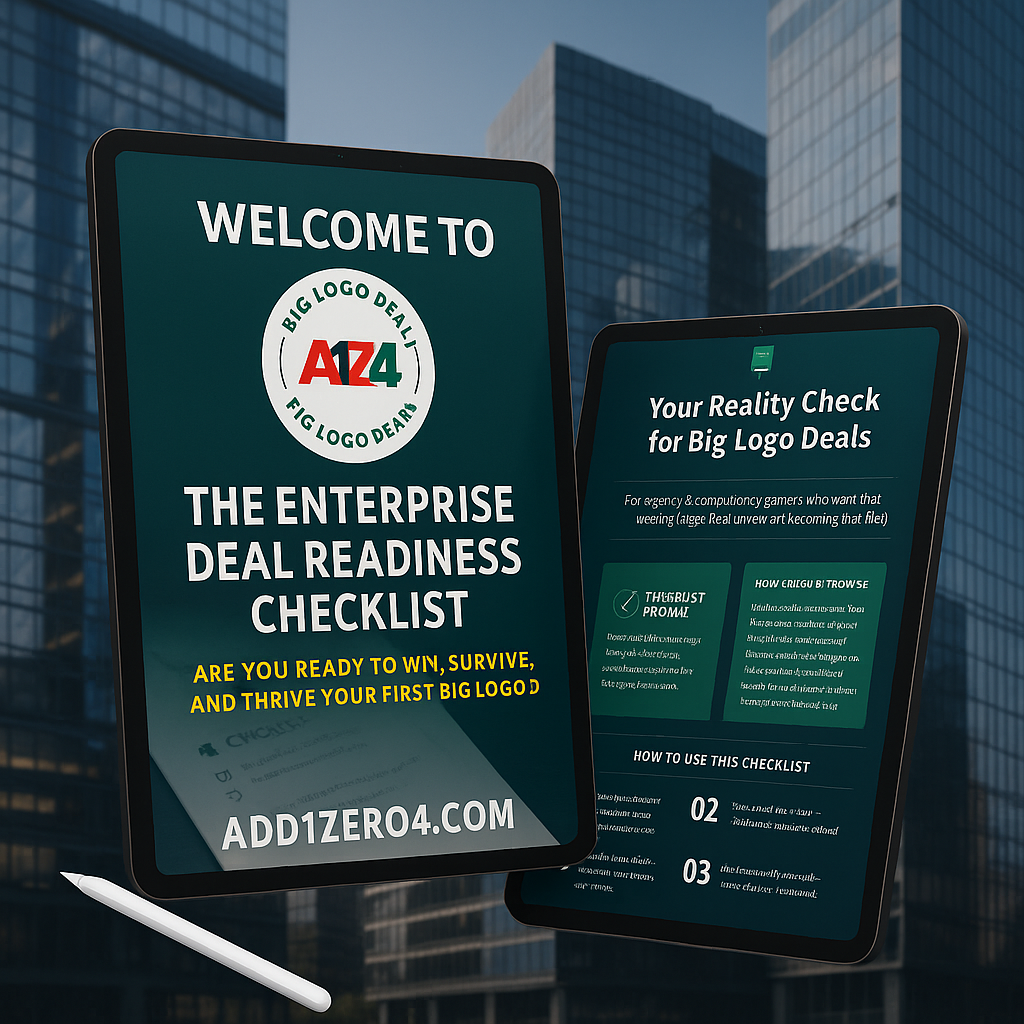
The Enterprise Deal Readiness Checklist
Skip the $100K+ learning curve. This insider’s checklist reveals if your B2B agency can win (and survive) Fortune 500 deals before you risk your stable revenue and best people chasing logos you’re not ready for.
The Enterprise Mindset: More Jedi Master, Less Eager Beaver
Landing those coveted big logo deals starts between your ears. The “hustle and grind” that got you SMB success needs a sophisticated upgrade. Think “Calm Confidence.” When you’re talking to a Fortune 500, appearing overly eager or “thirsty” for the deal can be a major turn-off. They want to see poise, an assurance that you’re the best solution, and that they need to come to that understanding. It’s a subtle art, like feigned indifference. You obviously care about winning the business, but your external demeanor should project, “It makes no difference to my life if you buy this. It might make a difference to yours if you don’t.”
This confidence extends to how your agency presents itself. Does your website and marketing collateral scream “enterprise-ready”? If you’re still rocking that “we get all our business from referrals, so our site’s a bit dated” vibe, it’s time for an overhaul. Big companies do Google you. Your online presence needs to pass their smell test. Simple is fine, but it must look credible and professional. Consider an Appointment-Focused Funnel for your website, making it incredibly easy for serious prospects to engage, rather than making them jump through hoops designed for smaller leads.
Understanding who you’re talking to is also key. Enterprise deals often involve a constellation of stakeholders – the “Delegated Shopper” just gathering info, the “Unfunded Mandate” who’s excited but has no budget, or the “Mid-Level Owner” who could be your champion. Recognizing these personas helps you tailor your approach and not waste energy barking up the wrong tree.
Are You Financially Strapped In for the Enterprise Rollercoaster?
Big deals mean big money, right? Yes, but they also mean big costs and potentially big risks if you’re not prepared. One of the harshest truths is that a massive enterprise deal can kill a smaller agency faster than no deals at all. Why? Cash flow, darling.
Enterprise clients often have longer payment cycles (Net 60, Net 90, or even more creative terms). You might be delivering work and paying your team for months before you see a dime. You absolutely must have the cash on hand to float these projects. A good rule of thumb? Assume you’ll need to float at least half the contract value for six months. If you don’t have that cushion, you’re playing with fire. This is where your financial readiness, understanding your Cost of Goods Sold (COGS) with brutal honesty, and having solid cash flow projections become non-negotiable. You can’t just “gut-check” your COGS anymore; precision is paramount.
Many founders forget to factor their own time into COGS or overestimate team utilization. An 80% gross margin might look great on paper, but if it’s based on unrealistic assumptions, you’re heading for trouble. You need to know your walk-away price – the point where the deal, no matter how prestigious the logo, simply isn’t profitable enough to justify the risk and effort. Want to dive deeper into whether your agency is truly ready for these financial hurdles? The Enterprise Deal Readiness Checklist is an invaluable resource.
Gearing Up Your Operations: Enterprise-Grade isn’t Optional
What got you here won’t necessarily get you there. Your well-oiled SMB processes might crack under enterprise pressure. These clients expect a higher level of everything: communication, project management, reporting, and quality assurance. Deadlines are sacrosanct, and errors are not easily forgiven.
Showing Up as the Expert: Enterprise clients expect you to have done your homework. Before your first delivery meeting (not just sales calls!), your team should be steeped in their business, their industry, and the specific challenges your project addresses. Record all your sales calls (tools like Fathom for Zoom are fantastic for this) and make them accessible to the delivery team. This ensures everyone has context and the client doesn’t have to repeat themselves.
Sales Enablement for the Win: Forget generic pitch decks. For serious b2b tech sales conversations with enterprises, you need targeted sales enablement materials. These are your “middle-of-funnel” assets – concise case studies (think one-page URLs, not clunky PDFs), ROI calculators, and clear explanations of your unique processes. Focus on numbers and tangible results you’ve achieved for other clients. And here’s a pro tip: invest in an information designer, not just a graphic designer. They specialize in making complex information easy to digest, which is crucial when your materials need to be understood by stakeholders who weren’t on the call.
Handling the Inevitable Scope Creep: It will happen. Enterprise clients, often without malice, will ask for more. Your team needs to be trained on the agreed-upon scope and how to politely but firmly escalate requests that go beyond it. “Free work” for an enterprise client rarely builds the same goodwill it does with an SMB; it often just sets a new, unpaid expectation.
Our Probably-Too-Honest Private Podcast
Find out what REALLY happens when agencies land enterprise deals (spoiler warning: one of them lost $100K)
Brought to you by Add1Zero4 and hosted by David “Ledge” Ledgerwood
Pricing & Packaging: Think Custom, Not Catalog
Your standard SMB packages? Park ’em. Enterprise clients don’t want off-the-shelf solutions. They expect bespoke offerings tailored to their specific, often complex, needs. This is actually good news because it means you can (and should) charge significantly more.
Remember that “twice the price for half the deliverables” concept? It’s a solid starting point. Why? Because the overhead with enterprise clients is immense. You’ll spend far more time in meetings, preparing custom reports, and navigating internal approvals than you ever did with SMBs. Your pricing must reflect this. If a client wants you to reformat a 65-slide presentation into a Word document just because their leadership prefers it (true story!), that time has to be baked into your rates.
Don’t fall into the “free stuff” trap here either. If you make a concession, document it clearly. If you’re providing something extra now that you intend to charge for later, state that upfront. And when it comes to payment terms, negotiate! Their “standard Net 90” isn’t set in stone. We once helped a client turn a $135B Chinese firm’s Net 90 into 40% upfront. It took calm confidence and a willingness to walk away, but it worked.
Navigating the Corporate Labyrinth: Legal & Procurement
Welcome to the land of MSAs (Master Service Agreements), NDAs (Non-Disclosure Agreements), and procurement portals. This is where many an enterprise deal gets bogged down.
Legal Counsel: For your first few big deals, don’t skimp on legal advice. But use your lawyer wisely. Don’t just have them redline everything (which enterprises will often ignore anyway). Instead, have them teach you what really matters – things like ensuring you can use the client’s logo in your marketing (a huge value!), intellectual property rights, and truly problematic liability clauses. Many standard corporate contracts are long and intimidating, but much of it is boilerplate you can’t change. Learn to identify the real risks.
NDAs: Most enterprise NDAs are harmless and just a cost of doing business. Watch out for non-competes or overly broad exclusivity clauses that could hamstring your agency’s future growth. If an NDA restricts you from working with an entire industry, that’s a red flag.
Procurement: Be prepared for paperwork. Lots of it. You’ll likely need to register on a supplier portal (some are user-friendly, many are… not). Have your W-9, banking details, insurance certificates, and company overview ready. Track everything meticulously.
The Big Logo Deals Course
Created by experts who have closed over $50 million in revenue over the last decade who teach you everything they know about closing deals with the logos you wish were on your client list.
The Long Game: Patience, Timing, and Finally, the Win
Enterprise sales cycles are marathons, not sprints. It’s a world of “hurry up and wait.” Decisions often involve a “constellation” of stakeholders, many of whom you’ll never meet. Your enthusiastic contact person might have zero actual buying power. Your job is to make them look good to their boss and help them navigate their internal processes.
Follow-Up with Finesse: When a prospect goes dark for months (and they will), polite persistence is key. Use a multi-touch follow-up cadence (email, LinkedIn, even selective, professional texting if you have their number). Add value with each touchpoint, don’t just “check in.” But also know when to let go. You won’t win them all.
What “Closed” Really Means: A verbal “yes” from your contact? Nice, but it means almost nothing. Don’t pop the champagne (another true, painful lesson learned by many, including us!). A deal is truly closed when contracts are signed, POs are issued, and you know you can actually bill for the work. Until then, you’re still selling.
Landing your first big logo client is a game-changer. It’s proof of concept, a magnet for future enterprise business, and a massive boost for your agency’s morale and bottom line. It’s a complex journey, requiring new skills, refined processes, and a hefty dose of patience. But the rewards – both financial and reputational – are immense.
If you’re serious about taking your agency to the next level and mastering the art of Big Logo Deals, then it’s time to equip yourself with the specialized knowledge and strategies that enterprise clients demand. This isn’t just about tweaking your current approach; it’s about a fundamental evolution of your business. And for those who are ready to dive even deeper and hear more real-world stories and tactics, the Big Logo Deals podcast offers ongoing insights from the trenches. The enterprise world awaits – are you ready to answer the call?