
So, you’ve built a successful digital agency. You’re slaying it for your SMB clients, delivering results, and your team is humming. But there’s that itch, right? That little voice whispering about bigger challenges, bigger budgets, and those iconic, household-name clients. You’re dreaming of growing a digital agency not just in headcount, but in impact and prestige. The allure of “Big Logo Deals” is strong.
Big Logo Deals
Learn how to close your first big enterprise deal and drive massive business growth.
But here’s the kicker: the playbook that got you here, the one that works wonders with small to medium-sized businesses, often falls flat when you step into the enterprise arena. It’s a whole different ballgame, and many agency owners find themselves swinging and missing, wondering why their proven strategies aren’t connecting. The truth is, big companies operate on a different wavelength, with unique processes, expectations, and a whole constellation of decision-makers. If you’re serious about landing these game-changing clients, it’s time for a new blueprint.
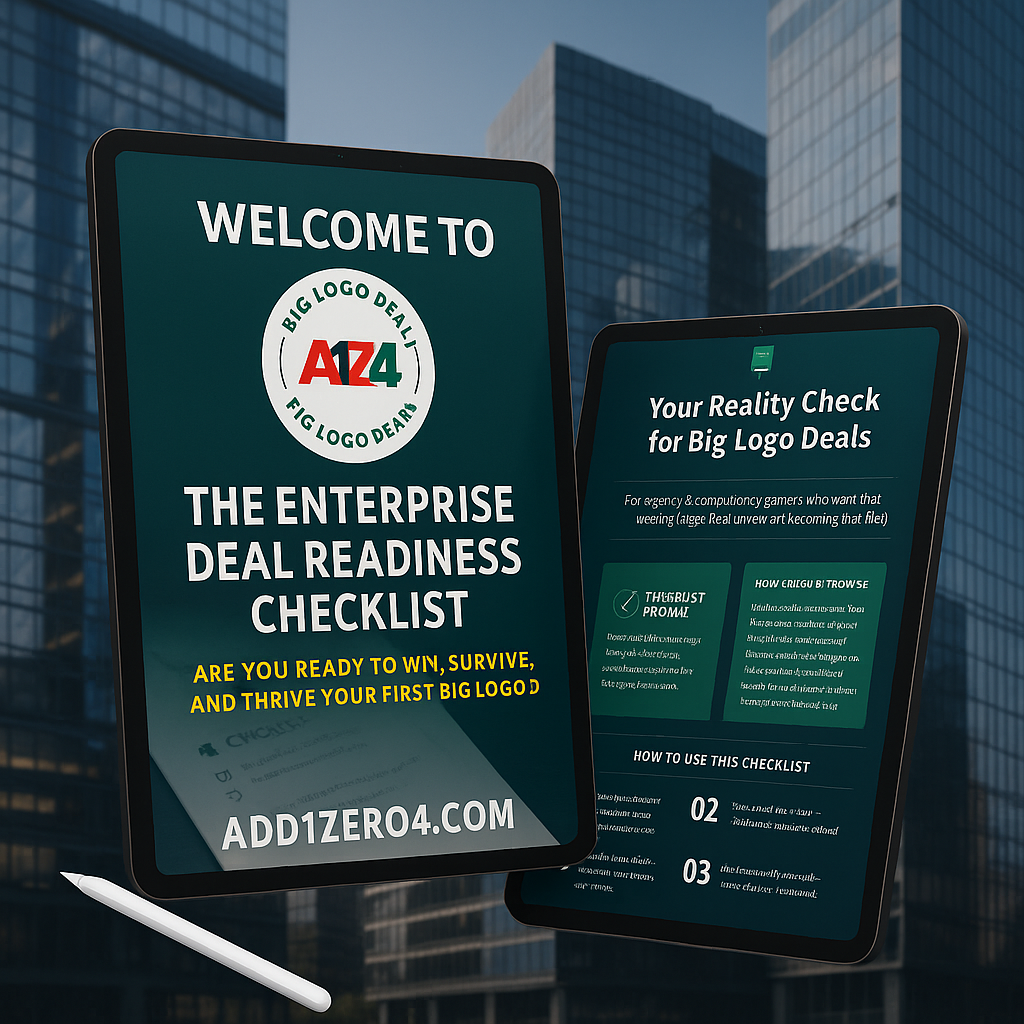
The Enterprise Deal Readiness Checklist
Skip the $100K+ learning curve. This insider’s checklist reveals if your B2B agency can win (and survive) Fortune 500 deals before you risk your stable revenue and best people chasing logos you’re not ready for.
The Mindset Shift: This Ain’t SMB Anymore, Toto
The first step in growing your digital agency by targeting enterprises is a fundamental mindset shift. What worked for a $5M company will get you laughed out of the virtual room with a $5B behemoth.
Look the Part: Your First Impression Matters (A Lot)
Remember that website you haven’t updated because “all your business comes from referrals”? Enterprise buyers, even the C-suite, use Google. If your online presence screams “mom-and-pop shop” (even a successful one), they’ll click away faster than you can say “procurement.” Your marketing, from your site to your LinkedIn, needs to exude credibility and professionalism. Simple is fine, but shabby is a deal-breaker.
And those aggressive, direct-response funnels that convert SMB leads? They’ll likely get an eye-roll from a corporate exec. Enterprise clients expect accessibility on their terms. Consider an appointment-focused funnel: clear, concise, and making it easy for them to book a discovery call, not wade through a 10-page sales letter.
Call Dynamics: From Duos to Decathlons
With SMBs, you’re often dealing with the founder or a couple of key decision-makers. Enterprise deals? Picture a “constellation” of stakeholders – sometimes 8-10 people, appearing and disappearing throughout a lengthy sales cycle. You’ll encounter various personas:
- The Delegated Shopper: An entry-level employee tasked with filling a spreadsheet.
- The Unfunded Mandate: A frazzled mid-level manager told to “solve this” with no clear budget.
- The Mid-Level Owner: Has some budget, some power, but still needs to sell you to their boss.
- The Chemistry Call Crew: Just feeling you out for cultural fit before letting you near a real proposal.
- The Leadership Presentation: Your shot at the “real” decision-makers (who probably haven’t read your proposal yet, despite what they say).
Understanding who you’re talking to and their actual influence is critical.
Calm Confidence: Ditch the “Thirsty” Vibe
In the SMB world, enthusiasm and a bit of hustle can be charming. With enterprises, it can come across as desperate or “thirsty.” The mantra here is Calm Confidence. Project an air of “It makes no difference to my life if you buy this. It might make a difference to yours if you don’t.” Of course, you care – it’s your revenue! But they don’t need to see that. They need to see an expert who is confident in their solution and is there to help them make the right decision. This isn’t arrogance; it’s the quiet assurance that you’re the best at what you do.
The Reality Check: Is Your Agency Really Ready for the Big Leagues?
Landing a massive client feels like winning the lottery. But be warned: massive deals can kill unprepared companies faster than no deals at all. Before you chase that shiny logo, you need an honest assessment of your agency’s financial and operational readiness.
The Financial X-Ray: Cash is King, Queen, and the Entire Royal Court
Enterprise clients often come with exacting standards, merciless contracts, and, crucially, slow payment cycles. Net 60 or Net 90 terms are common. Can your cash flow handle delivering work and paying your team for months before you see a dime? A good rule of thumb: assume you’ll need to float at least half the contract value for six months. Don’t have that cash on hand or a solid credit facility? You’re risking insolvency.
This is where understanding your Cost of Goods Sold (COGS) becomes non-negotiable. Enterprise clients will want to unbundle your services and may force you into hours/rates discussions. If you don’t know precisely what each component costs you to deliver (including often-forgotten founder time!), you’ll underprice and demolish your margins.
Are you truly prepared for this? The Enterprise Deal Readiness Checklist can be a great starting point to assess where you stand.
“Twice the Price, Half the Deliverables”: Pricing for Enterprise Pain
This might sound counterintuitive, but it’s a solid starting point for pricing enterprise deals. Why?
- Overhead is Massive: You’ll spend an enormous amount of time in meetings, communications, project management, and reporting that you simply don’t with SMBs. This must be baked into your price.
- Scope Realities: They probably don’t want to consume as much as an SMB client initially. They’re testing the waters.
So, if your SMB retainer is $5k/month for a certain scope, consider $10k/month for half that scope as a ballpark for an enterprise client. This accounts for the “enterprise tax” – the extra time, attention, and patience required.
Operational Strain: Expect Your Processes to Break
That well-oiled machine you’ve built for SMB delivery? Plan on it sputtering when an enterprise client comes on board. Their demands, approval layers, and communication styles are different. Your current team, already busy with existing clients, will be stretched incredibly thin. Don’t assume they can just “absorb” a 10x client. You might need to treat enterprise work almost as a separate practice within your business, at least initially.
Our Probably-Too-Honest Private Podcast
Find out what REALLY happens when agencies land enterprise deals (spoiler warning: one of them lost $100K)
Brought to you by Add1Zero4 and hosted by David “Ledge” Ledgerwood
Playing Their Game: Proposals, Pricing, and Proving Value
Once you’re mentally and financially bracing for impact, it’s time to learn how to engage enterprise clients in a way that resonates with them.
Speak Enterprise ROI: It’s All About Their Numbers
SMBs might be happy with “more leads” or “better brand awareness.” Enterprise clients, or at least their bosses who sign the checks, are hyper-focused on Return on Investment (ROI) and how your services contribute to their bottom line and specific Key Performance Indicators (KPIs). You need to understand how your direct contacts are measured and what their leadership truly cares about (hint: it’s usually tied to revenue or significant cost savings).
Sales Enablement That Actually Enables Sales
Forget those massive, over-designed “sales decks.” Enterprise decision-makers are busy. They want clear, concise information that gets to the point. Think:
- Low-design, high-impact: Simple visuals, short narratives.
- Easy to consume: One-page case studies (web links are better than bulky PDFs).
- Focused on numbers: Real results, real ROI from (ideally) other enterprise-level clients. If you don’t have those yet, project clearly how you’ll achieve it for them.
Build a library of modular sales enablement pieces you can pull up as needed during calls and link to in follow-up emails. This conveys that you “do this all day, every day.”
Proposals Built for Big Leagues (and Their Lawyers)
Your standard SMB packages won’t fly. Enterprise clients want custom solutions.
- Simplicity Wins: We’ve closed huge deals using straightforward Google Docs that clearly outline scope, deliverables, and, most importantly, costing. They’ll scroll to the price page first anyway.
- Be Ready for Redlines: Almost every enterprise will ask you to send your proposal in Word format so their legal team can redline it. Invest in an Office 365 license.
- RFPs (Requests for Proposal): These can be a massive time sink. Develop a rubric to decide which ones are worth your effort. Be wary of RFIs (Requests for Information) – you could be giving away your best ideas for free, which they’ll then include in an RFP sent to your competitors. Our rule of thumb for RFPs: only engage if you feel genuinely close to the purchasing decision or if the opportunity is astronomically large.
Pricing for Pain and Navigating Payment Terms
Revisit “twice the price, half the deliverables.” This isn’t just about profit; it’s about survival. You’re pricing for the inevitable scope creep, the endless approval cycles, and the sheer amount of hand-holding.
And payment terms? Get ready for a dance. Net 30 is a dream; Net 60 or 90 is common. Always try to negotiate. Can you get a percentage upfront to cover initial costs? Can you shorten the Net terms? Know your walk-away point and don’t be afraid to use it, even with a big logo on the line. A deal that bankrupts you isn’t a win.
The Endurance Test: Legal, Procurement, and a Whole Lotta Patience
The final frontier in landing big logo deals often feels like an obstacle course designed by sadists.
Legal Labyrinths and NDA Nuances
Enterprise Master Service Agreements (MSAs) can be terrifyingly long and dense.
- Legal Counsel: Get a good lawyer, especially for your first few big deals. But don’t just let them redline everything (which the enterprise will likely ignore). Use them to understand what actually matters and what the real risks are versus boilerplate.
- Publicity Clauses: Crucially, check if you can use their logo in your marketing! This is huge. If the contract forbids it, try to negotiate for written permission.
- NDAs (Non-Disclosure Agreements): Mostly standard. Watch for non-competes or overly broad exclusivity clauses that could hamstring your agency. Usually, they’re just a box-ticking exercise.
Procurement Purgatory: Portals and Paperwork
Get ready for vendor portals, supplier questionnaires, security audits, and endless forms. Each company has its own (often terrible) system. This is frictional work your team needs to handle, and it needs to be factored into your capacity and pricing. Keep meticulous records.
The “Hurry Up and Wait” Game & “Constellation Decision-Making”
Enterprise sales cycles are notoriously long. You’ll experience bursts of intense activity followed by weeks (or months!) of silence. This is due to “constellation decision-making”—multiple departments, budget cycles, and shifting priorities. Your contact might be enthusiastic, but they’re just one star in a large galaxy.
Following Up (Without Driving Yourself Crazy)
Polite persistence is key. Set reminders. Touch base. Offer value. Connect on LinkedIn. Use text messaging sparingly and professionally if you have their number. But also, know when to let it go. You won’t win them all. This is why a healthy pipeline is essential. Learn from each attempt. Sometimes, it’s not about you; priorities just changed internally.
What “Closed” Really Means (Hint: Not a Verbal “Yes”)
That “Okay, we want to do this!” email from your mid-level contact? That’s great! It’s a positive sign. It also means nothing concrete. Do not break out the champagne. A deal isn’t closed until agreements are signed, POs are issued, and you know you can actually bill for the work. Many a promising verbal has died a slow death in the black hole of internal approvals.
The Big Logo Deals Course
Created by experts who have closed over $50 million in revenue over the last decade who teach you everything they know about closing deals with the logos you wish were on your client list.
The Journey to Big Logos is a Marathon, Not a Sprint
Growing your digital agency to consistently win enterprise clients is a transformative journey. It requires a shift in mindset, a brutal an honest assessment of your capabilities, and a willingness to adapt almost every facet of how you operate. It demands patience, resilience, and a healthy dose of that “Calm Confidence” we talked about.
The path is challenging, littered with unfamiliar obstacles and processes that can feel designed to make you quit. But the rewards—working with iconic brands, tackling complex challenges, achieving new levels of revenue and stability—can be immense. Every big logo you land makes the next one easier. You build experience, credibility, and the kind of social proof that opens doors.
If you’re ready to stop dreaming about those big logo deals and start strategically pursuing them, it’s time to equip yourself with the right knowledge and framework. Dive deeper into the strategies that work, learn from those who’ve navigated this path, and get ready to add some serious zeros to your client contracts. Consider listening to insights on the Big Logo Deals podcast to hear real-world experiences.
This isn’t just about chasing bigger fish; it’s about fundamentally leveling up your agency. Are you ready to build your blueprint for enterprise success? The Big Logo Deals course is designed to give you that comprehensive playbook.