
So, your B2B service agency is doing well. You’ve built a solid reputation, your team is delivering great work for small to medium-sized businesses (SMBs), and revenue is steady. But you’ve got that itch, don’t you? You’re looking at those big, shiny logos – the enterprise clients, the household names – and wondering, “How do I get them?” If you’re nodding along, you’re in the right place. Transitioning from SMBs to enterprise-level clients is a major leap, and many agencies stumble because, frankly, big companies operate on a completely different planet than the ones you’re used to. This is where targeted b2b marketing and sales training becomes not just helpful, but essential.
Big Logo Deals
Learn how to close your first big enterprise deal and drive massive business growth.
Landing those “big logo deals” isn’t just about scaling your current efforts; it’s about understanding a whole new ecosystem. It requires a shift in mindset, operations, and sales strategy. Let’s dive into what it takes to make that leap and start adding a zero (or two!) to your deal sizes.
The Enterprise Mindset: It’s a Different League
First things first: your approach needs an upgrade. What worked with a 50-person company will fall flat with a 50,000-person behemoth.
From Eager to Assured: Cultivating “Calm Confidence”
Remember that hungry, “do-anything-for-the-deal” energy that might have won you early SMB clients? With enterprise prospects, it can come across as desperate or, worse, inexperienced. They’re not looking for a vendor who’s just “happy to be here.” They’re looking for a stable, confident partner. We call this “calm confidence.” It’s the quiet assurance that says, “We’re the best at what we do, we understand your complex needs, and while we’d love to partner, our success isn’t solely dependent on this one deal.” It’s about knowing your value and not being afraid to (politely) push back or walk away if the terms aren’t right. This isn’t arrogance; it’s the posture of a peer, not a supplicant. Think of it like this: “It makes no difference to my life if you buy this. It might make a difference to yours if you don’t.” That’s the vibe.
Look the Part: Your Shop Window Matters
How many times have you heard (or said), “Our website isn’t great, but we get all our business from referrals”? That’s fine for a referral-driven SMB-focused agency. But enterprise clients will scrutinize your digital presence. Your website, your LinkedIn profiles, your case studies – they all need to scream credibility and professionalism. If your online presence looks like a student project, they’ll assume your service delivery is equally amateur. Simple and clean is fine, but it must pass the corporate “smell test.” They need to believe you can handle the scale and complexity they bring. Investing in professional design and copy isn’t a cost; it’s an entry ticket.
The Constellation of Stakeholders
With SMBs, you might deal with the owner or a couple of key decision-makers. Easy peasy. Enterprise deals? Get ready for a crowd. You could be juggling 8-10 (or more!) stakeholders, each with different priorities, levels of influence, and understanding of what you do. You’ll encounter the “delegated shopper” (often an intern sent to gather info), the “unfunded mandate” (a mid-level manager tasked with a vague project), and hopefully, a “mid-level owner” who can become your internal champion. Understanding these roles and how to navigate this “constellation decision-making” is crucial. It’s rarely a straight line to a “yes.”
Feeling intrigued about mastering this new mindset and navigating these complex relationships? For deeper dives into the attitude and deal-making strategies essential for the enterprise world, check out the Big Logo Deals podcast.
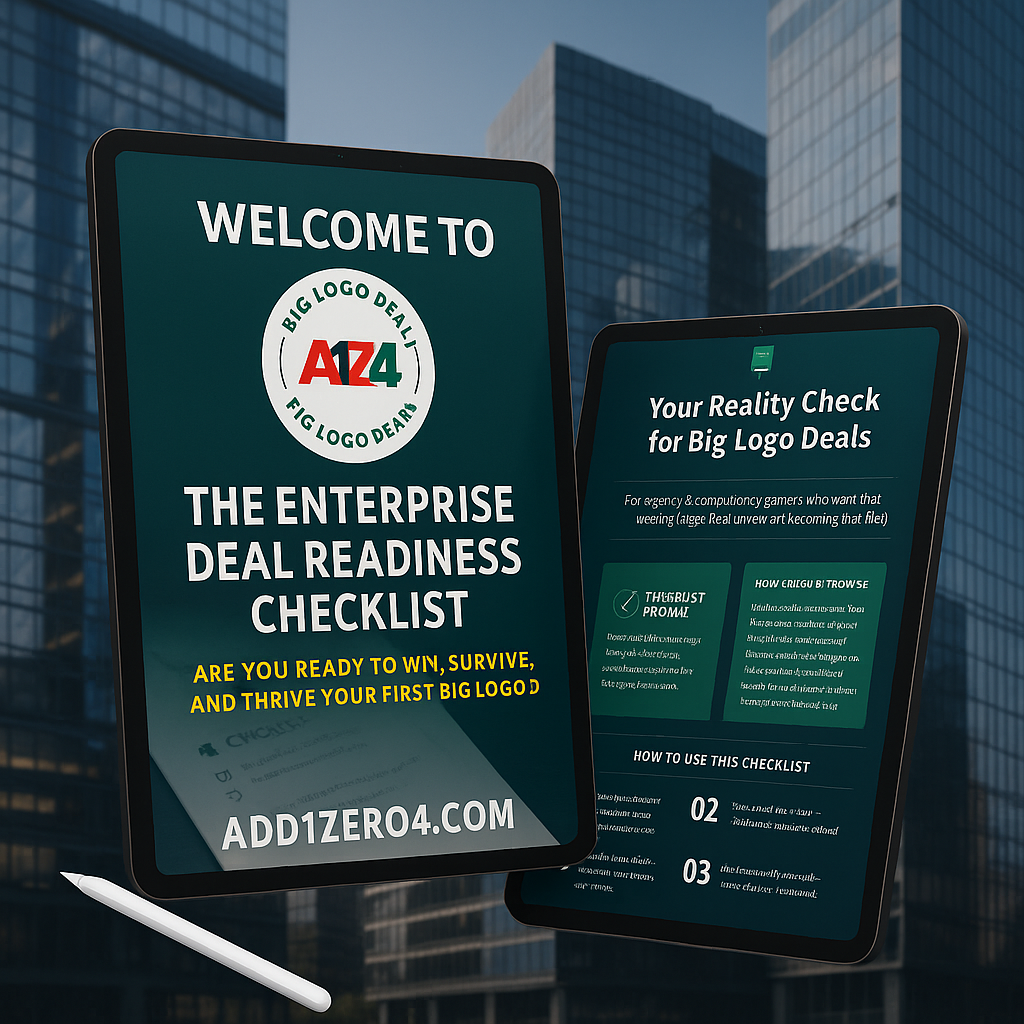
The Enterprise Deal Readiness Checklist
Skip the $100K+ learning curve. This insider’s checklist reveals if your B2B agency can win (and survive) Fortune 500 deals before you risk your stable revenue and best people chasing logos you’re not ready for.
Are You Really Ready? The Operational & Financial Gauntlet
Landing a massive client feels like winning the lottery. But if you’re not prepared, that winning ticket can bankrupt you. This isn’t hyperbole; big deals can, and do, kill unprepared agencies.
The Financial Tightrope: Cash Flow is King (and Queen, and the Entire Royal Court)
Enterprise clients often mean larger contracts, but they also mean longer payment cycles (Net 60, Net 90, anyone?), more complex invoicing, and significant upfront investment from your side to deliver. You might need to hire, invest in new tools, or dedicate significant team resources before you see a dime.
A critical rule of thumb: whatever your total contract value for the first six months, assume you’ll need to float at least half that amount in cash just to be safe. If you don’t have adequate cash reserves or a solid line of credit, you’re playing with fire.
Pricing for the Big Leagues: “Twice the Price, Half the Deliverables”
This might sound counterintuitive, but it’s a solid starting point for pricing enterprise work. Why?
- Overhead: Enterprise clients demand more. More meetings, more reports, more hand-holding, more internal politics to navigate. Your SMB pricing doesn’t account for this.
- Scope Dilution: They often don’t want or need the full “package” you offer SMBs. They have internal teams and specific, often narrower, needs.
So, if your standard SMB retainer is $5k/month for a comprehensive package, an enterprise version might be $10k/month for a more focused, tailored set of deliverables. You need to calculate your Cost of Goods Sold (COGS) meticulously, factoring in all this new overhead, to ensure your margins remain healthy. Don’t forget to include your own time in COGS if you’re still heavily involved in delivery.
Operational Tsunami: Your Processes Will Break
That well-oiled machine you’ve built for SMB delivery? Expect enterprise clients to throw a giant wrench into it. Their approval processes are slower, their communication needs are different, and their quality standards can be exacting. Be prepared to treat your enterprise work almost as a separate business unit, at least initially. Your current team, already busy with SMB clients, likely can’t just absorb an enterprise client without something giving. This often means your existing SMB accounts might feel a pinch. Be proactive: communicate with your loyal SMB clients, explain the situation, and set up clear escalation paths if they feel service is slipping.
The shift to enterprise-level work requires robust b2b marketing and sales training, but also a hard look at your internal readiness. To help you gauge if your agency is truly prepared for these challenges, download the Enterprise Deal Readiness Checklist. It’s a fantastic resource for a no-nonsense self-assessment.
Our Probably-Too-Honest Private Podcast
Find out what REALLY happens when agencies land enterprise deals (spoiler warning: one of them lost $100K)
Brought to you by Add1Zero4 and hosted by David “Ledge” Ledgerwood
Navigating the Enterprise Maze: Sales, Proposals, and Legal Labyrinths
Selling to enterprise clients is less of a sprint and more of an ultramarathon through a bureaucratic obstacle course.
The Sales Cycle: Patience is Your Superpower
Forget quick closes. Enterprise sales cycles are notoriously long. It’s a “hurry up and wait” game. There will be multiple calls, revisions, and internal discussions on their end that you’re not privy to. You need to master the art of polite persistence. One of our core philosophies is “Calm Confidence.” It’s about being patient, focused, and understanding that you don’t have to win every deal for your business to thrive.
Proposals That Actually Work
Many agencies create beautiful, lengthy proposals that are more like pitch decks. Here’s a secret: enterprise buyers often skip straight to the pricing page. Your proposal shouldn’t be re-selling your agency; that should have happened during your sales conversations. Keep proposals simple, to the point, and focused on their needs and the clear costing. Google Docs can be your best friend here – easy to share, comment on, and revise. And yes, be prepared to convert it to Word for their redlining.
When it comes to RFPs (Requests for Proposal), tread carefully. They can be massive time sinks. Our rule of thumb: only engage if you feel genuinely close to the purchasing decision or if the opportunity is astronomically large enough to justify the risk-weighted investment of your time.
Pricing and Packaging (Again!): Customization is Key
As mentioned, enterprise clients don’t want your off-the-shelf SMB packages. They expect bespoke solutions. Be prepared to “unwind” your services into component parts and price them accordingly. They’ll want to understand the value of each piece. This is where knowing your COGS intimately becomes non-negotiable. If you underprice a component, your overall margin on the deal can evaporate.
The Money Dance: Getting Paid
“Net 30 if you’re lucky, Net 60 is common, Net 90 isn’t unheard of.” This is the reality of enterprise payment terms. Don’t just accept their standard terms. Can you negotiate for a portion upfront? Shorter net terms? Milestone-based payments? Always ask. We once helped a client turn a Net 90 (after all work completion!) with a $100B+ firm into 40% upfront and 60% Net 90 on the remainder. It took “calm confidence” and a willingness to walk away. You also need to master their procurement portals and invoicing systems, which can be a nightmare. Getting paid is your responsibility; don’t abdicate it.
Legal & Procurement: The Paperwork Mountain
Master Service Agreements (MSAs), Statements of Work (SOWs), Non-Disclosure Agreements (NDAs), insurance requirements, data security audits… welcome to the enterprise paperwork pile-up!
- MSAs: Often long, dense, and non-negotiable on major points. Get legal counsel initially to understand what really matters (like publicity clauses allowing you to use their logo!) and what’s just boilerplate.
- NDAs: Mostly harmless, but watch for non-competes or overly broad exclusivity clauses.
- Insurance: They’ll likely require E&O insurance. You can often negotiate down excessive coverage amounts or remove types of insurance irrelevant to your services.
- Data Security: Be prepared for IT audits. Using major cloud providers helps, as you can often leverage their security certifications.
This entire process, from initial contact to signed contract (and getting paid!), is a complex dance. It requires a different set of skills and a deeper understanding of how large organizations function.
The Big Logo Deals Course
Created by experts who have closed over $50 million in revenue over the last decade who teach you everything they know about closing deals with the logos you wish were on your client list.
Playing the Long Game: Follow-Up, Defining the Win, and Building Alliances
The enterprise journey is about persistence and perspective.
The Art of the Follow-Up (When They Go Dark)
Prospects will go silent for weeks, even months. It’s rarely personal. They’re busy, priorities shift. Your job is polite persistence. A structured follow-up cadence is good. Connecting on LinkedIn helps. Using text messages (sparingly and professionally) can cut through the noise. But ultimately, know when to let a deal go. You won’t win them all.
What “Closed-Won” Actually Means
An enthusiastic “Yes, let’s do it!” from a mid-level manager is not a closed deal. A verbal agreement means nothing until contracts are signed, POs are issued, and you’re through their vendor setup process. Don’t break out the champagne (a lesson learned the hard way by many, including us!) until you know you can bill it. Making business decisions, like hiring, based purely on a verbal commitment is a recipe for heartache.
Your Internal Advocate: Your Most Valuable Asset
Often, your initial contact is your champion, the person who believes in your agency and wants to bring you in. Your role is to make them look good to their boss. Help them sell your services internally. Understand their KPIs and how they’re evaluated. Ask them about the procurement process, who the real decision-makers are, and how you can support their internal pitch. Sometimes, your ability to help them navigate their own company is as valuable as your service itself.
Ready to Land Your Big Logo?
Transitioning your B2B service agency from SMBs to enterprise clients is a challenging but incredibly rewarding journey. It demands more than just good marketing or sales skills; it requires a comprehensive b2b marketing and sales training approach that overhauls your mindset, operations, financial planning, and understanding of complex organizational structures.
The path is strewn with potential pitfalls, from cash flow crises fueled by massive deals to operational breakdowns under enterprise-level scrutiny. But the rewards – transformative growth, higher margins, and the prestige of working with world-renowned brands – are immense. Each big logo you land makes the next one easier, creating a powerful momentum for your agency.
If you’re ready to stop dreaming about those big logo deals and start strategically pursuing them, it’s time to get equipped with the right knowledge and frameworks. The Big Logo Deals course is designed specifically for agency owners like you, providing the deep, actionable insights you need to navigate this transition successfully. Stop wondering and start winning. Your next big client is out there.