
So, you’re a B2B services agency owner. You’ve built a solid business, likely serving small to medium-sized businesses (SMBs). You’re good at what you do – be it marketing, design, advertising, or consulting. Your clients love you, referrals keep trickling in, and you’re thinking, “What’s next?” The answer, for many ambitious agency founders, is landing those “big logo” deals. The kind of clients whose names on your roster make prospects sit up and take notice. Meta. AWS. Siemens. You get the picture.
Big Logo Deals
Learn how to close your first big enterprise deal and drive massive business growth.
But here’s the rub: knowing how to do B2B sales with these enterprise behemoths is a whole different ball game than charming your local SMB heroes. It’s like going from playing in your regional league to suddenly being scouted for the World Cup. The rules, the players, the stakes – everything changes.
Many agencies hit a wall because they try to apply their SMB playbook to enterprise clients. Spoiler: it usually doesn’t work. These giants operate on a different wavelength, with complex internal structures, unique buying cycles, and expectations that can feel alien if you’re used to the nimbleness of smaller companies. The good news? Cracking the enterprise code is learnable. It’s about understanding their world and adapting your approach.
The Enterprise Mindset: More Than Just Sales Swagger
Landing your first big logo isn’t just about a slick pitch; it’s about a fundamental shift in how you present your agency and how you engage.
Looking the Part: First Impressions Count (Big Time)
Remember that website you haven’t updated because “all your business comes from referrals”? Enterprise prospects will check it out. And they use Google, just like everyone else. If your online presence screams “scrappy startup” while you’re pitching a six-figure deal, it creates a disconnect.
- Core Values, Subtly Aligned: You might value “fun over work” internally (and that’s great!), but be mindful of how that plays on your “About Us” page when a corporate buyer, drowning in Q4 targets, is assessing you. Professionalism and results-orientation resonate.
- Website & Materials: Simple is fine, but it must look credible. Tight, professional, and error-free. Your proposal documents, case studies – everything needs to pass the sniff test for a company used to high standards. They need to believe you can handle their scale.
- Lead Funnels: That aggressive, direct-response funnel that works for SMBs? It might get an eye-roll from an enterprise contact. They expect accessibility on their terms. Consider a more direct contact route for potential enterprise leads, even if it means a bit more spam. An appointment-focused funnel, where the goal is to get them on a call, often works best.
Calm Confidence: The Anti-Desperation Play
Ever heard the phrase “too thirsty” in sales? Enterprise buyers can smell desperation a mile away. They’re not looking for a vendor who needs their business; they’re looking for a partner who can solve their problems. This is where “Calm Confidence” comes in.
It’s the vibe that says, “It makes no difference to my life if you buy this. It might make a difference to yours if you don’t.”
Of course, you care! But that’s your motivation, not theirs. Your focus should be on providing immense value and helping them see you as the best solution. This isn’t about arrogance; it’s about genuine belief in your offering and knowing your worth. Be prepared to walk away if the deal isn’t right – knowing your numbers and guardrails is key here.
Becoming Their Internal Advocate
Often, your first point of contact in an enterprise isn’t the ultimate decision-maker. They might be a mid-level manager, excited about your services but needing to sell it up the chain. Don’t just send them your proposal and hope for the best.
Position yourself as their advocate. Offer to help them make the internal case. Say something like, “I know you need to pitch this internally. It’s my job to support you in that. How about we set up a call where I can help you prepare, or even join you to present to your leadership?”
They’re not experts in selling your services. You are. Helping them look good to their boss is a powerful way to build trust and get your foot further in the door.
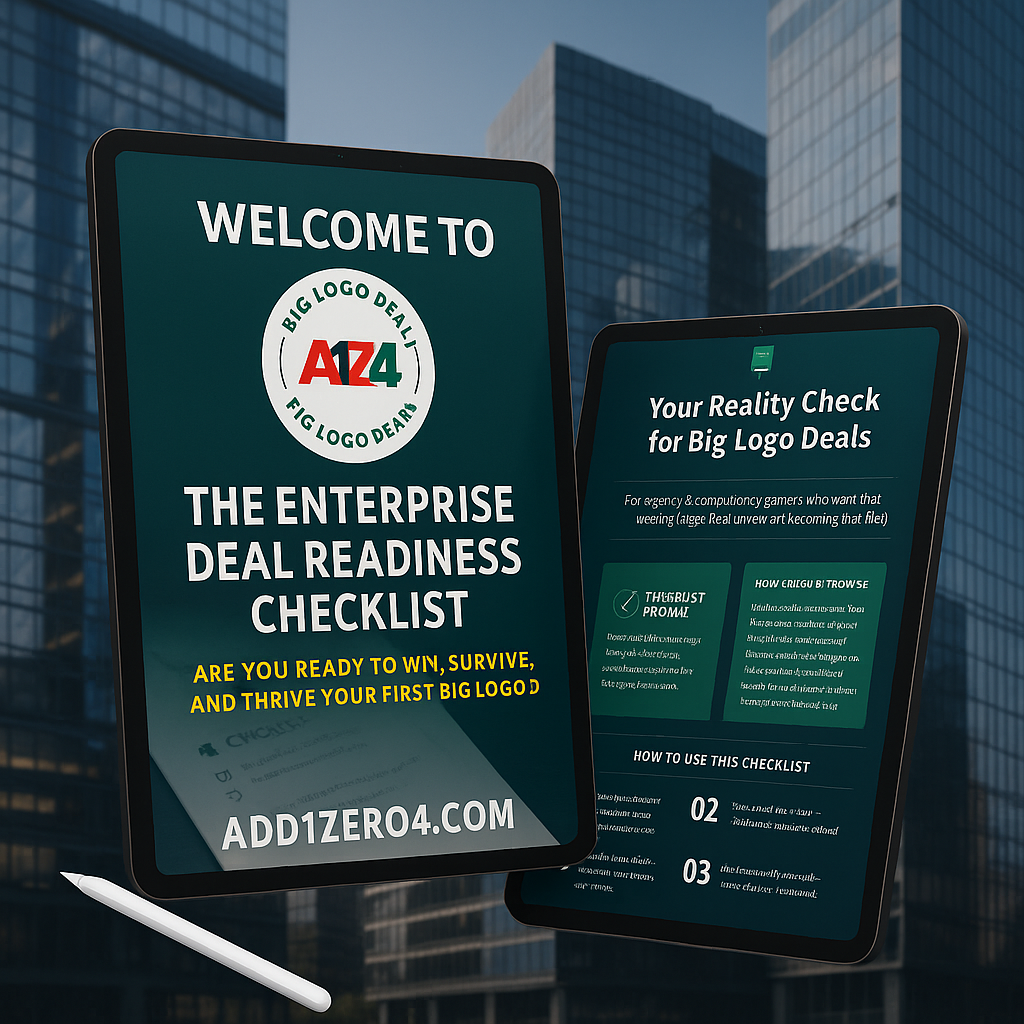
The Enterprise Deal Readiness Checklist
Skip the $100K+ learning curve. This insider’s checklist reveals if your B2B agency can win (and survive) Fortune 500 deals before you risk your stable revenue and best people chasing logos you’re not ready for.
Speaking Their Language: Operations and Financials in B2B Sales
Enterprise clients scrutinize everything. Your internal operations and financial understanding need to be rock-solid before you even think about pitching them.
Are You Really Ready? The Financial X-Ray
Here’s a hard truth: a massive deal can kill your company faster than no deals at all if you’re not financially prepared. Enterprise clients often have longer payment terms (Net 60, Net 90 isn’t uncommon). Can you float payroll and expenses for months while waiting for that big check?
- Cash on Hand: A rule of thumb? Have at least half of the first six months’ contract value in unallocated cash before the deal starts. This is your “self-insurance.”
- COGS Clarity: Understand your Cost of Goods Sold (COGS) inside out. This isn’t just about salaries; it’s about all costs associated with delivery, including your own time if you’re still hands-on. Enterprise clients will often ask you to “unwind” your packages into component parts. If you don’t know your COGS for each, you can underprice and torpedo your margins. Aim for a healthy gross margin (40%+ is a good starting point for B2B services).
- Walk-Away Price: Knowing your COGS helps you define your absolute walk-away price. No matter how tempting that big logo is, if the deal pushes you below this, you must be prepared to say no.
- Opportunity Cost: What are you giving up to service this massive client? Will your best team members be pulled from profitable SMB accounts? Factor this in.
Before you even dream of those enterprise-level retainers, get brutally honest with your numbers. The Enterprise Deal Readiness Checklist can be a great starting point to assess if your agency is truly prepared for the financial and operational rigors.
Pricing for the Big Leagues: It’s Not What You Think
That standardized package you’ve perfected for SMBs? Enterprise clients will likely want a customized version. And here’s a counterintuitive tip that often works: “Twice the price for half the deliverables.”
Why?
- Overhead: They demand a lot more attention – more meetings, more reports, more hand-holding. This “invisible” work needs to be priced in.
- Perceived Value: Paradoxically, pricing too low can make you seem less capable in their eyes.
- Reduced Scope (Initially): They might not want to consume as much as an SMB client right out of the gate. Start with a more focused scope.
So, if your SMB retainer is $5k/month, your starting ballpark for an enterprise might be $10k/month for a more streamlined initial engagement.
Sales Enablement That Actually Works
Forget those 50-page, over-designed pitch decks. Enterprise decision-makers are busy. Your sales enablement materials should be:
- Low-Design, High-Impact: Think clean, simple, visual, and concise. Google Docs can be your best friend.
- Easy to Consume: One-page case studies, short videos explaining a specific process, or clear ROI metrics are gold.
- ROI-Focused: They care about results. Soft goals are nice, but ultimately, their bosses want to see how your services impact the bottom line. If you can show how you’ve helped other (ideally large) companies achieve tangible results, you’re speaking their language.
Build a library of modular content pieces you can pull from as needed, rather than one monolithic deck.
Our Probably-Too-Honest Private Podcast
Find out what REALLY happens when agencies land enterprise deals (spoiler warning: one of them lost $100K)
Brought to you by Add1Zero4 and hosted by David “Ledge” Ledgerwood
Navigating the Enterprise Maze: Procurement, Legal, and Long Waits
This is where many SMB-focused agencies get lost. The internal workings of a large corporation can feel like a bureaucratic labyrinth.
Decoding the “Constellation”: Who Really Decides?
In SMB sales, you’re often talking to the owner or a key decision-maker. In an enterprise, you’ll encounter a “constellation” of stakeholders. The person who seems super enthusiastic might be an “unfunded mandate” – tasked with research but having zero budget authority. Or they might be a “delegated shopper,” just filling out a spreadsheet.
Your job is to map the account (even informally at first), understand who holds the budget, who influences the decision, and who your internal champion is. Ask early: “What does your procurement process look like?” “Have you onboarded a new vendor like us before?” Your understanding of their process can make you seem far more credible.
The Paperwork Gauntlet: NDAs, MSAs, and POs
Get ready for paperwork. Lots of it.
- NDAs (Non-Disclosure Agreements): Mostly standard. Check for a reasonable duration (2-3 years) and ensure it’s mutual. Watch out for hidden non-competes or exclusivity clauses that could limit your agency’s future.
- MSAs (Master Service Agreements): These can be monstrous. They’ll likely insist on their paper. You’ll need to review carefully. Focus on key clauses: publicity (can you use their logo?), intellectual property, insurance requirements, and payment terms.
- SOWs (Statements of Work): These detail what you’ll do, when, and for how much.
- POs (Purchase Orders): Often, you can’t bill until a PO is issued. Get that PO number!
- Supplier Portals: Many large companies use procurement portals (like Ariba or Coupa) where you’ll upload documents and invoices. Be prepared for potentially clunky interfaces.
The Art of the Follow-Up (Without Being a Pest)
Enterprise sales cycles are long. Months can go by with radio silence. Polite persistence is key.
- Cadence: Have a follow-up sequence. Spread out your touchpoints.
- Add Value: Don’t just ask “any updates?”. Share a relevant article, a new insight, or a success story.
- Multi-Channel: Connect on LinkedIn. If you have their mobile (and permission!), a polite text can sometimes cut through the noise.
- Know When to Fold ‘Em: Sometimes, priorities shift internally, and it has nothing to do with you. Don’t take it personally. Move on to the next prospect in your pipeline.
When is a Deal Actually a Deal?
That enthusiastic “Yes, let’s do it!” from your mid-level contact? That’s a “verbal.” It means nothing until the ink is dry on the MSA/SOW and a PO is in hand. Don’t make the mistake many have (including seasoned pros!) of celebrating too early. Loose lips sink ships – and morale – if a verbal falls through.
The deal is “closed-won” when you can confidently bill them. Only then is it time to pop the (metaphorical or real) champagne.
The Big Logo Deals Course
Created by experts who have closed over $50 million in revenue over the last decade who teach you everything they know about closing deals with the logos you wish were on your client list.
Ready to Land Your Whale?
Transitioning from SMBs to enterprise clients is a significant undertaking. It demands a new level of professionalism, financial acumen, operational rigor, and a deep understanding of how to do B2B sales in a complex environment. It’s challenging, yes, but the rewards – in terms of revenue, prestige, and agency growth – can be transformative.
Every big logo you successfully serve makes the next one easier to land. You build experience, you refine your processes, and your reputation grows. If you’re serious about adding a zero (or two!) to your agency’s revenue by working with enterprise clients, it’s time to equip yourself with the right knowledge and strategies.
This is just a glimpse into the world of big logo deals. If you’re ready to dive deeper and get the full playbook on attracting, closing, and thriving with enterprise clients, check out the Big Logo Deals course. For more ongoing insights and stories from the front lines of enterprise sales, tune into the Big Logo Deals podcast.
The journey to landing those dream clients starts with understanding their world. Get ready to level up your B2B sales game – those big logos are waiting.