
Alright, fellow agency owner. Let’s talk turkey. You’re grinding it out, delivering killer work for your SMB clients. You’re a rockstar in their world. But there’s that itch, right? That whisper of bigger. Bigger clients, bigger budgets, bigger impact. You’re eyeing those enterprise logos, the ones that make your competitors green with envy and your mom finally understand what you do.
Big Logo Deals
Learn how to close your first big enterprise deal and drive massive business growth.
But then you dip your toe into the enterprise pool, and it feels… different. Like, “Did I just step onto another planet?” different. The language, the pace, the sheer number of people involved – it’s a world away from the SMBs you know and love. Suddenly, your tried-and-true marketing agency business model that got you here feels less like a well-oiled machine and more like a tricycle in the Indy 500.
If you’re nodding along, you’re not alone. Many brilliant B2B service agencies hit this wall. The truth is, landing and thriving with enterprise clients isn’t just about doing more of what you already do. It’s about a fundamental shift in how your agency operates, thinks, and presents itself. It’s about enterprise-proofing your entire business model.
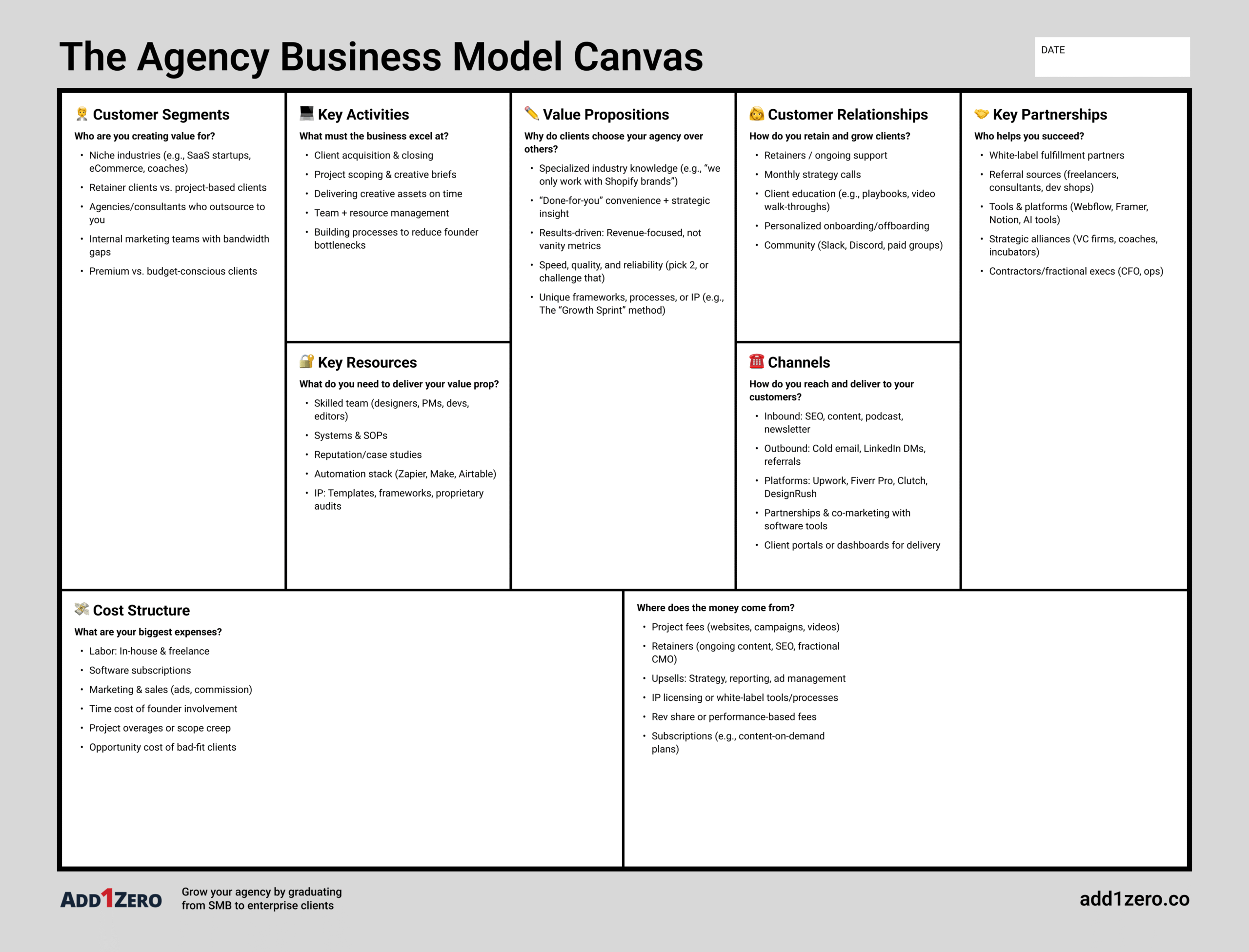
The SMB Comfort Zone vs. The Enterprise Arena
You’ve built a successful agency serving small to medium-sized businesses. You probably get a lot of business from referrals, your website might be “good enough,” and your sales process is relatively straightforward. You talk to a decision-maker or two, nail the pitch, and boom – new client.
Here’s the kicker: what works for SMBs can be a deal-breaker in the enterprise world.
“We Don’t Really Market Ourselves, We Get Referrals.”
Sound familiar? For SMBs, a strong referral network is gold. But enterprise clients? They Google. They scrutinize. They need to see a polished, credible online presence that screams “we can handle your multi-million dollar account.” If your website looks like it was last updated when dial-up was king, or your LinkedIn presence is sparse, you’re not even getting to the starting line. You need to look legit. Simple is fine, but it must pass the corporate smell test. They’re about to drop serious cash; they need confidence you can deliver.
Your “Perfected” Sales Funnel Might Be an Enterprise Eye-Roll.
Those highly automated, long-form direct response funnels that convert SMB leads? Enterprise buyers often see them as impersonal and clunky. They expect accessibility on their terms. Sometimes, that means a simple, direct email address on your contact page – yes, even with the risk of spam – because they don’t have time for your intricate qualification hoops. Consider an Appointment-Focused Funnel, where your homepage’s primary goal is to get quality meetings booked.
“Who Am I Even Talking To?” – The Stakeholder Maze.
SMB deals? Maybe 2-3 stakeholders, decision-maker usually clear. Enterprise deals? Welcome to the “constellation of decision-makers.” You might be juggling 8-10 stakeholders, many of whom appear and disappear throughout the (often very long) sales cycle. You need to understand the different players:
- The Delegated Shopper: Often an intern or junior employee tasked with filling a spreadsheet.
- The Unfunded Mandate: A frazzled mid-level team member given a vague task, now desperately seeking solutions.
- The Mid-Level Owner: Has some budget, gets it, but still needs to sell you to their boss. This is often your sweet spot.
- The Chemistry Call: A screening to see if you’re a cultural fit before they invest more time.
- The Leadership Presentation: The big show, where you finally get all the “right people” in one (virtual) room. Be prepared to re-explain everything.
Understanding these dynamics is crucial. If you want to dive deeper into who’s who in enterprise deals, you might find the insights from the Big Logo Deals podcast particularly illuminating.
The Enterprise Deal Readiness Checklist
Skip the $100K+ learning curve. This insider’s checklist reveals if your B2B agency can win (and survive) Fortune 500 deals before you risk your stable revenue and best people chasing logos you’re not ready for.
Remodeling Your Agency for the Big Leagues
Transitioning to enterprise clients isn’t just a new sales strategy; it’s a full marketing agency business model renovation.
1. The “Calm Confidence” Makeover: Attitude is Everything
Remember that “little swagger” that closes deals? It’s not about being cocky; it’s about Calm Confidence. Enterprise buyers can smell desperation a mile away. You need to project that you’re the best solution, but you genuinely don’t need their business more than they need your expertise.
- Feigned Indifference (When You Secretly Want It Bad): “It makes no difference to my life if you buy this. It might make a difference to yours if you don’t.” Practice this. Internalize it. Of course, you care, but remove that self-motivated urgency from your sales interactions.
- Be Your Prospect’s Advocate: Often, your mid-level contact needs to sell your services internally. Don’t just hand them a proposal and hope for the best. Offer to help them. “I know you need to pitch this up the chain. How about we set up a call where I can support you in that?” They’re not experts in your domain; you are. Make them look good.
- Knowing Your Walk-Away: What are your guardrails? What can you truly afford to give? Some deals, even with a sexy logo, aren’t worth it. Be prepared to say “no” without flinching. This isn’t weakness; it’s smart business.
Our Probably-Too-Honest Private Podcast
Find out what REALLY happens when agencies land enterprise deals (spoiler warning: one of them lost $100K)
Brought to you by Add1Zero4 and hosted by David “Ledge” Ledgerwood
2. Financial Fortitude: Can You Afford to Win?
This is where many agencies stumble. Big deals mean big money, right? Yes, but they also mean big expenses and often, looong payment cycles.
- The Cash Flow Reality Check: Enterprise clients often have Net 60, Net 90, or even longer payment terms. Can you float payroll and operating costs for months while waiting for that check? Rule of thumb: assume you’ll need to float at least half the contract value for 6 months. If not, that “bet-the-company” deal could actually sink your company.
- COGS – Know Your Numbers: You must understand your Cost of Goods Sold for every service component. Enterprise clients will want to unbundle your packages. If you don’t know your COGS for each piece, you’ll underprice and kill your margins. And no, you can’t base COGS on a 40-hour fully utilized week for your team. That’s fantasy land.
- Pricing – “Twice the Price, Half the Deliverables”: Why? Because enterprise work involves massive overhead: more meetings, more reporting, more hand-holding. That $5k/month SMB retainer? Think $10k/month for an enterprise client, for less initial scope. They’re buying your expertise and the ability to navigate their complex systems.
Feeling a bit overwhelmed by the financial gymnastics? The Enterprise Deal Readiness Checklist can help you assess if your financial house is in order.
3. Operational Overhaul: Delivering Like a Global Player
Your smooth SMB processes? Get ready for them to break. And that’s okay.
- Show Up as THE Expert: Enterprise clients expect you to have done your homework. Deeply. Read their annual reports, press releases, industry trends. Record your sales calls (with permission!) and share them with your delivery team. They need to understand the nuances of the engagement from day one.
- Sales Enablement That Slays: This isn’t just about top-of-funnel content. It’s about “middle-of-funnel” materials – case studies, process diagrams, ROI calculators – that your sales team uses to demonstrate 1:1 value. Keep it simple, visual, and focused on the numbers. No one wants a 50-page, over-designed PDF. A well-crafted Google Doc can close a six-figure deal.
- Enterprise Customer Standards are Different: Communication, delivery, reporting – it’s all more intense. They move slowly, then want things yesterday. Be prepared for constant communication, reconfirming next steps, and navigating multiple (sometimes conflicting) stakeholder needs. An information designer, not just a graphic designer, can be invaluable in creating clear, compelling update materials.
- Managing Scope Creep (Because It’s Coming): “Favors” don’t work with big companies like they do with SMBs. If you do free work, you’re just doing free work. Train your team to stick to the SOW and how to artfully escalate requests for more. Document everything.
4. Pricing & Packaging: Ditch the SMB Menu
Enterprise clients don’t want your standard packages. They want bespoke solutions.
- Unbundling is Key: They’ll want to pick and choose. If you’ve priced your SMB packages as a bundle, you need to be able to price out individual components profitably.
- RFPs – The Necessary Evil?: Requests for Proposals can be a soul-crushing time sink. Our rule of thumb: only respond if you feel very close to the purchasing process or if it’s an absolutely massive opportunity that justifies the risk. Often, RFPs are written by non-experts asking the wrong questions. Read between the lines.
- Payment Term Tango: Net 30, 60, 90? Milestone billing? Upfront (rare, but ask!)? It’s all negotiable. Don’t just accept their standard terms. Push for what keeps your cash flow healthy. We once helped a client turn a Net 90 (after all work done) from a $100B+ company into 40% upfront. Calm confidence and knowing your limits works.
The Big Logo Deals Course
Created by experts who have closed over $50 million in revenue over the last decade who teach you everything they know about closing deals with the logos you wish were on your client list.
5. The Legal & Procurement Labyrinth
Welcome to MSAs, NDAs, SOWs, POs, supplier portals, and security audits. It’s a lot.
- Legal Counsel (the Smart Way): Yes, you need it, especially for your first few big deals. But don’t pay a lawyer to redline every clause of a 60-page MSA you can’t change anyway. Use them to understand what really matters – publicity clauses (can you use their logo?), IP ownership, and genuinely risky terms.
- NDAs are Usually Fine, But Watch For: Non-competes disguised as NDAs. Exclusivity clauses. Unreasonably long durations. Most are boilerplate CYA, but read them.
- Procurement Portals & Paperwork: Every large company has its own system, often clunky. Keep meticulous records. Know who needs what, when. Billing errors or missed PO numbers can delay payment for months.
6. Patience & Timing: The Enterprise Marathon
This isn’t a sprint. It’s a marathon. Maybe an ultra-marathon.
- Constellation Decision-Making: As mentioned, approvals can take forever, involving people you’ve never met. That “verbal yes” from your excited advocate? It means nothing until the ink is dry on a PO or signed contract. Don’t buy the champagne yet (trust me on this one!).
- The Art of the Follow-Up: Prospects will ghost you for months. Polite persistence is key. Set reminders. Add value. Connect on LinkedIn. Use text (judiciously!) if you have their number.
- Know When to Walk Away: You won’t win them all. Learn from each attempt. Maybe it wasn’t you; priorities change. This is why a healthy pipeline is critical.
Ready to Make the Leap?
Transforming your marketing agency business model to attract and serve enterprise clients is a significant undertaking. It requires a shift in mindset, a tightening of financials, an overhaul of operations, and a healthy dose of patience. But the rewards – larger contracts, higher margins, game-changing logos on your website, and the thrill of playing in the big leagues – are immense.
It’s about moving beyond just being a “vendor” and becoming a strategic partner. It’s about understanding that enterprise clients aren’t just bigger SMBs; they’re a different species.
If you’re serious about making this leap and want a proven roadmap, battle-tested strategies, and the kind of “Ledge-level” wisdom that turns six-figure agencies into seven-figure powerhouses, then it’s time to explore the Big Logo Deals course. We’ve distilled decades of experience closing deals with companies like Meta, AWS, and Siemens into a clear path for you.
Stop wondering how to break into the enterprise world and start building the agency that big logos can’t ignore. Your future self (and your bank account) will thank you.