
So, you run a PR agency. You’re good at it. You’ve built a solid reputation, probably cut your teeth on small to medium-sized businesses (SMBs), and you’ve got a portfolio of wins you’re proud of. Your current PR agency business model has served you well, netting you referrals and keeping the lights on, maybe even growing steadily. But now, you’re looking at the big leagues. You’re eyeing those household name clients, the “big logos,” the ones that can transform your agency’s trajectory, revenue, and industry clout.
Big Logo Deals
Learn how to close your first big enterprise deal and drive massive business growth.
Exciting, right? Absolutely. But here’s the kicker: the PR agency business model that got you here, the one that works like a charm with SMBs, often needs a serious overhaul to consistently land and thrive with enterprise clients. These giants operate on a different planet. They have different rules, different expectations, and a whole different way of making decisions. Many agency owners, just like you, hit a wall when they try to make this leap because they’re essentially speaking a different language than these massive corporations.
If you’re nodding along, thinking, “Yeah, that’s me,” then you’re in the right place. Let’s talk about what it really takes to adapt your PR agency business model to not just attract, but also successfully manage and retain those dream enterprise clients.
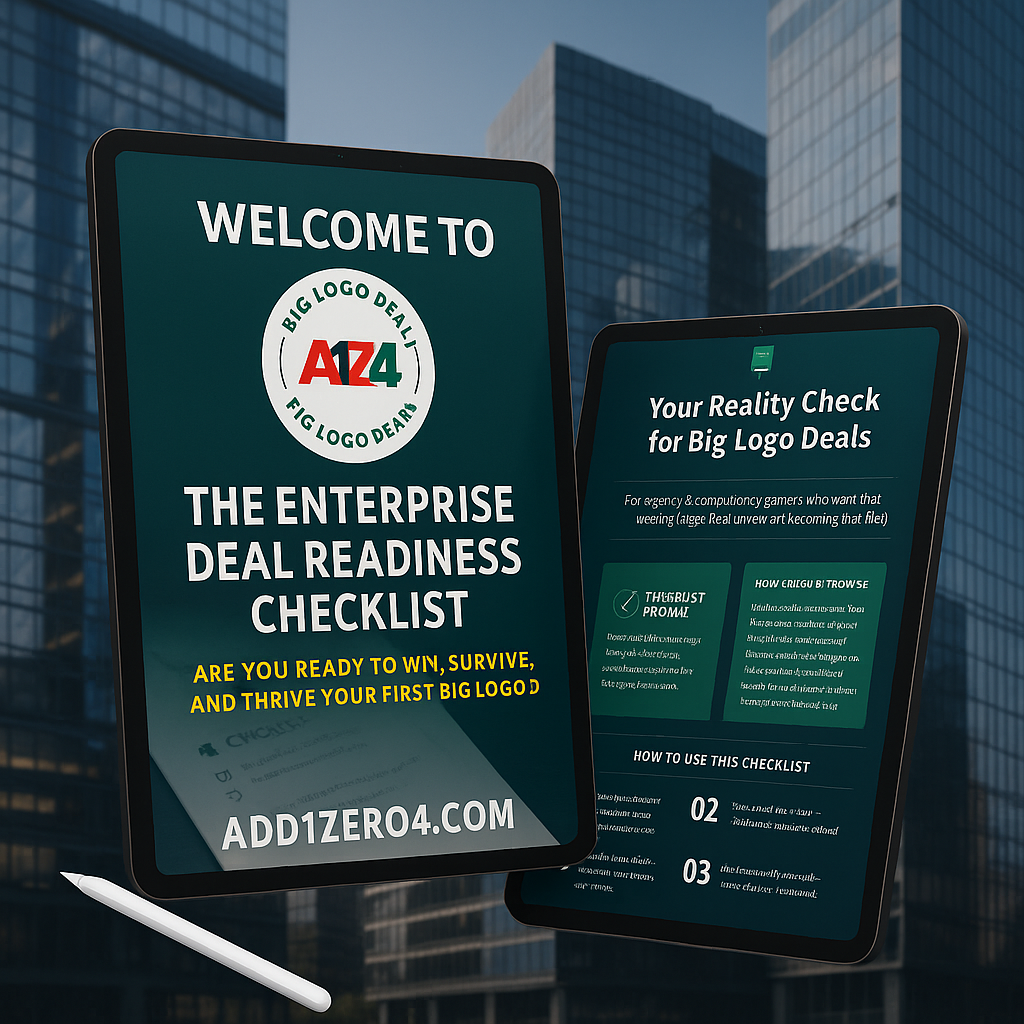
The Enterprise Deal Readiness Checklist
Skip the $100K+ learning curve. This insider’s checklist reveals if your B2B agency can win (and survive) Fortune 500 deals before you risk your stable revenue and best people chasing logos you’re not ready for.
The Enterprise Shift: Why Your SMB Playbook Falls Short
Working with SMBs often means direct access to decision-makers, quicker turnarounds, and simpler procurement processes. Your PR agency business model likely thrives on agility, personal relationships, and perhaps a more informal operational style. This is great for getting things done efficiently with smaller companies.
Enterprise clients? They’re a whole different ball game. Think of it like this:
- The Labyrinth of Decision-Making: Remember that time you pitched the SMB owner over coffee and got a “yes” on the spot? With enterprise, you’re often dealing with what we call “constellation decision-making,” and it’s critical to understand who’s who in the buying committee. You might talk to a “Delegated Shopper” (an intern or junior staffer sent to gather info), an “Unfunded Mandate” (a mid-level manager tasked with a project but no real budget power yet), or even a “Mid-Level Owner” who’s an advocate but still needs multiple layers of approval. Decisions can take months, involve 8-10 (or more!) stakeholders who appear and disappear, and are often tied to rigid budget cycles that have nothing to do with the calendar year.
- Sky-High Expectations: Enterprise clients pay top dollar, and they expect flawless execution, meticulous reporting, and constant communication. The level of project management, quality assurance, and sheer attention to detail required is often 10x what you’re used to. One slip-up can have major consequences.
- The Financial Rollercoaster: Big logos mean big contracts, which is fantastic! But they also often mean Net 60, Net 90, or even longer payment terms. Can your current cash flow handle floating significant costs for months while waiting for that massive check to clear? This is where many agencies get into hot water, sometimes even risking the entire business on a deal that looked like a dream.
Simply put, the shift from SMB to enterprise sales is significant. What enterprise clients buy, how they buy, and what they expect post-sale is fundamentally different. Your PR agency business model needs to reflect this new reality.
Adapting Your PR Agency Business model: More Than Just a New Pitch Deck
Transitioning to serve enterprise clients isn’t just about tweaking your service packages. It’s a holistic shift that involves truly enterprise-proofing your agency’s business model. Here’s how that looks, drawing from what we’ve seen help countless agencies make the leap:
1. Cultivating “Calm Confidence” and Mastering the Conversation
You’re a PR pro; you know how to craft a compelling narrative. But when you’re in a room (virtual or otherwise) with enterprise decision-makers, “thirsty” energy is a deal-killer. They can smell desperation a mile away. What you need is Calm Confidence. It’s the quiet assurance that says, “We’re the best at what we do, and we’re here to help you understand how we can solve your problem. It makes no difference to my life if you buy this. It might make a difference to yours if you don’t.”
This isn’t arrogance; it’s a deep-seated belief in your value and an understanding that you don’t need any single deal to survive. This comes from knowing your numbers, your worth, and having a healthy pipeline.
Beyond your demeanor, you need to understand the type of call you’re on. Are you educating a “Delegated Shopper,” or are you in a “Chemistry Call” where they’re just trying to see if you’re a cultural fit before even discussing a proposal? Or is it the “Leadership Presentation” where you finally have all the key players? Each requires a different approach. Often, your role isn’t just to sell your PR services, but to sell yourself as an advocate for your internal contact, helping them navigate their own bureaucracy to get your winning enterprise proposal approved.
2. Operational Overhaul: Looking and Acting the Part
How does your PR agency look to an enterprise prospect?
- Your Digital Front Door: That website you haven’t updated because “all our business comes from referrals”? Enterprise clients will scrutinize it. It needs to be professional, current, and clearly articulate your value proposition for companies of their scale. Simple is fine, but shabby is a no-go.
- Lead Funnels that Don’t Annoy: Those aggressive, automated direct-response funnels might work for some, but enterprise buyers often expect to be accessible on their terms. Consider an “Appointment-Focused Funnel” – make it easy for them to learn a bit and then book a call. A simple contact form, maybe even a direct email for high-value inquiries, can be more effective than a convoluted sequence.
- Sales Enablement for PR: Forget generic brochures. Your entire approach to sales enablement needs to evolve. Enterprise clients want to see proof. This means case studies showcasing tangible PR ROI for brands they respect (or at least of a similar size). Think metrics, impact on business objectives, not just “we got them featured in X publication.” Have these materials ready, not as a clunky PDF, but as easily shareable, modular pieces of content. Perhaps a one-pager on your crisis comms methodology, or a short video explaining your approach to global product launches.
- Process Rigor: What got you here (flexible, perhaps ad-hoc processes) won’t get you there. Enterprise deals demand robust systems for project management, client communication, and reporting. They’ll want to know who’s doing what, when, and how progress is being tracked, often in their preferred format (which might be a specific BI dashboard or a weekly spreadsheet, not your standard quarterly PowerPoint).
Our Probably-Too-Honest Private Podcast
Find out what REALLY happens when agencies land enterprise deals (spoiler warning: one of them lost $100K)
Brought to you by Add1Zero4 and hosted by David “Ledge” Ledgerwood
3. Financial Fortitude: Pricing, COGS, and Cash Flow for the Big Leagues
This is where the rubber meets the road, and where many agencies stumble.
- Pricing Your Value: That $5K/month retainer for SMBs? For enterprise, a good starting point is often “twice the price for half the deliverables.” Why? Because the “deliverables” for enterprise include a massive amount of overhead: more meetings, more complex stakeholder management, more detailed reporting, and navigating their internal processes. You’re not just delivering PR execution; you’re delivering high-touch strategic partnership and navigating complexity. Price accordingly.
- Understanding Your COGS (Cost of Goods Sold): Do you really know what it costs to deliver every aspect of your PR services, including a portion of your own time if you’re involved in delivery? Without this clarity, you can’t set a profitable “walk-away” price. Enterprise clients will often ask you to “unbundle” services, and if you don’t know your COGS for each component, you can easily underprice and kill your margins.
- Cash is King (Still): Remember those Net 60/90 terms? You need the cash reserves to float your team’s salaries, tool subscriptions, and any campaign costs before you see a dime. A rule of thumb: aim to have at least half of the first six months’ contract value in unallocated cash before the deal starts. This isn’t just about surviving; it’s about being able to say “no” to unfavorable terms.
- Avoiding “Free Stuff”: Doing a small “favor” for an SMB client can build goodwill. With enterprise, “free work” often just sets an expectation for more free work. The person you did the favor for might not even be the one who approves the next budget. Be explicit about scope and what’s an add-on. If you do something extra, document it, show its value, and make it clear it’s a one-time thing or will be billed next time.
4. Navigating Their World: Legal, Procurement, and Endless Paperwork
Welcome to the land of MSAs (Master Service Agreements), SOWs (Statements of Work), POs (Purchase Orders), and vendor portals that look like they were designed in 1998.
- Legal Hurdles: They will make you sign their contract. It will be long. It will be dense. While you should have legal counsel review it, understand what really matters. Focus on key clauses:
- Publicity: Can you use their logo in your marketing after you’ve crushed it for them? This is huge for PR agencies. Negotiate this.
- Insurance: They’ll often ask for sky-high coverage. Understand what’s reasonable for your agency size and risk profile, and push back on excessive demands.
- NDAs: Mostly standard, but watch for non-competes or overly broad confidentiality that could hamstring your future business.
- Procurement Purgatory: Getting set up as an approved vendor can be a marathon. You’ll need W-9s, bank details, company info, team member lists, and more. Keep all this organized and be prepared for them to ask for it in their specific format, often via a clunky supplier portal.
The Big Logo Deals Course
Created by experts who have closed over $50 million in revenue over the last decade who teach you everything they know about closing deals with the logos you wish were on your client list.
5. The Art of Patience & The Long Follow-Up
The enterprise sales cycle is a marathon, not a sprint.
- “Hurry Up and Wait”: You’ll have flurries of activity followed by…silence. For weeks. Sometimes months. Your contact isn’t ignoring you (probably); they’re dealing with their own internal fires, budget meetings, and shifting priorities.
- Polite Persistence: Your job is to follow up without being a pest. Add value. Share a relevant article. Congratulate them on a company win. Use a mix of email, LinkedIn, and yes, even text if you’ve built that rapport and have their mobile.
- Verbals Mean Nothing (Almost): That enthusiastic “Yes, let’s do it!” from your main contact? Fantastic! But don’t pop the champagne yet (seriously, I learned this the hard way). The deal isn’t closed until contracts are signed, POs are issued, and you know you can actually bill them. Many a deal has died in the procurement or legal swamp after a verbal “yes.”
Ready to Play in the Big Leagues?
Transforming your PR agency business model to win big logo clients is a significant undertaking. It requires a shift in mindset, operations, financial strategy, and a healthy dose of patience. But the rewards – in terms of revenue, prestige, and the sheer excitement of working on high-impact campaigns for major brands – are immense.
It’s about understanding that enterprise clients aren’t just bigger versions of SMBs; they’re a different species. Learning their language, anticipating their needs, and structuring your agency to meet their unique demands is the core of a successful transition.
If you’re serious about adding a zero (or two!) to your agency’s revenue by landing these game-changing clients, it’s time to get equipped with the right framework and insights.
Want to dive deeper into what it takes to get your agency truly enterprise-ready?
- Start by assessing your agency’s current state with the Enterprise Deal Readiness Checklist.
- For ongoing insights and strategies from those who’ve been in the trenches, tune into the Big Logo Deals Podcast.
- And when you’re ready for a comprehensive system to guide you through every step of landing and thriving with enterprise clients, explore the Big Logo Deals course.
The big logos are out there. With the right PR agency business model, you can make them yours.