
So, your media buying agency is crushing it with SMBs. You’re delivering results, your team’s in a groove, and things are good. But then you look up. You see those household names, the “big logos,” and a little voice whispers, “What if?” What if your agency could land one of those clients? The kind of client that doesn’t just add a zero to your revenue, but catapults your reputation into a new stratosphere.
Big Logo Deals
Learn how to close your first big enterprise deal and drive massive business growth.
If that sounds familiar, you’re not alone. Many agency owners dream of making that leap. But here’s the hard truth: the media buying agency business model that got you here, the one that works so well for small to medium businesses, often hits a brick wall when faced with enterprise-level clients. It’s not just about scaling up your current operations; it’s about understanding that these giants operate on a completely different planet, with their own rules, languages, and expectations.
They’re not just “bigger SMBs.” Their internal workings, decision-making processes, and even their perception of value can be baffling if you’re used to the nimbleness and directness of smaller companies. This gap in understanding is precisely where many promising agency-enterprise relationships falter before they even begin. But don’t worry, we’re about to pull back the curtain and show you how to re-engineer your approach.
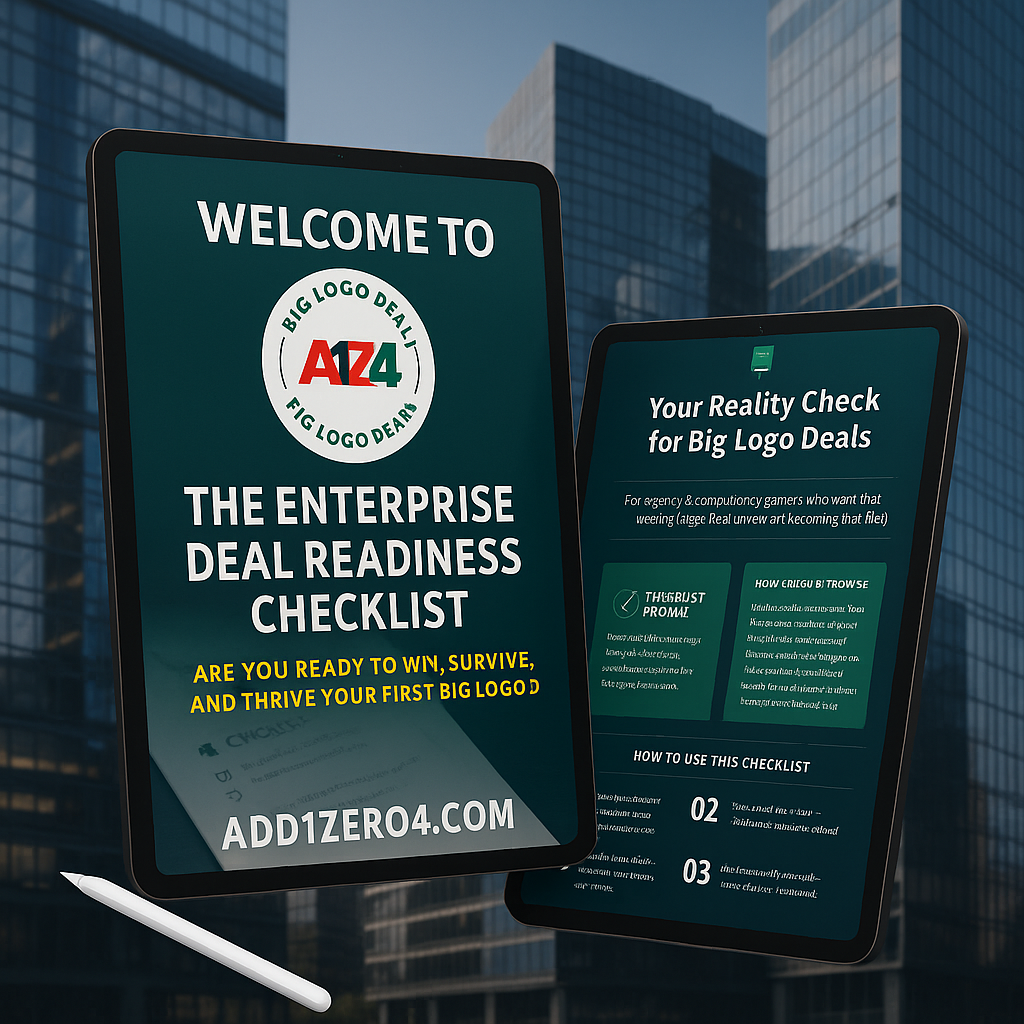
The Enterprise Deal Readiness Checklist
Skip the $100K+ learning curve. This insider’s checklist reveals if your B2B agency can win (and survive) Fortune 500 deals before you risk your stable revenue and best people chasing logos you’re not ready for.
The Enterprise Mindset Shift: It’s More Than Just Bigger Budgets
Before you even draft a proposal or think about pricing, the first critical adjustment to your media buying agency business model is internal: your mindset. Landing big logo deals isn’t just about having the technical chops; it’s about projecting the right kind of energy.
Think about it. You’re asking a massive company, with layers of stakeholders and significant risk aversion, to trust your agency with a substantial budget and a piece of their brand. They need to feel, deep in their bones, that you’re not just capable, but a safe, reliable, and expert pair of hands. This is where “Calm Confidence” comes in. It’s the antithesis of the “thirsty” sales approach. It’s not about desperation or high-pressure tactics. It’s an aura that says, “We’re the best solution for your specific challenge, and while we’d be delighted to partner with you, our success isn’t contingent on this one deal.” This isn’t arrogance; it’s the quiet assurance that comes from genuine expertise and a healthy pipeline. Enterprise buyers can smell desperation a mile away, and it’s a major turn-off.
Beyond your demeanor, how does your agency look to an enterprise scout? Your website, your LinkedIn presence, even the way you articulate your company’s core values – it all needs to pass the enterprise “sniff test.” If your site screams “we primarily serve local dentists” (no offense to dentists!), a global brand manager might click away before they even get to your case studies. Is your messaging sophisticated? Is your design clean and professional? Does it look like you can handle complexity? Simple is fine, but shabby is a deal-breaker.
And then there’s the cast of characters. In SMB land, you might deal with one or two decision-makers. In the enterprise world, you’ll encounter a constellation, and it’s critical to learn who’s who in the enterprise sales cycle:
- The Delegated Shopper: Often an intern or junior staffer tasked with filling a spreadsheet. You’ll need to give them what they need to make their boss happy.
- The Unfunded Mandate Holder: A frazzled mid-level employee told to “solve this problem” with no clear budget. Your job is to become their hero and help them champion your solution upwards.
- The Mid-Level Owner: Has some budget, understands the need, but still needs to sell it to their higher-ups. These are often your best entry points.
- The Chemistry Call: Sometimes, before any serious talk, they just want to see if you “fit” their culture.
- The Leadership Presentation: The big one, where you finally get all (or most) of the key players in a room.
Understanding these archetypes helps you tailor your approach, ask the right questions, and navigate the internal landscape effectively.
Fortifying Your Financials: Can Your Media Buying Agency Business Model Handle the Heat?
This is where the dream of enterprise riches can turn into a nightmare if you’re not careful. Landing a massive deal feels incredible, but that euphoria can quickly curdle if your agency’s financial foundations aren’t rock-solid. Here’s a shocking truth: massive deals can kill companies faster than no deals.
Why? Because enterprise clients often come with extended payment terms (Net 60, Net 90, or even longer), complex invoicing procedures, and a demand for resources that can strain your cash flow to its breaking point. You’ll likely need to hire or allocate significant team resources before you see a dime. This is why you must enterprise-proof your marketing agency business model; the one that works for SMBs is likely not built for that kind of financial lag.
So, how do you price for this new reality? A rule of thumb we’ve seen work wonders is “twice the price for half the deliverables” compared to your SMB offerings. Sounds counterintuitive, right? But consider this: enterprise clients require significantly more overhead. More meetings, more reporting, more hand-holding, more internal stakeholder management. That $5k/month retainer for an SMB might translate to a $10k/month starting point for an enterprise, but with a more focused, less sprawling scope initially. They often don’t want the full SMB smorgasbord right away.
You also need to get intimately familiar with your Cost of Goods Sold (COGS) for enterprise-level work. It’s not just about your team’s salaries. It’s about the extra project management time, the specialized reporting software you might need, and the “switching cost” as your team juggles these demanding accounts. If your gross margin on these deals isn’t healthy (think 40% as an absolute floor, aiming much higher), you’re working for vanity, not profit.
And Accounts Receivable (AR)? With enterprise, it’s a whole different beast. You can’t be casual about invoicing. You need a system. You need to understand their procurement portals. You need to be prepared to chase payments politely but persistently. Waiting an extra 30, 60, or 90 days for a six-figure payment can cripple a smaller agency. Are you truly prepared for this? The Enterprise Deal Readiness Checklist can be a great starting point to assess if your agency has the financial (and operational) backbone for these larger engagements.
Our Probably-Too-Honest Private Podcast
Find out what REALLY happens when agencies land enterprise deals (spoiler warning: one of them lost $100K)
Brought to you by Add1Zero4 and hosted by David “Ledge” Ledgerwood
Operational Overhaul: Gearing Up for Enterprise-Level Delivery
If your financial model needs an upgrade, your operational model likely needs a full-blown transformation. The processes that make your SMB work sing? Enterprise clients will break them. Guaranteed. Mastering the enterprise sales process steps means re-engineering your delivery, because their demands for communication, reporting, and project management are on another level.
They expect you to show up as the undisputed expert from day one. This means doing your homework – deep homework. Reading their annual reports, understanding their industry trends, knowing their competitors, and dissecting their past marketing efforts. When you walk into that first big meeting (even if it’s virtual), you need to exude knowledge, not just about media buying, but about their specific world.
Your sales enablement materials need to evolve too. Forget the generic pitch deck. Enterprise clients want to see tailored insights, data-driven recommendations, and clear ROI projections. How will you track and present performance data in a way that resonates with their internal reporting structures? Some want elaborate slide decks; others want raw data for their BI tools. Flexibility is key. And if you’re not already, record your sales calls! The nuances discussed in those initial conversations are gold for your delivery team.
Scope creep is not a matter of if, but when and how much. Your “very helpful” team, used to going the extra mile for appreciative SMBs, might accidentally give away the farm to an enterprise client who will simply see it as the new baseline. You need clear SOWs, robust project tracking, and a team trained to politely but firmly manage scope, escalating when necessary. Remember, free work for an enterprise rarely earns you goodwill; it just sets new, unpaid expectations.
Pricing and Packaging for the Big Leagues: It’s Not Just About Rate Cards
Your beautifully crafted, standardized packages that SMBs love? Enterprise clients will likely want to deconstruct them. They don’t buy “off the rack.” They expect a bespoke suit. This means your media buying agency business model needs to embrace customization in its pricing and packaging.
This doesn’t mean reinventing the wheel every time, but it does mean being prepared to unbundle services, create custom scopes, and price based on value and complexity, not just hours or impressions. Your proposals need to reflect this. While the format can be a simple, direct Google Doc, the content must cover the anatomy of a winning enterprise proposal: what you understand the challenge to be, your proposed solution, and the investment. The flashy 50-page deck often gets skimmed to the pricing page anyway. You should have already sold them on your “why” during the sales process.
Understanding different payment structures is also crucial. Milestone billing is common. Upfront payments are rare but amazing if you can get them (especially for initial strategy or setup phases). Post-delivery billing carries risk, so price accordingly. Don’t be afraid to negotiate terms. Their “standard” Net 90 might become Net 45 with a bit of calm, confident discussion. For more deep dives into crafting compelling offers and structuring deals that work for both you and these giants, tuning into the Big Logo Deals podcast can provide invaluable, real-world insights from those who’ve been in the trenches.
The Big Logo Deals Course
Created by experts who have closed over $50 million in revenue over the last decade who teach you everything they know about closing deals with the logos you wish were on your client list.
Navigating the Labyrinth: Legal, Procurement, and the Virtue of Patience
Welcome to the part of the enterprise game that can make even seasoned agency owners want to tear their hair out: legal, procurement, and the seemingly endless waiting. Your standard MSA? They’ll likely want you to sign theirs – a document that can be dozens of pages long, filled with dense legalese.
NDAs are standard, and usually harmless, but read them carefully. Watch out for over-reaching non-competes or exclusivity clauses that could hamstring your agency’s future growth. Insurance requirements will be more stringent; you’ll need to ensure your coverage (Professional Liability/E&O, Cyber, etc.) is up to snuff. And procurement portals? Each one is a unique adventure in bureaucracy. Get ready to fill out endless forms and provide detailed company information.
Then there’s the decision-making process itself. It’s rarely a single person. Think “constellation decision-making.” Your enthusiastic mid-level contact might love you, but they need approval from their boss, their boss’s boss, finance, legal, and possibly a committee that meets quarterly. This is why patience isn’t just a virtue; it’s a survival skill. You have to be prepared for the enterprise sales cycle marathon.
Following up is an art. You need to be persistent without being a pest. Polite check-ins, offering additional value, and understanding their internal timelines are key. And remember, a “verbal yes” from your contact means almost nothing until contracts are signed and POs are issued. I once celebrated a “verbal commit” with champagne for the team, only for the deal to evaporate a month later due to lack of internal approval. Painful lesson learned: hold the bubbly until the ink is dry (or the digital signature is secured).
Ready to Add That Zero? The Path to Your First Big Logo Awaits
Transitioning your media buying agency business model to successfully court and win enterprise clients is a marathon, not a sprint. It requires a fundamental shift in mindset, a reinforcement of your financial and operational structures, and a deep understanding of how these large, complex organizations actually work. It’s about more than just being good at media buying; it’s about becoming a trusted, credible, and operationally sound partner that can navigate their world with confidence and deliver undeniable value.
The hurdles are real, but the rewards – both financial and reputational – can be transformative. Stop wondering “what if” and start taking a_ction.
If you’re serious about leaving the SMB-only pond and swimming with the enterprise sharks, if you’re ready to learn the specific mindset, tactics, and execution frameworks that turn ambitious agency owners into big logo closers, then it’s time to get equipped. The Big Logo Deals course is designed to be your comprehensive roadmap, guiding you through every critical step of this journey. Stop guessing, and start strategically positioning your agency to win the clients you’ve always dreamed of. Your next big deal is waiting.