
Alright, agency owner. You’ve built something great. You’re slaying it with small to medium-sized businesses (SMBs), delivering awesome results, and your reputation is solid. But there’s that itch, right? The allure of the “big logo” clients, the enterprise giants whose names everyone knows. Landing one of those can be a game-changer, catapulting your agency into a new league.
Big Logo Deals
Learn how to close your first big enterprise deal and drive massive business growth.
But here’s the kicker: the b2b sales cycle for those enterprise behemoths? It’s a whole different beast compared to what you’re used to. It’s longer, more complex, and plays by an entirely different set of rules. Many agencies, brilliant as they are, stumble when they try to make this leap, simply because they don’t understand how these large organizations operate.
If you’re ready to move from a steady stream of SMB projects to landing those transformative enterprise deals, you need to master their unique b2b sales cycle. Let’s break down what that really means and how you can navigate it without losing your sanity (or your shirt).
The Great Divide: Understanding the Enterprise vs. SMB B2B Sales Cycle
With your SMB clients, you’re probably used to a relatively straightforward b2b sales cycle. You might talk to one or two key decision-makers, the process is fairly quick, and often your biggest competitor is just inertia – getting them to do something now rather than later.
Enter the enterprise world. Prepare for a b2b sales cycle with more twists and turns than a rollercoaster:
- More Stakeholders: Forget two or three contacts. You could be juggling relationships with 8, 10, or even more stakeholders, many of whom appear and disappear throughout the process. Keeping track of who’s who and what they care about is a job in itself.
- Glacial Urgency: “Urgent” in enterprise-speak can mean “sometime this quarter… maybe.” They’re often beholden to rigid budget cycles and internal politics that can make things move at a snail’s pace.
- Budget Hoops: Getting budget approval can be a multi-layered saga, often involving people you’ll never meet.
- The Long Game: Be prepared for a significantly longer b2b sales cycle. We’re talking months, sometimes even a year or more, from initial contact to a signed deal.
It’s not just about being patient; it’s about understanding the why behind these differences and adapting your entire approach.
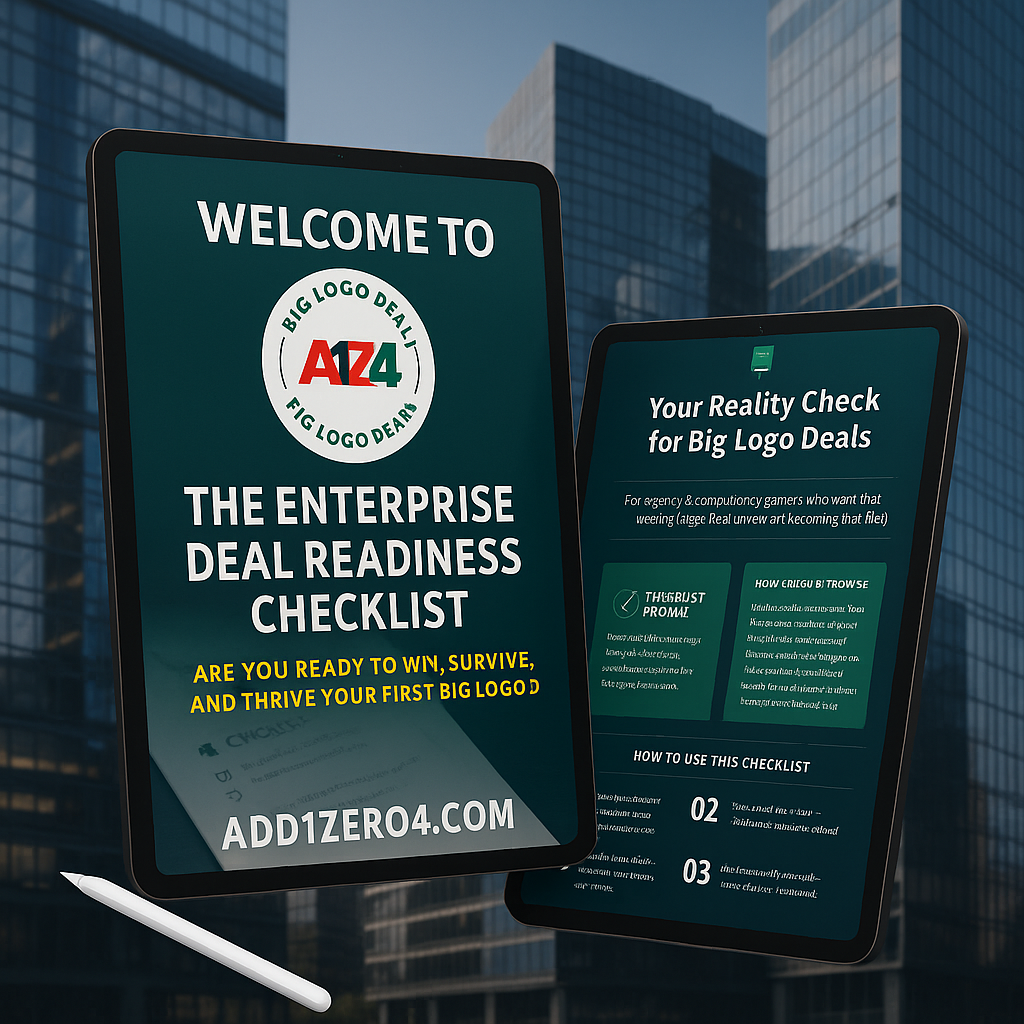
The Enterprise Deal Readiness Checklist
Skip the $100K+ learning curve. This insider’s checklist reveals if your B2B agency can win (and survive) Fortune 500 deals before you risk your stable revenue and best people chasing logos you’re not ready for.
Level Up Your Attitude: The Mindset for a Marathon B2B Sales Cycle
Before you even think about pitching, your agency needs to project a certain image. The enterprise b2b sales cycle often starts before you even have a conversation.
- Looking Legit: Does your online presence scream “enterprise-ready”?
- Core Values (Subtly): While your fun, entrepreneurial culture is awesome, be mindful of how overtly you broadcast “fun over work” on your “About Us” page when a buttoned-up enterprise buyer is checking you out. It’s fine to live those values internally without making them front-and-center for this audience.
- Website & Marketing: That “we get all our business from referrals, so our website is outdated” excuse won’t fly. Enterprise clients will scrutinize your site. It needs to be professional, current, and instill confidence that you can handle their scale. Simple is fine, shabby is not.
- Lead Funnels: Highly automated, aggressive direct-response funnels that work for SMBs can be an instant turn-off for enterprise prospects. They expect accessibility on their terms. Consider an appointment-focused funnel that makes it easy for them to connect with a human.
- Mastering “Calm Confidence”: Throughout the long b2b sales cycle, you need to project what we call “Calm Confidence.” It’s the antidote to sounding desperate or “thirsty.”
- Remember this mantra: “It makes no difference to my life if you buy this. It might make a difference to yours if you don’t.” Of course, you care about closing the deal, but that’s your motivation, not theirs.
- Your vibe should be: “We’re the best solution, and you need to come to that understanding yourself.” This comes from truly knowing your stuff and being prepared to walk away if the terms aren’t right.
- Becoming Their Advocate: Often, your initial contact at a big company is a mid-level manager who’s excited about your services but needs to sell it internally to their boss. Don’t just send them your proposal and hope for the best. Offer to help them make the case. Position yourself as their partner in navigating the internal approval maze. They’re not sales experts; you are (or you should be for what you offer).
- Developing Thick Skin: You’ll encounter difficult personalities, endless questions, and frustrating delays. It’s rarely personal. People in large companies are under immense pressure. Stay focused on collaboration and understanding their motivations. And critically, learn when to politely but firmly say “no” to unreasonable requests or scope creep, even during the sales process.
Financial Fortitude: Can You Afford the Enterprise B2B Sales Cycle?
This is where many agencies get into trouble. Big deals mean big potential revenue, but they also come with big upfront costs and slow payment cycles.
- Cash Flow is King (and Queen, and the Entire Royal Court): Enterprise clients often have Net 60, Net 90, or even longer payment terms. That means you could be delivering work (and paying your team) for months before you see a dime. A rule of thumb: if you don’t have at least half of the first six months’ contract value in unallocated cash before the deal starts, you’re risking insolvency. That “bet-the-company” deal can literally sink your company if you’re not prepared.
- Pricing for the Pain: Your SMB pricing model won’t cut it. A good starting point we often suggest is “twice the price for half the deliverables.” Why? Because enterprise clients demand significantly more overhead: more meetings, more reporting, more hand-holding. This needs to be baked into your pricing.
- COGS Clarity: You must understand your Cost of Goods Sold (COGS) for every service component. Enterprise clients will often want to unbundle your packages and see line-item pricing. If you don’t know your true costs, you can easily underprice and destroy your margins.
- Opportunity Cost: Chasing a massive enterprise deal takes significant time and resources. What other opportunities are you sacrificing? Are your best people pulled away from profitable SMB clients? Factor this into your decision-making.
Our Probably-Too-Honest Private Podcast
Find out what REALLY happens when agencies land enterprise deals (spoiler warning: one of them lost $100K)
Brought to you by Add1Zero4 and hosted by David “Ledge” Ledgerwood
Operational Readiness: Supporting a Demanding B2B Sales Cycle
- Show Up as the Expert (Every Time): Enterprise clients expect you to know their business, their industry, and their challenges before you even start. Read everything: press releases, annual reports, industry trends. Record your sales calls (with permission!) and make sure your delivery team has access to these insights. Onboarding teams should practice their meetings to sound ultra-professional.
- Sales Enablement that Works: This isn’t just top-of-funnel content. We’re talking about “middle-of-funnel” materials – specific case studies, process diagrams, ROI calculators – that your sales team uses during direct interactions to demonstrate expertise and value. Keep it simple, visual, and focused on numbers. Build a library of these modular pieces you can pull from as needed.
- Enterprise Customer Standards are Different:
- Communication: Expect slower decision-making but be prepared for sudden demands. Communicate early, often, and reconfirm everything. Navigate multiple stakeholders, some of whom may have conflicting agendas.
- Reporting: Find out their preferred reporting format (slides, docs, BI dashboards) and be prepared to adapt. It doesn’t matter if you like quarterly slide decks if they want weekly spreadsheets.
- Processes Will Break: Whatever well-oiled machine you have for SMBs, assume enterprise clients will break it. Be agile.
Navigating Proposals, Pricing, and Payments in the Enterprise Cycle
The paperwork and financial discussions in an enterprise b2b sales cycle can be daunting.
- Proposals that Close: Forget overly designed, 50-page pitch decks. Enterprise buyers scroll straight to the pricing. Your proposal should be a concise business document (we’re fans of Google Docs for easy collaboration and commenting) that clearly outlines scope and cost. The “selling” should have happened before the proposal.
- RFPs (Requests for Proposals): Be wary. RFPs are designed to commoditize you. Only respond if you feel very close to the purchasing decision or if the opportunity is truly massive and justifies the considerable effort. Often, they are written by non-experts asking the wrong questions.
- Customized Pricing, Not Packages: They won’t want your standard SMB packages. Expect to create entirely custom scopes. Remember “twice the price, half the deliverables” and price for all that inevitable overhead.
- Payment Structures:
- Upfront: Ideal, but rare. Don’t be afraid to ask, especially if you need seed money for talent.
- Milestone Billing: Very common. Structure these to mimic monthly revenue as much as possible.
- Avoid Post-Delivery/Proof-of-Delivery if Possible: This puts all the financial risk on you.
- Negotiate Terms: Don’t just accept their standard Net 90. Push for shorter terms or partial upfront payments. We once helped a client turn a Net 90 (after all work done) from a $100B+ company into 40% upfront. It’s possible with Calm Confidence.
The Gatekeepers: Legal and Procurement in the B2B Sales Cycle
Towards the end of the b2b sales cycle, you’ll encounter legal and procurement. These can be major hurdles if you’re unprepared.
- Legal Counsel: For your first few enterprise deals, get experienced legal counsel to review their (often lengthy and complex) Master Service Agreements (MSAs). Don’t just let them redline everything (which can stall deals for months); use them to understand what really matters and what risks are acceptable.
- NDAs (Non-Disclosure Agreements): Mostly boilerplate. Watch out for non-competes or overly broad exclusivity clauses that could limit your future business.
- Contract Language Pitfalls:
- Publicity Clauses: Can you use their logo in your marketing? This is HUGE. If the contract says no, try to negotiate for written permission. The value of landing a big logo is significantly diminished if you can’t talk about it.
- Insurance Requirements: They’ll often ask for more coverage than you need. Push back on irrelevant types or excessive amounts.
- Data Security/IT Audits: Be prepared. Using major cloud providers can help, as you can often refer to their security certifications.
The Big Logo Deals Course
Created by experts who have closed over $50 million in revenue over the last decade who teach you everything they know about closing deals with the logos you wish were on your client list.
Patience & Timing: The Unspoken Rules of the Enterprise B2B Sales Cycle
This is perhaps the most crucial, yet hardest, part.
- Constellation Decision-Making: Decisions are made by committee, often involving unseen approvers. It’s a stark contrast to quick SMB decisions. One client of ours signed a $12k/month deal with a $50M tech company in a week. Another $35k deal with an $80B conglomerate took four calls, three proposal revisions, and four levels of approval. That’s the enterprise reality.
- Whose Word Matters? Your enthusiastic initial contact might have zero actual buying power. They might be your internal advocate, needing your help to sell the project internally. Ask early: “What’s the procurement process? Have you onboarded a new vendor before?” Your acumen here can make you seem more legit than competitors.
- The Art of Following Up (Without Being Annoying): Polite persistence is key. They’re busy; you’re not their top priority. Set reminders, touch base, offer value. Connect on LinkedIn. Use text (sparingly and professionally) if you have their mobile. Know when to let it go – you won’t win them all.
- When is the Deal Actually Closed? A verbal “yes” means nothing. Don’t pop the champagne (we learned this the hard way after a $40k verbal evaporated). A deal is closed when agreements are signed, POs are issued, and you know you can bill. Until then, you’re still selling.
Ready to Conquer the Enterprise B2B Sales Cycle?
Landing big logo clients is a marathon, not a sprint. The b2b sales cycle is longer, the demands are higher, and the processes are more convoluted. But the rewards – in terms of revenue, prestige, and agency growth – can be transformative.
It requires a shift in mindset, a tightening of your financials and operations, and a healthy dose of “Calm Confidence.” If you’re tired of the SMB grind and ready to play in the big leagues, you need a playbook specifically designed for enterprise engagement.
The Big Logo Deals course is built on a decade of experience helping agencies like yours make this exact transition. We provide the mindset, tactics, and execution framework necessary to not just close your first big enterprise logo, but to thrive in these complex relationships.
Want to dive deeper and get ready for those big conversations?
- Start by assessing your agency’s readiness with our Enterprise Deal Readiness Checklist.
- Tune into the Big Logo Deals podcast for more insights and real-world stories.
The enterprise world might seem intimidating, but with the right knowledge and approach, your agency can absolutely crack the code. It’s time to stop dreaming about those big logos and start strategically pursuing them. You’ve got this.