
So, you’re running a web design agency. You’re good at what you do. Your team cranks out slick designs, happy small to medium-sized business (SMB) clients sing your praises, and things are… well, fine. But “fine” isn’t “fantastic,” is it? Deep down, you’re eyeing those massive projects, the ones with household names attached – the “big logo deals” that could catapult your agency into a whole new stratosphere. The question that keeps you up at night is likely: how to grow a web design agency from a reliable SMB player to an enterprise-level powerhouse?
Big Logo Deals
Learn how to close your first big enterprise deal and drive massive business growth.
The truth is, the leap from serving local businesses to partnering with giants like Meta, AWS, or Siemens isn’t just about scaling your current operations. It’s about entering an entirely new arena, one with different rules, different expectations, and a vastly different way of doing business. Many talented agency owners stumble here, not because they lack skill, but because they lack the insider knowledge of how these corporate behemoths actually operate. It’s like going from playing local league baseball to stepping into the World Series – the game is the same, but the stakes, strategies, and sheer scale are worlds apart.
If you’re ready to stop wondering and start winning those game-changing contracts, let’s pull back the curtain.
Dressing the Part: More Than Just a Pretty Website
You wouldn’t show up to a Fortune 500 pitch meeting in a stained t-shirt, right? Your agency’s “look” – from your website to your sales collateral – needs to scream “enterprise-ready.”
I can’t tell you how many times I’ve heard, “Yeah, our website isn’t great, but we get all our business from referrals.” That’s fantastic for the SMB world, but enterprise clients? They Google. They scrutinize. Your online presence is your digital handshake, and if it looks shabby or screams “small-time,” they’ll click away faster than you can say “missed opportunity.”
Actionable Insight: Audit your agency’s “About Us” page. Values like “fun over work” are cool for internal culture, but enterprise clients are looking for partners who reflect their own (often more buttoned-up) ethos. Ensure your marketing materials are tight, professional, and convey that you can handle the big leagues. Simplicity is fine, but it must be polished.
And your lead funnels? That aggressive, direct-response, long-form sales page that works wonders for SMBs? Enterprise decision-makers will likely roll their eyes and close the tab. They expect to be accessible on their terms. Consider an Appointment-Focused Funnel. Make your homepage a lean, mean, appointment-generating machine. Drive all CTAs to a simple lead form, then a calendar booking. It keeps things focused and professional.
Thinking about how you conduct those crucial first calls? Ditch the “I’m just a sales guy” mentality. On a video call, you’re a representative of your agency’s power. Frame yourself well, look into the camera, and amplify your active listening – it’s exhausting, yes, but it shows engagement. And for goodness sake, slow down when screen sharing; lag can make even the best presentation look jittery.
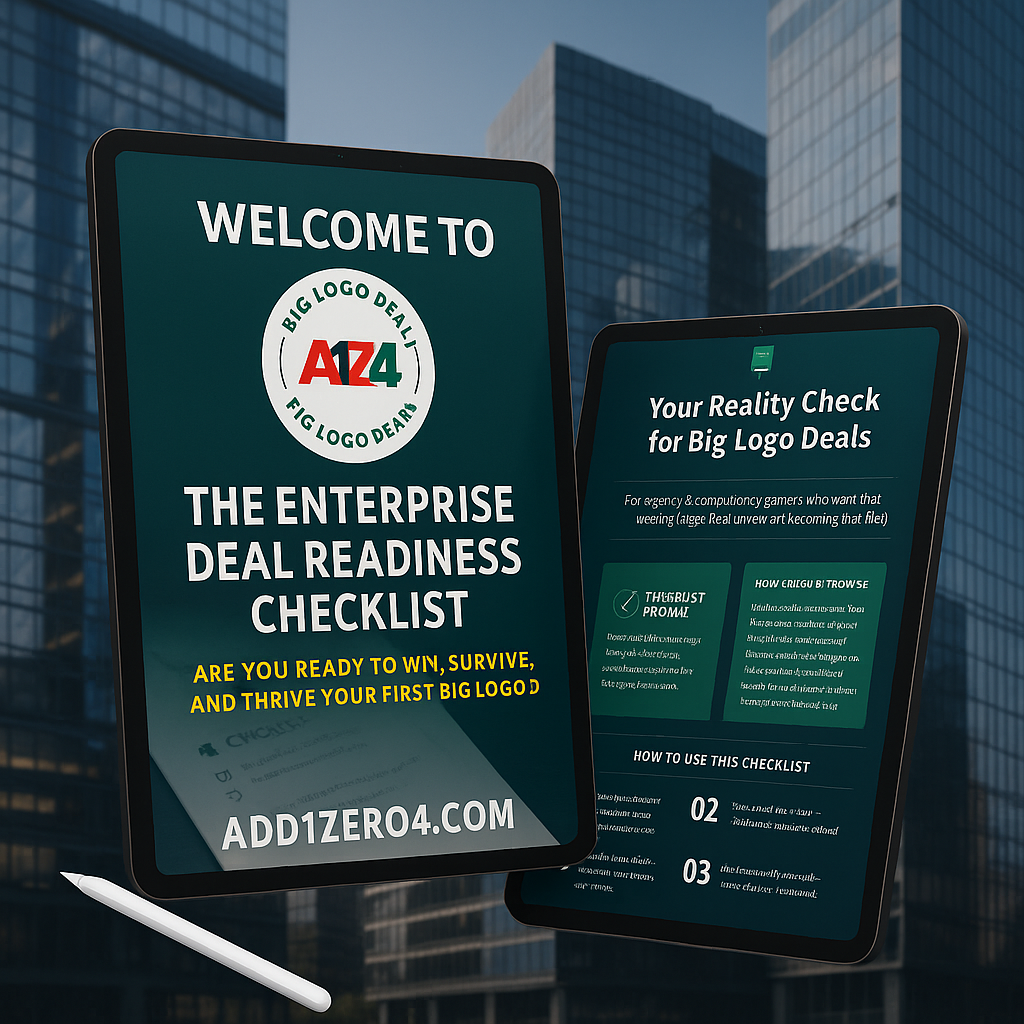
The Enterprise Deal Readiness Checklist
Skip the $100K+ learning curve. This insider’s checklist reveals if your B2B agency can win (and survive) Fortune 500 deals before you risk your stable revenue and best people chasing logos you’re not ready for.
The “Calm Confidence” Playbook for Big Deals
Ever felt that desperate “please pick me!” vibe when talking to a big prospect? That’s “sales thirst,” and it’s a major turn-off for enterprise buyers. What you need is “Calm Confidence.” It’s the mindset that says, “It makes no difference to my life if you buy this. It might make a difference to yours if you don’t.”
Of course, you care! But that’s your motivation, not theirs. You’re there to provide value, to be the best solution to their problem. This isn’t arrogance; it’s the quiet assurance that comes from knowing your stuff and understanding their world.
Understanding the Players & the Pitch:
SMB deals might involve 2-3 stakeholders. Enterprise? Try 8-10, appearing and disappearing like characters in a sprawling novel. You’ll encounter:
- The Delegated Shopper: Often an intern or junior staffer with a checklist. Give them what they need to look good to their boss.
- The Unfunded Mandate: A frazzled mid-level employee tasked with a vague project. Your goal? Become their advocate and get a meeting with leadership.
- The Mid-Level Owner: Has some budget, gets it, but still needs to pitch upwards. This is often where deals are born.
- The Chemistry Call: A screening to see if you’re a cultural fit before they let you in deeper.
- The Leadership Presentation: Your moment with all the key decision-makers. Be prepared to re-state everything.
When they ask “What makes you different?”, don’t trot out clichés like “we care more.” Dig deep. What’s truly unique about your agency’s approach to web design for complex organizations? If you don’t have a crisp answer, it’s homework time.
Deal-Making Levers (Beyond Just Cutting Price):
A savvy enterprise buyer will always ask for a discount. Don’t just cave. Your first lever is a polite “No.” If they persist, think trades:
- Payment Timing: Can they pay upfront for a discount? Shorten Net terms?
- Length of Commitment: A longer contract in exchange for a rate adjustment?
- Removing Onerous Clauses: Can they ease up on extreme insurance demands?
- Testimonials/Case Studies: A guaranteed, high-quality testimonial is valuable.
Remember, it’s a value-for-value exchange. Don’t devalue your service. We once helped a client tell a $135B firm they couldn’t accept their Net 90 terms. The client was terrified, but they knew their limits. The behemoth budged, agreeing to 40% upfront. That’s Calm Confidence in action.
Is Your Bank Account Ready for the Big Time?
Here’s a sobering truth: a massive deal can kill your agency faster than no deals at all if you’re not financially prepared. Enterprise clients often have exacting standards, merciless contracts, and, crucially, long payment cycles.
The Cash Flow Crunch:
Imagine landing a $100k project. Awesome! Now imagine you have to pay your team, freelancers, and cover overheads for 3-4 months before you see a dime. That’s the reality. Our rule of thumb: whatever your total contract value, assume you’ll need to float at least half that value in cash-on-hand for six months. If you don’t have it, or a solid credit line, you risk insolvency. This isn’t fear-mongering; it’s financial prudence.
COGS – Know Your Numbers, Know Your Walk-Away Price:
You need to understand your Cost of Goods Sold (COGS) with precision. What does it actually cost to deliver each service, accounting for staff time (including your own!), overhead, and that inevitable “switching time” between tasks? Enterprise clients will often want to “unwind” your packages into component parts. If you don’t know your COGS for each, you can underprice and demolish your margins. Aim for a gross margin of at least 40%, ideally much higher. Know your absolute walk-away price and stick to it, no matter how shiny the logo.
“Do or Die” Means You’re Already Dead:
If you’re ever thinking, “If we don’t land/deliver this, we’re screwed,” it’s already too late. That pressure leads to bad decisions and potential ruin.
Our Probably-Too-Honest Private Podcast
Find out what REALLY happens when agencies land enterprise deals (spoiler warning: one of them lost $100K)
Brought to you by Add1Zero4 and hosted by David “Ledge” Ledgerwood
Gearing Up Operations: It’s a Different Ballgame
Your well-oiled SMB machine? Enterprise clients will likely break all your established processes. They expect a level of attention, communication, and reporting that’s orders of magnitude greater.
Showing Up as The Expert (For Real):
Enterprise clients expect you to arrive already knowing a lot about their business, their industry, and their challenges. Read their annual reports, press releases, and industry trends. Record your sales calls (tools like Fathom for Zoom are great) and make those recordings available to your delivery team. They need the full context. Preparing to sell is not the same as preparing to deliver.
Sales Enablement – Equipping Your Team to Win:
Sales enablement isn’t just for your sales reps; it’s about arming your entire engagement team with the right materials. Think:
- Clean, simple, data-rich case studies: Focus on ROI you’ve delivered (even for SMBs, frame it in terms they understand).
- Modular content: Instead of one massive sales deck, have a library of one-pagers, short videos, and process diagrams you can pull up as needed. This makes you look prepared and agile.
- Visuals that communicate value: An information designer (not just a graphic designer) can be invaluable in creating materials that clearly explain complex offerings and nuanced value propositions to non-experts.
Enterprise Customer Standards – Communication, Delivery, Reporting:
Expect slower movement, more approval layers (we had a client wait nine months for an enterprise to choose music for a project!), and shifting stakeholder needs. Communicate early and often. Reconfirm next steps. Be firm but supportive. If their delays impact timelines, state it clearly and professionally: “To hit the [X date] milestone, we need your approval by [Y date].”
And what about your existing SMB clients when you land that whale? Be upfront. Tell them you’ve booked a big new client and you’re putting measures in place (like a “bat phone” for direct escalation) to ensure their service doesn’t suffer. Transparency builds trust.
Pricing & Packaging: “Twice the Price, Half the Deliverables”
Your standard SMB packages? Enterprise clients don’t want them. They want bespoke solutions. This is good news because you can (and should) charge more. Our mantra: “Twice the price, half the deliverables.”
Why?
- Overhead: Enterprise clients demand a lot of meetings, reports, and hand-holding. This non-billable time needs to be baked into your price. We once had to convert a 65-slide presentation into a Word document by hand because a corporate leader “didn’t like slides.” That’s enterprise overhead!
- Reduced Scope (Initially): They often don’t want to consume as much as an SMB client right out of the gate.
So, if your $5k/month SMB retainer includes X, Y, and Z, your enterprise equivalent might be $10k/month for X and Y. This isn’t gouging; it’s realistic pricing for the increased complexity and attention required.
No More “Free Stuff”:
Doing favors for SMB clients builds goodwill. For enterprise clients, “free work” often just becomes an expectation, especially if the person you did the favor for isn’t the ultimate decision-maker. If you do offer something extra, document it clearly on the invoice as a line item with a cost, then a credit.
Payment Cadences & Terms:
Net 30 and credit card payments? Unlikely. Expect Net 45, Net 60, even Net 90. And it’s all negotiable. If their terms are Net 60, ask for Net 30. If they won’t pay upfront, negotiate a milestone-based payment structure to protect your cash flow. Don’t be afraid to push back – politely but firmly.
The Big Logo Deals Course
Created by experts who have closed over $50 million in revenue over the last decade who teach you everything they know about closing deals with the logos you wish were on your client list.
Navigating the Corporate Maze: Legal, Procurement, and Patience
Legal & Contracts:
Yes, you need your standard contract reviewed by a lawyer. But with big companies, 80% of the time, you’ll be signing their paper – often a 60-page Master Services Agreement (MSA) that’s dense and intimidating. Your lawyer’s job is to help you understand the real risks, not just redline every clause (which often stalls deals). Key things to watch for:
- Publicity Clauses: Can you use their logo in your marketing? This is HUGE. If not, or if it requires complex written approval, that significantly diminishes the deal’s long-term value for your agency.
- Insurance Requirements: They’ll often list every type of insurance imaginable. Push back on what’s irrelevant to your services (e.g., high-level cyber-security if you’re not handling PII, or automobile liability if you’re remote).
- NDAs: Mostly boilerplate. Watch for non-competes or overly broad exclusivity clauses. These can hamstring your agency’s growth.
Procurement Portals & Paperwork:
Get ready for forms, vendor portals (SAP Ariba, Coupa, etc. – some are user-friendly, many are not), security audits, and endless requests for information. Keep meticulous records. Designate someone to own this process. This is all frictional cost you need to account for.
Patience & Timing – The Long Game:
Enterprise sales cycles are marathons, not sprints. You’ll deal with “constellation decision-making” – numerous stakeholders, shifting priorities, and budget cycles that don’t align with the calendar year (Google “What is [Company X]’s fiscal year?”).
Your enthusiastic contact person? They might be an advocate, not the actual decision-maker. Your job is to help them sell your services internally. Ask early: “What’s your procurement process? Have you onboarded a new vendor before?” This acumen alone can make you stand out.
When is a Deal Really Closed?
A verbal “yes” means nothing. Don’t pop the champagne until contracts are signed and a Purchase Order (PO) is issued. We learned this the hard way after buying champagne for the team based on a VP’s verbal, only for the deal to evaporate a month later due to lack of internal approval. It’s demoralizing. The deal is closed when you can confidently bill it.
Follow-Up & Letting Go:
Prospects will go dark for months. Polite persistence is key. Use a follow-up cadence, connect on LinkedIn, and don’t be afraid of a well-placed, polite text. But also know when to let go. You won’t win them all. Learn from each experience.
Are You Ready to Add1Zero?
Growing your web design agency by landing big logo deals is a journey, not an overnight transformation. It requires a shift in mindset, a re-tooling of your processes, and a deep understanding of a completely different client world. It’s challenging, yes, but the rewards – in terms of revenue, prestige, and the sheer excitement of working on impactful projects – are immense.
If you’re tired of just dreaming about those big logos and are ready to learn the specific mindset, tactics, and execution strategies to make them a reality, then it’s time to get serious.
The journey to your first enterprise client can feel daunting, but you don’t have to go it alone. The Big Logo Deals course is designed to give agency owners like you the comprehensive playbook, developed over a decade of closing deals with the world’s largest companies.
Want to see if your agency is even ready to start these conversations? Download our free Enterprise Deal Readiness Checklist. It’ll give you a clear picture of where you stand and what you need to work on.
And for ongoing insights and stories from the trenches, tune into the Big Logo Deals Podcast.
Stop wondering how to grow a web design agency to the next level. Start learning the proven strategies to make it happen. The big leagues are waiting.