
So, your agency is crushing it. You’ve built a solid reputation, a portfolio of happy SMB clients, and a team that knows how to deliver. But there’s that itch, isn’t there? The one that whispers about bigger projects, household names, and the kind of revenue that truly transforms your business. You’re eyeing the enterprise league, but landing those “big logo” clients feels like a whole different ball game. And guess what? It is.
Big Logo Deals
Learn how to close your first big enterprise deal and drive massive business growth.
The leap from serving Small and Medium-sized Businesses (SMBs) to courting massive Enterprise corporations isn’t just about scaling up your current efforts. It’s a fundamental shift in approach, mindset, and operations. Many agencies stumble here, not because they lack talent, but because they underestimate just how different the SMB vs Enterprise sales landscape truly is. Enterprise clients don’t just operate on a larger scale; they operate on a different wavelength.
If you’re ready to stop wondering and start winning those game-changing deals, understanding these differences is your first, non-negotiable step. Let’s break down what changes when you step into the enterprise arena.
The Players on the Field: Who You’re Really Talking To
In the SMB world, you’ve probably gotten used to a relatively straightforward cast of characters.
- SMB Sales: You’re often dealing with the founder, a C-level exec, or a manager with significant autonomy. You might have 2-3 key contacts, and the path to the decision-maker is usually pretty clear. Decisions can be made relatively quickly, driven by an immediate need or opportunity.
- Enterprise Sales: Welcome to the “constellation.” You could be juggling conversations with 8, 10, even 15+ stakeholders, many of whom appear and disappear throughout a long sales cycle. Job titles can be misleading, and the person who seems most enthusiastic – your internal “champion” – might have influence but zero actual buying power. They might be tasked with researching vendors like you but still need to sell the idea (and your agency) internally to layers of management you haven’t even met.
The Impact for Your Agency:
Your SMB charm and direct approach need an upgrade. For enterprise deals, you’ll need sophisticated communication strategies, meticulous account mapping (yes, you’ll actually need to map out who’s who in the enterprise sales cycle and who really matters), and a hefty dose of patience. You’re not just selling your services; you’re often coaching your champion on how to navigate their own internal bureaucracy to get your proposal seen by the right eyes. Forget quick wins; think strategic, multi-threaded relationship building.
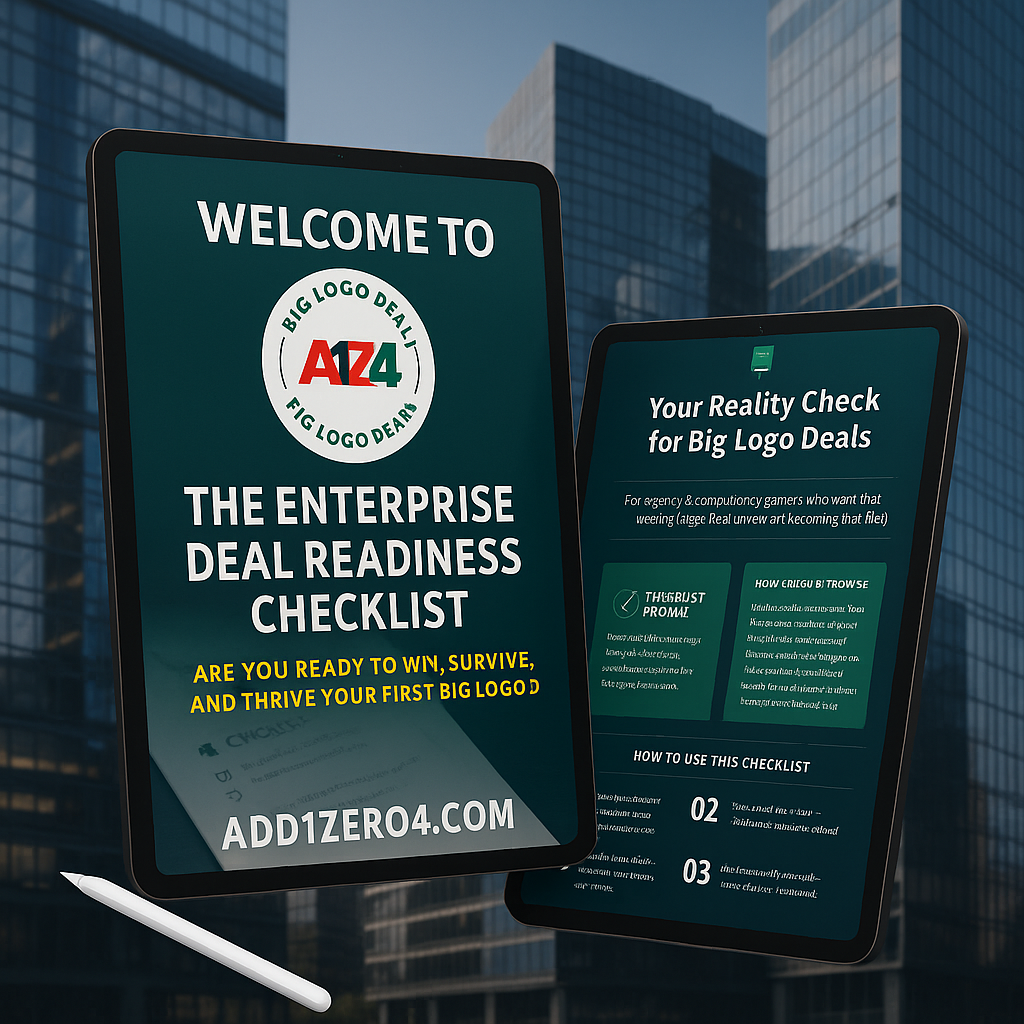
The Enterprise Deal Readiness Checklist
Skip the $100K+ learning curve. This insider’s checklist reveals if your B2B agency can win (and survive) Fortune 500 deals before you risk your stable revenue and best people chasing logos you’re not ready for.
The Pace of the Game: Timelines, Urgency, and Budget Cycles
The rhythm of business is drastically different when comparing SMBs and enterprises.
- SMB Sales: There’s often a palpable sense of urgency. The client has a problem, and they want it solved – yesterday. Your main competitor might be another agency, but just as often, it’s inertia. Getting them to “do something now” is key. Their budget is usually tied to the calendar year, and they can often find or reallocate funds if the ROI is clear.
- Enterprise Sales: Urgency? Often near zero. They move to their own rhythm, dictated by complex internal priorities and, crucially, budget cycles that are often not aligned with the standard calendar year. A company’s fiscal year might end in February, August, or some other seemingly random month. You could have a fantastic meeting in March, only to find out their budget for your type of service won’t even be discussed until Q4 for a potential start next year. Sales cycles are long – a true enterprise sales cycle marathon that can take months, sometimes even a year or more.
The Impact for Your Agency:
This is where “Calm Confidence” becomes your superpower. Pushing too hard will backfire. Instead, you need to master strategic follow-up. (Want to dive deeper into what that looks like? The Big Logo Deals podcast has some great insights on this). You’ll need to ask upfront about their fiscal year and budget submission deadlines. If you’re not prepared for their timeline, you’ll miss the window to even be considered. Patience isn’t just a virtue here; it’s a prerequisite.
Our Probably-Too-Honest Private Podcast
Find out what REALLY happens when agencies land enterprise deals (spoiler warning: one of them lost $100K)
Brought to you by Add1Zero4 and hosted by David “Ledge” Ledgerwood
The Rulebook: Processes, Expectations, and What They Really Want
How you operate and what clients expect shifts dramatically.
- SMB Sales: SMBs are often more flexible. They might appreciate you going the extra mile, throwing in a “favor,” and your well-honed service packages might be exactly what they need. Contracts are typically your paper, and procurement is usually straightforward.
- Enterprise Sales: Get ready for rigidity. Enterprises run on established, often labyrinthine, processes.
- Procurement is King: You’ll face extensive vendor approval processes, security audits (Is your data handling up to snuff? Using cloud services for email and storage makes this much easier), and insurance requirements that might seem over the top (you’ll need to negotiate these down to what’s reasonable for your service type).
- Their Paper, Their Rules: Forget your standard contract. 80% of the time, you’ll be signing their Master Services Agreement (MSA), a document that can be dozens of pages long and filled with dense legalese.
- No “Standard” Packages: Your beautifully crafted SMB packages? They’ll likely be rejected. Enterprises want bespoke solutions. They’ll ask you to “unbundle” your services and price out individual components, often in ways that don’t make sense to you.
- “Favors” Don’t Count: That extra work you did for an SMB client that built goodwill? In an enterprise, it’s just free work that gets forgotten or, worse, becomes an expectation. Scope creep needs to be managed formally.
The Impact for Your Agency:
Your entire operational model needs to be enterprise-ready. You’ll need to enterprise-proof your agency’s business model to handle these new demands. This means having your financial house in impeccable order, your processes documented, and your team trained to navigate these complexities. You’re not just delivering a service; you’re navigating a corporate machine. Every bit of “extra” work, every meeting, every report they demand (and they will demand them) needs to be factored into your pricing. Speaking of which…
The Scoreboard: What “Winning” Looks Like (and What It Costs)
The financial dynamics of SMB vs Enterprise sales are worlds apart.
- SMB Sales: Pricing can be more straightforward. You might have retainers, project fees, or value-based packages that are relatively easy to explain and sell. Payment terms are often favorable (Net 30 or even credit card on file), and ROI discussions, while important, might be simpler.
- Enterprise Sales:
- Pricing Power (and Pain): Remember the “twice the price for half the deliverables” guideline? It’s not about being greedy; it’s about covering the immense overhead, the endless meetings, the multiple revisions, and the sheer time it takes to manage an enterprise account. They’ll scrutinize every line item and expect you to justify your costs.
- Payment Purgatory: Kiss Net 30 goodbye for most big clients. Net 60, Net 90, or even longer terms are common. This means your Accounts Receivable (AR) becomes a critical function. You need enough cash on hand to float the costs of delivering work for months before you see a dime. A massive deal can literally bankrupt you if you’re not financially prepared to “finance” it.
- ROI is Everything (to Someone): Your direct contact might talk about “brand awareness,” but their boss, and their boss’s boss, are looking at hard ROI. You need to understand how your work ties back to their key performance indicators (KPIs) and be prepared to report on it meticulously.
The Impact for Your Agency:
Financial readiness is non-negotiable. Before you even think about pitching a “bet the company-sized deal,” you need crystal clarity on your cash flow, your Cost of Goods Sold (COGS) for enterprise-level delivery (which is different!), and your walk-away price. This isn’t just about a bigger paycheck; it’s about ensuring the paycheck doesn’t come at the cost of your company’s survival. Not sure if your agency is truly ready? The Enterprise Deal Readiness Checklist is an invaluable tool to assess your current state.
The Big Logo Deals Course
Created by experts who have closed over $50 million in revenue over the last decade who teach you everything they know about closing deals with the logos you wish were on your client list.
Your Game Plan: Adapting Your Agency for the Big Leagues
- Marketing & Positioning:
- Look Legit: Your website can’t look like an afterthought. It needs to project credibility and professionalism. Simple is fine, but shabby is a deal-breaker.
- Core Values: Re-think how you present your company culture. That “fun over work” vibe that attracts entrepreneurial talent might not resonate with a corporate buyer. It’s about presentation, not changing who you are.
- Lead Funnels: Aggressive, automated funnels can be a turn-off. Your B2B outbound marketing strategies should shift toward appointment-focused funnels that offer easy access for busy enterprise prospects.
- Sales Approach:
- Calm Confidence: Ditch the “thirsty” sales pitch. Enterprise buyers can smell desperation a mile away. Project an aura of calm confidence – you’re the expert, and you know your worth.
- Be an Advocate: Often, your first contact needs help selling your services internally. Position yourself as their partner in this process.
- Master the Calls: Understand the different types of calls you’ll encounter (from a “delegated shopper” intern to a full “leadership presentation”) and adapt your style accordingly. Learning from successful B2B sales examples can provide a roadmap.
- Operational Shifts:
- Sales Enablement: You need to rethink your B2B sales enablement and develop materials (not just fancy decks, but concise, data-driven pieces) that help your sales team demonstrate deep expertise during the sales process.
- Record & Share: Record your sales calls (with permission, of course!). These recordings are goldmines of information for your delivery team. Ensure knowledge is shared across teams.
- Process Resilience: Be prepared for all your existing SMB processes to break under enterprise pressure. Agility and strong internal communication are key.
Making the Leap: It’s a Transformation, Not Just a Transaction
Transitioning from SMB to enterprise sales is a significant undertaking. It’s more than just aiming for bigger clients; it’s about fundamentally re-engineering parts of your agency to meet a different set of demands and expectations. The learning curve can be steep, and the initial deals will test your patience, your finances, and your resolve.
But the rewards? They can be transformative. Landing that first big logo acts as a catalyst, opening doors to more enterprise clients with increasing ease. It builds social proof, deepens your team’s expertise, and can dramatically alter your agency’s growth trajectory and profitability.
Understanding the critical differences in SMB vs Enterprise sales is the essential first step. Armed with this knowledge, you can start building the mindset, the strategies, and the operational muscle to not just compete for, but win and thrive with, big logo clients.
Ready to stop dreaming about those big deals and start closing them? The Big Logo Deals course is designed to give agency owners like you the complete playbook – the mindset, tactics, and execution know-how – to navigate the enterprise landscape and secure those game-changing contracts. It’s time to add that zero (or two!) to your client roster.