
Ever find yourself staring at your agency’s client roster, proud of the great work you do for small and medium-sized businesses (SMBs), but with a nagging feeling? That itch? The one that whispers, “What if we could land a really big one? A household name? A ‘logo’ that makes prospects sit up and take notice?”
Big Logo Deals
Learn how to close your first big enterprise deal and drive massive business growth.
If you’re the founder of a B2B service agency – be it advertising, marketing, design, or development – you’re likely nodding. You’ve built a solid business, but the leap from servicing Main Street to conquering Enterprise Avenue feels like scaling Everest in flip-flops. The truth is, your current b2b sales experience, honed on SMBs, might be the very thing holding you back from those game-changing deals.
Working with giants like Meta, AWS, or Siemens isn’t just about bigger budgets; it’s an entirely different ball game. They operate under a different set of rules, speak a different language, and frankly, what works for a $5M company will get you laughed out of the room (or worse, ghosted) by a $5B behemoth.
So, how do you transform your agency’s b2b sales experience to not just survive, but thrive in the enterprise world? Let’s dive in.
The Enterprise Shift: More Than Just Bigger Deals
First, let’s be brutally honest. Enterprise clients are not just SMBs with more zeros on their checks. Their world is complex, layered, and often, maddeningly slow.
- Decision-Making is a Constellation, Not a Straight Line: Remember how you usually talk to the owner or a single decision-maker at an SMB? Forget that. Enterprise deals often involve 8-10 (or more!) stakeholders, many of whom appear and disappear throughout the sales cycle. Budget cycles are rigid, urgency is often near-zero, and getting everyone aligned can feel like herding cats… in a hurricane.
- Expectations are Sky-High: These companies are paying top dollar, and they expect flawless execution, meticulous communication, and proactive project management. Errors or missed deadlines aren’t just frowned upon; they can be deal-breakers. Their contracts are often merciless, requiring you to fix issues on your own dime.
- They Expect You to Know Their World: They won’t have time to educate you on their industry’s nuances or their company’s internal politics. They expect you to show up having done your homework, understanding their challenges, and speaking their language.
If this sounds daunting, it is. But it’s also where the biggest opportunities lie. The agencies that crack this code don’t just win bigger deals; they build more resilient, profitable businesses.
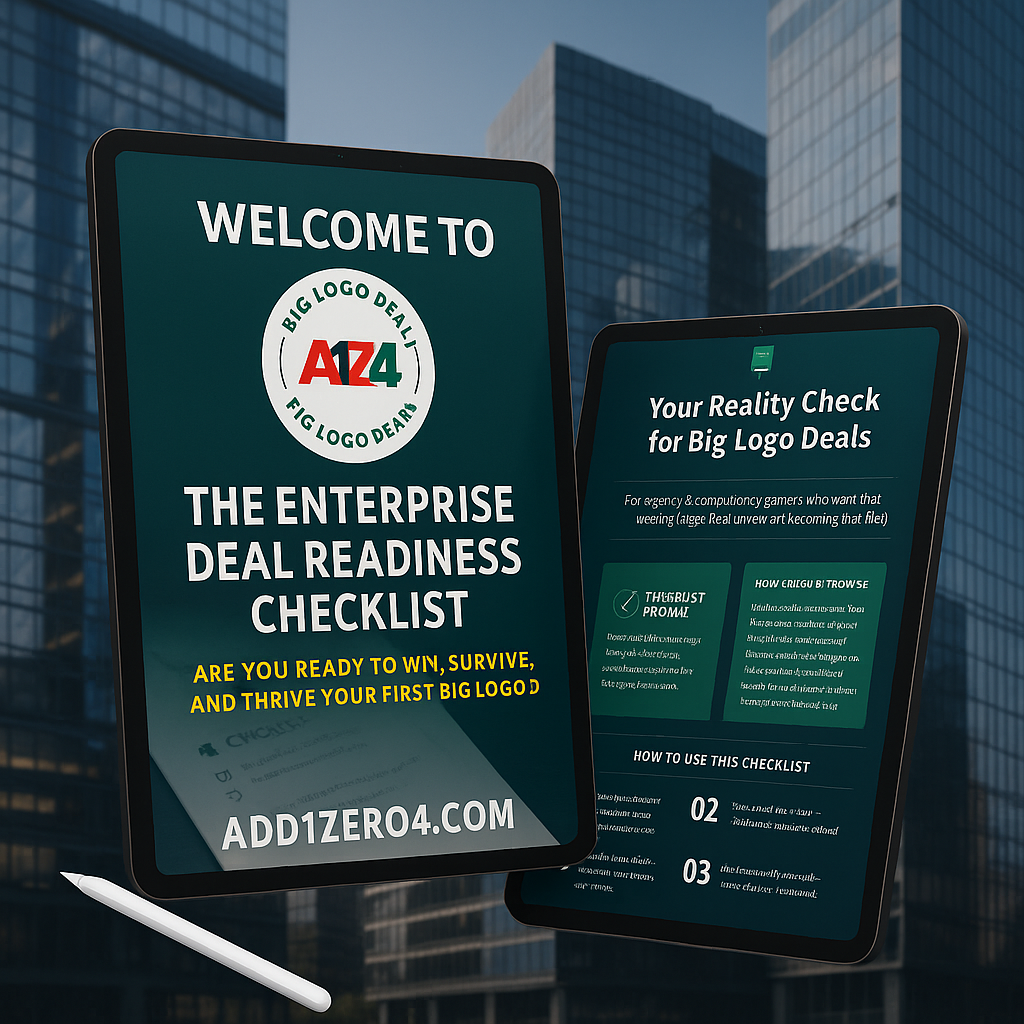
The Enterprise Deal Readiness Checklist
Skip the $100K+ learning curve. This insider’s checklist reveals if your B2B agency can win (and survive) Fortune 500 deals before you risk your stable revenue and best people chasing logos you’re not ready for.
Mindset & Approach: The “Calm Confidence” Factor
So, you’ve got a lead from a massive company. Your adrenaline is pumping. Your first instinct might be to bend over backward, promise the moon, and generally act like an overeager puppy.
Resist.
The enterprise game demands a different kind of energy: Calm Confidence. It’s not swagger; it’s a deep-seated belief in your value, an understanding of your worth, and the quiet assurance that you don’t need this one deal to survive. They can smell desperation, and it’s a major turn-off.
- Look Legit: Your online presence is your first impression. That website you haven’t updated because “all your business comes from referrals”? Enterprise prospects Google you. If your site looks shabby or amateurish, they’ll click away before you can say “proposal.” Simple is fine, but it must look professional and credible. Wondering if your agency passes the enterprise sniff test? Our Enterprise Deal Readiness Checklist is a great place to start a quick self-audit.
- Master the Call (All 5 Types of Them): Not all calls are created equal. You might be talking to a “Delegated Shopper” (an intern filling a spreadsheet), an “Unfunded Mandate” (a frazzled mid-level manager with a problem but no budget), or, if you’re lucky, a “Mid-Level Owner” who actually has some clout. Your approach needs to adapt. And when they ask, “What makes you different?” – “we care more” isn’t going to cut it. You need a real, unique value proposition.
- Become Their Advocate: Often, your initial contact isn’t the ultimate decision-maker. They’re an internal champion who needs to sell you up the chain. Don’t just send them a proposal and hope for the best. Offer to help them make the internal case. Make them look good to their boss.
This “Calm Confidence” isn’t about feigning indifference to the prospect; it’s about being indifferent to whether or not the deal closes in your favor. Your job is to provide value and insight. When you project that, you earn respect and, more importantly, trust.
Financial Fortitude: Are You Ready to Play Ball?
Landing a six-figure or seven-figure deal is exhilarating. Until you realize it could bankrupt you. This sounds dramatic, but it’s a harsh reality many agencies face when they’re not financially prepared for the enterprise leagues.
- Cash is King (and Queen, and the Entire Royal Court): Enterprise clients often have Net 60, Net 90, or even longer payment terms. That means you could be delivering work (and paying your team) for months before you see a dime. A good rule of thumb: assume you’ll need to float at least half the total contract value for six months. If you don’t have that cash on hand or a solid line of credit, that dream deal can quickly become a nightmare.
- COGS – Know It, Live It, Breathe It: You’ve probably estimated Cost of Goods Sold for your SMB work. For enterprise deals, “kinda-sorta-gut-check” won’t cut it. You need meticulous COGS calculations. Enterprise clients will often want to unbundle your packages and scrutinize line items. If you don’t know your true costs (including your own time and overhead!), you’ll underprice and kill your margins. Aim for a gross margin of at least 40%, ideally much higher.
- Metrics That Matter (to Them): Enterprise clients are hyper-focused on ROI. While your direct contact might talk about “brand awareness,” their boss (the one signing the checks) cares about hard numbers. Understand their KPIs, benchmark before you start, and be prepared to demonstrate tangible value. This isn’t just about keeping them happy; it’s about securing renewals and upsells.
If you’re looking at your books and thinking, “If we don’t land this massive deal, we’re screwed,” then you’re already in trouble. “Do or die” means you’re already dead in the enterprise world.
Our Probably-Too-Honest Private Podcast
Find out what REALLY happens when agencies land enterprise deals (spoiler warning: one of them lost $100K)
Brought to you by Add1Zero4 and hosted by David “Ledge” Ledgerwood
Operational Overhaul: Gearing Up for the Big Leagues
Your current team and processes are likely well-oiled machines for SMB clients. That’s great! Now, prepare for enterprise clients to throw a giant monkey wrench into all of it.
- Expect Your Processes to Break: What got you here won’t get you there. Enterprise clients often don’t want your standard packages. They want bespoke solutions, and they’ll have unique communication, reporting, and approval demands that will stretch your existing systems to their breaking point (and beyond). Be prepared to build new, more robust processes specifically for them.
- Dedicated Attention is Non-Negotiable: No enterprise client wants to feel like they’re sharing their account manager with ten other companies. Assume key team members will be at least 50% consumed by a new enterprise account. Do you have the bandwidth? What if someone gets sick, or an existing SMB client has an emergency? You might need to hire or bring in specialized contractors with enterprise experience.
- Sales Enablement Isn’t Just for Salespeople: The deep research your sales team does shouldn’t live in a silo. Share it! Your delivery team needs that context. Record your sales calls (with permission, of course!) and make them available. Tools like Fathom for Zoom can be invaluable for this. Build a library of case studies, testimonials, and ROI data that your entire team can leverage.
- Customer Success Takes on New Meaning: When you land that first big logo, your existing SMB clients will feel it if you’re not careful. Be transparent. Tell them you’ve landed a major client and you’re committed to ensuring their service doesn’t slip. Give them a clear escalation path (a “Bat Phone” to you directly if needed).
Remember, delivering for an enterprise isn’t just about doing the work; it’s about managing a complex relationship with exacting standards.
Pricing & Packaging: Value, Not Just Volume
That beautifully designed, standardized package that works so well for your SMB clients? Enterprise buyers will likely want to dissect it, customize it, and question every component.
- “Twice the Price, Half the Deliverables”: This is a solid starting point when thinking about enterprise pricing. Why? Because the overhead is immense. You’ll spend countless hours in meetings, preparing reports, and navigating internal bureaucracy – time you can’t bill for directly. So, if your SMB retainer is $5K/month, your enterprise equivalent for roughly half the core deliverables might start at $10K/month.
- No “Freebies”: Doing a “favor” for an SMB client often builds goodwill that pays off later. With large companies, free work usually just sets an expectation for more free work. The person you did the favor for might not even be the one who can reciprocate. If you do offer something extra, document it clearly as a one-time concession and state its actual value.
- Flexible Payment Cadences: Kiss goodbye to easy monthly credit card payments. Enterprise clients have their own payment structures: milestone billing, upfront payments (rare, but ask!), post-delivery, or even proof-of-delivery. Understand their system, negotiate terms that protect your cash flow (e.g., push for shorter Net terms, or a percentage upfront if terms are long), and be prepared to walk away if their terms are untenable.
Your proposal process also needs an upgrade. Ditch the flashy, 50-page pitch decks. Enterprise clients want clear, concise business documents that get straight to the point: what you’ll do, how it benefits them, and what it costs. Google Docs can be surprisingly effective.
The Big Logo Deals Course
Created by experts who have closed over $50 million in revenue over the last decade who teach you everything they know about closing deals with the logos you wish were on your client list.
Navigating the Labyrinth: Legal & Procurement
Welcome to the thrilling world of MSAs (Master Service Agreements), NDAs (Non-Disclosure Agreements), supplier portals, and security audits. This is where patience and attention to detail are paramount.
- Legal Counsel is Your Friend (But Use Them Wisely): If you’ve never had an attorney review your standard client contract, do it now. For enterprise deals, you’ll almost always be signing their paper. It will be long, dense, and full of legalese. A good lawyer can help you understand the real risks, not just redline every clause (which enterprises rarely accept). Learn what actually matters (like publicity clauses allowing you to use their logo, or IP ownership) and what’s just boilerplate.
- NDAs: Mostly Harmless, But Watch for Pitfalls: Most enterprise NDAs are standard. Check the duration (2-3 years is typical) and ensure it’s mutual. The big red flags? Non-competes that could hamstring your ability to work with other clients in their industry, or exclusivity clauses. Don’t sign those unless the compensation is astronomical.
- Procurement: The Paperwork Black Hole: Be prepared for endless forms, security questionnaires, and clunky supplier portals. Keep meticulous records of everything. This is frictional, non-billable work, so factor it into your overhead.
The Long Game: Patience & Timing in Enterprise Sales
If you’re used to SMB sales cycles of a few weeks or a couple of months, buckle up. Enterprise sales are a marathon, not a sprint.
- “Hurry Up and Wait”: This is the unofficial motto of enterprise sales. You’ll have flurries of activity, then… crickets for weeks, or months. Priorities shift, budgets get reallocated, key contacts go on vacation or leave the company. Polite persistence is key.
- A Verbal “Yes” Means… Almost Nothing: That enthusiastic manager who said, “This is great, let’s do it!”? Fantastic. But it’s not a closed deal. Not until contracts are signed, POs are issued, and you’re through procurement. Don’t break out the champagne (or tell your whole team) based on a verbal. It’s heartbreaking when it falls through.
- Follow-Up with Value: Don’t just “check in.” Provide relevant insights, share useful articles, or offer a new perspective. Connect on LinkedIn. And if you’ve got their mobile (ask for it!), a polite, well-timed text can sometimes cut through the noise. For more insights on navigating these long cycles, and to hear from others who’ve successfully landed big deals, check out the Big Logo Deals podcast. It’s a great resource for keeping your motivation high.
Eventually, you’ll learn when to keep pushing and when to let a deal go. Not all of them will close, and that’s okay if you have a healthy pipeline.
Your Agency’s Next Chapter: Enterprise Success
Transitioning your agency to successfully serve enterprise clients is a profound shift in your b2b sales experience and your entire operational model. It demands a new level of professionalism, financial astuteness, operational rigor, and unwavering patience. It’s not easy, but the rewards – transformative revenue, higher margins, and the prestige of working with industry leaders – are immense.
Ready to stop dreaming about those big logo deals and start strategically pursuing and winning them? If you’re tired of guessing and want a proven roadmap based on decades of experience closing multi-million dollar deals with companies like Meta, AWS, General Dynamics, and Siemens, then it’s time to level up.
The Big Logo Deals course is designed specifically for B2B service agency owners like you, providing the mindset, tactics, and execution framework necessary to close your first – and next – major enterprise client.
Stop leaving big money on the table. It’s time to add that zero to your revenue.