
You’re an agency owner, and you’ve mastered the art of serving small to medium-sized businesses (SMBs). Your team is a well-oiled machine, referrals are flowing, and clients love you. But then there’s that other league: the enterprise clients. The household names, the “big logos.” They represent a whole new level of revenue, stability, and prestige. The problem? Landing them feels like trying to decipher an alien language. Their enterprise sales process steps are a world away from the SMB game you know.
Big Logo Deals
Learn how to close your first big enterprise deal and drive massive business growth.
If you’ve ever felt that your agency is ready for bigger challenges but find yourself scratching your head when a giant corporation shows interest, you’re not alone. These behemoths operate differently, think differently, and buy differently. Cracking their code is the key to unlocking massive growth. And it often starts with understanding that their world requires a completely different playbook than you’re used to. If you’re serious about making this leap, programs like the Big Logo Deals course are designed to demystify this exact journey.
So, let’s break down the enterprise sales process steps from your perspective as a B2B services agency owner, and explore how you can navigate this lucrative but complex landscape.
Step 1: The Mindset Shift – You’re Not in Kansas Anymore
Before you even think about your first enterprise sales call, a fundamental shift in mindset is required. This isn’t just “SMB sales but bigger.” It’s a different beast entirely.
Embrace “Calm Confidence”
Ever heard the term “sales breath”? That reek of desperation when you really want the deal? Enterprise buyers can smell it a mile away, and it’s a turn-off. Instead, cultivate what we call “Calm Confidence.” It’s the vibe that says, “It makes no difference to my life if you buy this. It might make a difference to yours if you don’t.” Of course, you care about landing the deal – it’s your revenue! But this mindset isn’t about actual indifference; it’s about projecting an assuredness that you’re the best solution, and the prospect needs to arrive at that understanding themselves. You’re there to help, to provide value, not to push. This isn’t swagger; it’s a quiet, firm belief in your agency’s capabilities.
“Looking Legit” is Non-Negotiable
When an enterprise prospect gets a whiff of your agency, what’s the first thing they’ll do? Google you. Your website, your LinkedIn presence – these are your digital front doors. If they look dated, unprofessional, or like you’re still figuring things out, that corporate buyer will click away faster than you can say “procurement.” Simple and clean is fine, but it must pass the sniff test. They’re considering investing significant sums; they need to believe you can deliver at an enterprise level.
Even your lead funnels need an upgrade. That high-pressure, automated, long-form sales page funnel that works for some SMBs? It’s likely to get an eye-roll from a corporate buyer. They expect accessibility on their terms. Consider an “Appointment-Focused Funnel,” where your homepage’s primary goal is to get qualified leads to book a meeting.
A Quick Word on Core Values
Many agencies, born from an entrepreneurial spirit, rightly champion values like “fun over work” or “family first.” These are fantastic for culture. However, be mindful of how these are presented externally when targeting enterprises. They might not share these overt work-life balance values, or at least, they don’t broadcast them. It’s fine to live by these values internally, but plastering “we value fun more than work” on your ‘About Us’ page might not resonate with a corporate buyer under pressure.
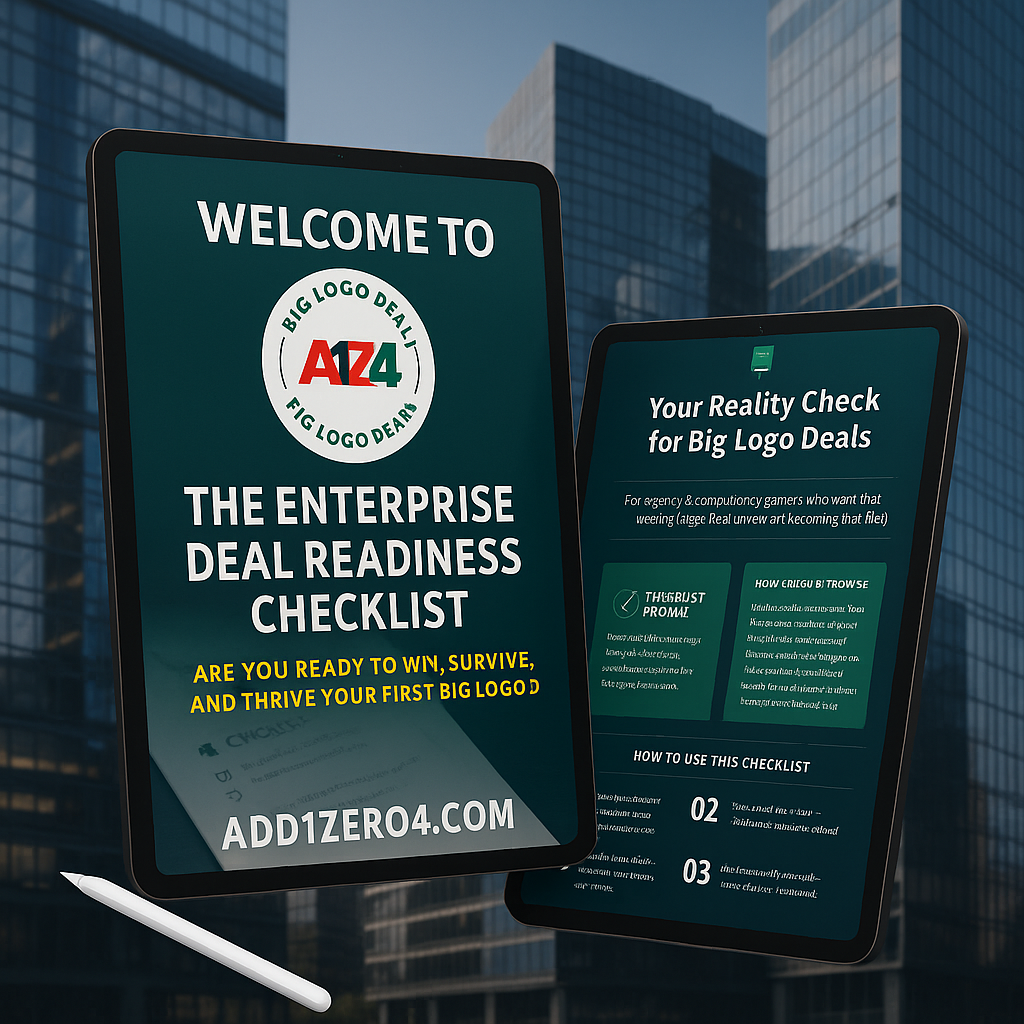
The Enterprise Deal Readiness Checklist
Skip the $100K+ learning curve. This insider’s checklist reveals if your B2B agency can win (and survive) Fortune 500 deals before you risk your stable revenue and best people chasing logos you’re not ready for.
Step 2: Identifying the Players – Who’s Who in the Enterprise Zoo?
In SMB deals, you’re often talking to one or two decision-makers. In the enterprise world, welcome to the “constellation.” You could be dealing with 8-10 (or more!) stakeholders, many of whom appear and disappear throughout the sales cycle.
You’ll encounter various personas:
- The Delegated Shopper: Often an entry-level employee or intern tasked with “researching firms who do X.” They’ll have a checklist and are trying to make an apples-to-apples comparison for their boss.
- The Unfunded Mandate: A frazzled mid-level team member told to “get this done” with a vague outline and no clear budget. They’re excited by solutions but have little power. Your goal is to become their advocate and get to their leadership.
- The Mid-Level Owner: Likely has some budget and a clearer understanding. They’re a good starting point but will almost always need to pitch your services upwards.
- The Chemistry Call Contact: Some enterprises start with a “chemistry call” to see if you’re a cultural and project fit before letting you into more advanced discussions.
- The Leadership Presentation Audience: This is when you finally get all the “right people” in the room. Be prepared to restate everything, as many won’t have read your proposal, even if they say they did.
Understanding who holds the budget, who influences decisions, and who is simply gathering information is critical. It’s rarely a straight line. For deeper insights into navigating these complex stakeholder maps, resources like the Big Logo Deals podcast offer continuous learning.
Step 3: Crafting Your Approach – Speaking Their Language, Not Yours
The tactics that won you SMB clients often need a serious overhaul for the enterprise stage.
Ditch the Standard SMB Packages (Mostly)
You’ve likely spent years refining your service packages for SMBs. That’s smart for scaling. But enterprise clients? They often don’t want your standard package. They want to feel like the solution is tailored specifically to their massive, unique needs. Be prepared to “unbundle” your services and customize. This can feel like throwing out your well-honed playbook, but it’s often necessary.
A good starting point when ballparking for an enterprise client, especially if you’re used to SMB pricing, can be: “twice the price for half the deliverables.” Why? Because the overhead of managing an enterprise account – the meetings, the reporting, the sheer attention required – is significantly higher.
Focus on ROI That Their Bosses Care About
Your direct contact might talk about “brand awareness” or “thought leadership.” But you can bet their boss, and their boss’s boss, are looking at harder metrics, usually tied to revenue or significant cost savings. Understand how your direct contacts are measured and what their leadership truly values. You need to help them build the business case for your services in terms their organization understands.
Sales Enablement: Beyond the Pitch Deck
Sales enablement isn’t just a fancy pitch deck. It’s about having a library of “middle-of-funnel” content – case studies (even anonymized if necessary), process flowcharts, short videos explaining unique methodologies – that your sales team can deploy 1:1 to demonstrate expertise and ROI. These materials are more detailed than your top-of-funnel marketing and are crucial for substantiating your claims during sales conversations. Keep them simple, easy to consume, and focused on numbers and results.
Proposals: Keep it Simple, Get to the Point
Many agencies create beautifully designed, lengthy proposals. Here’s a radical thought: by the time you send a proposal, the “selling” should largely be done. We’re big fans of simple proposals, often created in Google Docs, that get straight to the point. Guess what corporate buyers scroll to first? The pricing. Don’t make them hunt for it. An effective proposal is a business document for closing, not another marketing piece.
Our Probably-Too-Honest Private Podcast
Find out what REALLY happens when agencies land enterprise deals (spoiler warning: one of them lost $100K)
Brought to you by Add1Zero4 and hosted by David “Ledge” Ledgerwood
Step 4: The Financial Reality Check – Can You Afford to Win?
This is where many aspiring agencies stumble. Landing a big logo is exhilarating, but it can also be financially ruinous if you’re not prepared.
Big Deals Can Sink Small Ships
Enterprise clients often have exacting standards, demand more communication, and come with inevitable scope creep. More critically, their payment terms can be brutal. Net 30 is a dream; Net 60, Net 90, or even longer after delivery is common. This means you are effectively financing the deal. You’ll be paying your team and covering expenses long before that big check arrives.
Cash Flow is King (and Queen, and the Entire Royal Court)
A stark rule of thumb: look at what you plan to charge an enterprise client for the first six months. If you don’t have at least half that amount in unallocated cash before the deal starts, you’re putting your business at serious risk. This is the minimum “self-insurance” you need. Any deal that feels “do or die” for your agency means you’re likely already in over your head. Understanding your Cost of Goods Sold (COGS) for these larger, more complex projects is also paramount. You can’t price effectively if you don’t know your true costs.
Are you truly ready for the financial implications of an enterprise deal? The Enterprise Deal Readiness Checklist is an invaluable tool to help you assess this critical aspect.
Step 5: The Legal & Procurement Maze – Alphabet Soup and Hoops to Jump Through
Once you’ve navigated the initial sales conversations and financial assessments, get ready for the administrative marathon: legal and procurement.
MSAs, SOWs, POs – Get Used to the Acronyms
Large companies live by their paperwork. You’ll likely encounter:
- Master Services Agreements (MSAs): These are their standard, often lengthy, legal contracts. You’re unlikely to get major changes, but you might be able to redline critical items.
- Statements of Work (SOWs): These detail the specific services, deliverables, timelines, and pricing for each project.
- Purchase Orders (POs): Often, you can’t even invoice without a PO number.
- Supplier Portals: Get ready to learn a variety of (often clunky) online systems to submit documents, track invoices, and manage your vendor profile. SAP Ariba, Coupa, Oracle Procurement Cloud – these are just a few.
NDAs: Mostly Harmless, But Read the Fine Print
Non-Disclosure Agreements (NDAs) are standard. For the most part, they’re about protecting their confidential information, and they’re a cost of doing business. Check the duration (2-3 years is typical) and ensure it’s mutual if possible. The big red flag? Non-compete clauses or overly broad exclusivity terms that could hamstring your ability to work with other clients in their industry. Don’t sign those away lightly.
Insurance: They’ll Ask for the Moon
Enterprise contracts will have insurance requirements. Often, these are boilerplate and may include coverage types your agency doesn’t need (like extensive cyber liability if you’re not handling PII, or auto liability if you’re fully remote) and in amounts that are far too high for your business size. This is an area to push back on. Get the types and amounts adjusted to what’s reasonable and relevant for the services you provide.
The Big Logo Deals Course
Created by experts who have closed over $50 million in revenue over the last decade who teach you everything they know about closing deals with the logos you wish were on your client list.
Step 6: The Long Game – Patience, Follow-Up, and Defining “Closed”
If you’re used to quick SMB sales cycles, buckle up. The enterprise world moves at its own pace.
The “Hurry Up and Wait” Reality
Enterprise sales cycles are marathons, not sprints. Decisions involve multiple layers of approval, budget cycles, and shifting internal priorities. A prospect might go dark for months, not because they’re not interested, but because your project isn’t their only (or even top) priority. Polite persistence is key. Follow up, add value, but don’t be a pest. This is where your “Calm Confidence” truly shines.
Ledge, our founder, learned this the hard way. Early in his career, he got a verbal “yes” on a $40,000 scope from a VP at a huge firm. He bought champagne for the team, only to receive an email a month later: “Sorry. Unable to get approval on this spend.” The lesson: a verbal commitment, especially in the enterprise world, means very little until the ink is dry (or the PO is issued).
When is a Deal Really Closed?
For SMBs, it’s usually a signed agreement and payment info. For enterprises, it’s trickier. We generally consider a deal “closed-won” once agreements are signed and/or a PO is issued, and you know you can actually bill for the work. Even then, things can get stuck in procurement. Don’t start substantive work (and certainly don’t celebrate with the team) based on a verbal “yes.” Loose lips sink ships, and celebrating prematurely can be incredibly demoralizing if the deal falls through.
Step 7: Delivering the Dream (and Surviving It)
Congratulations, you’ve landed the big logo! Now the real work begins: delivering on your promises and ensuring this becomes a launchpad, not a landmine.
Enterprise Delivery: Higher Stakes, Higher Expectations
Your well-oiled SMB delivery processes might crack under the strain of an enterprise client. They expect more detailed progress tracking, more sophisticated reporting, and more proactive communication. Assume your existing processes will need adapting, if not a complete overhaul, for this new class of client.
Scope Creep: It’s Not a Matter of If, But When
Enterprise clients, often without ill intent, will ask for more. Your “very helpful” team, accustomed to going the extra mile for appreciative SMBs, might inadvertently give away free services. With enterprises, “free work” often just becomes the new baseline expectation, without any corresponding goodwill or future benefit. Train your team on the signed scope, how to identify scope creep, and how to artfully escalate requests for additional work (which should become new SOWs and revenue opportunities).
Your Existing Clients Will Feel It
Your best people are likely already busy serving your existing SMB clients who pay the bills. When a big logo lands, those same top performers will be stretched thin. Be proactive. Communicate with your SMB clients. Let them know you’ve landed a major account and while you’re scaling, you’re committed to maintaining their service levels. Give them a clear escalation path (a “Bat Phone”) if they feel anything is slipping. Transparency and honesty go a long way.
Ready to Stop Guessing and Start Closing Big Logos?
Navigating the enterprise sales process is a journey, not a destination. It requires a shift in mindset, a new set of skills, and a deep understanding of how these large organizations operate. It’s challenging, yes, but the rewards – in terms of revenue, stability, and the sheer thrill of working with iconic brands – can be transformative for your agency.
If you’re ready to move beyond the SMB world and systematically target and win enterprise clients, you don’t have to figure it all out through painful trial and error. The Big Logo Deals course provides the specific mindset, tactics, and execution framework to help your B2B services agency confidently close and thrive with your first, and subsequent, big enterprise logos. Stop dreaming about those big deals and start making them a reality.