
You’ve built a killer B2B services agency. You’re a rockstar with SMBs, turning out great work and getting fantastic results. Your team is humming, and clients love you. But there’s that itch, isn’t there? That little voice whispering about bigger challenges, bigger impact… and let’s be honest, bigger paychecks. You’re eyeing those “big logo” clients, the enterprise behemoths whose names alone can transform your agency’s reputation and revenue.
Big Logo Deals
Learn how to close your first big enterprise deal and drive massive business growth.
But here’s the rub: cracking the enterprise sales process is a whole different ball game. It’s not just a scaled-up version of what you do for small businesses; it’s a complete evolution from SMB whisperer to enterprise titan. Enterprise clients operate in a different universe, with their own languages, rituals, and a cast of characters that can make your head spin. Many agencies, brilliant with SMBs, stumble hard when they try to make the leap because they lack the insider knowledge of how these giants really work.
If you’re ready to stop wondering and start winning those coveted enterprise deals, you’re in the right place. Let’s pull back the curtain on what it actually takes.
The Enterprise Shift: It’s More Than Just Size
The first hurdle in the enterprise sales process is a mental one, and truly understanding the shift from SMB to enterprise sales is foundational to your success. You need to understand that “bigger” doesn’t just mean more employees or revenue; it means more complexity, more stakeholders, and often, way less urgency than you’re used to.
Think about your typical SMB deal. You might talk to the owner, maybe a marketing manager. Decisions are relatively quick. With enterprise, you could be dealing with 8-10 (or more!) stakeholders, many of whom appear and disappear throughout the sales cycle. You’re not just selling your service; you’re navigating a complex internal web of influence, budget cycles, and departmental priorities.
The “Why Us?” Question Gets Magnified:
SMBs often look for agility and a personal touch. Enterprises look for stability, proven processes (even if they want you to customize everything for them), and iron-clad risk mitigation. Your “we’re nimble and creative” pitch needs a serious upgrade to “we’re a reliable partner who understands enterprise-level demands and can deliver consistently.”
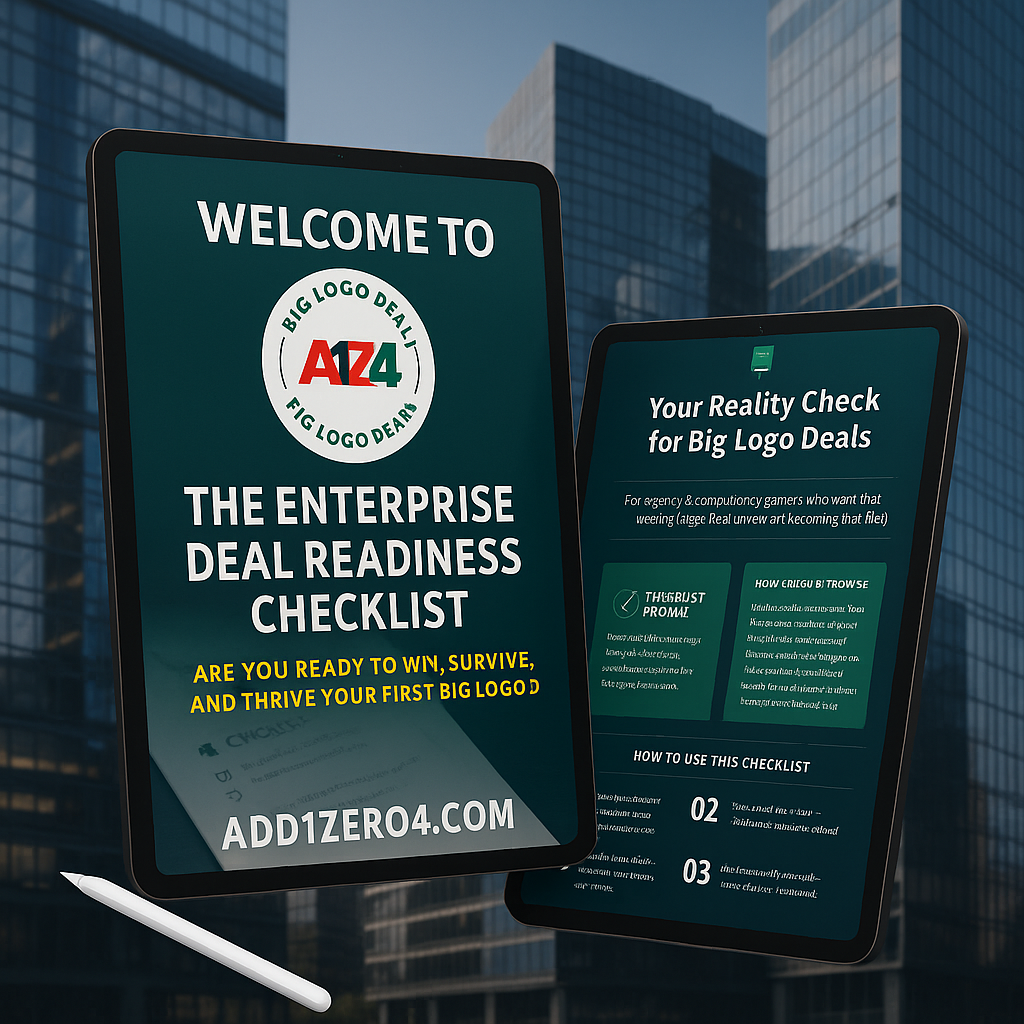
The Enterprise Deal Readiness Checklist
Skip the $100K+ learning curve. This insider’s checklist reveals if your B2B agency can win (and survive) Fortune 500 deals before you risk your stable revenue and best people chasing logos you’re not ready for.
Looking Legit: Your First Impression with the Big Leagues
Before you even get a sniff of an enterprise deal, they’ll be checking you out. And trust me, their standards are different.
Your Website & Marketing: That website that works fine for referrals? It might scream “too small” to an enterprise buyer. They’re looking for polish, professionalism, and an image that says you can handle their scale. Simple is okay, but “shabby” or “outdated” is a deal-killer. They need to believe you can deliver on a six or seven-figure contract, and your online presence is often their first smell test.
Core Values – A Subtle Tweak: Many agency founders, myself included, started businesses because the corporate world wasn’t our vibe. Our core values might shout “fun over work” or “family first.” That’s awesome for your internal culture. But be mindful of how that plays to an enterprise client whose internal culture might be… well, more corporate. It’s not about changing who you are, but about presenting the face that resonates with their world.
Lead Funnels for Enterprise: If your funnel is all aggressive direct response and long-form sales pages, expect an eye-roll and a quick browser close from an enterprise prospect. They expect to be able to reach you on their terms. Consider an appointment-focused funnel. Make it easy for them to connect, perhaps even offering a more direct contact path for inquiries from larger organizations. Yes, you might get some spam, but the potential upside is worth it.
Want to make sure your agency is putting its best foot forward? Our Enterprise Deal Readiness Checklist can help you spot areas for improvement.
Navigating the Labyrinth: Stakeholders, Budgets, and Bureaucracy
Welcome to the world of “constellation decision-making.” In the enterprise sales process, it’s rarely one person calling the shots, which makes understanding who’s who in the buying committee absolutely essential.
The Cast of Characters:
You’ll encounter various personas:
- The Delegated Shopper: Often an entry-level employee tasked with filling a spreadsheet comparing vendors. Give them what they need, but know it’s a long road.
- The Unfunded Mandate: A frazzled mid-level person given a vague task who stumbles upon you. They’re excited but have no real power. Your job is to make them your advocate to get to their leadership.
- The Mid-Level Owner: Has some budget, “gets it,” but still needs to pitch you upwards. This is often fertile ground.
- The Chemistry Call: A screening to see if you’re a cultural and project fit before they let you into deeper conversations.
- The Leadership Presentation: Your shot with (hopefully) all the “right people.” Be prepared to re-explain everything.
Understanding who you’re talking to and what their motivations are is critical. What does a “win” look like for them within their organization?
Budget Cycles & Approvals:
Forget the standard calendar year fiscal cycle you see with most SMBs. Enterprises often have bizarre fiscal years (ending in February, August, you name it). Ask about their budget cycle. When are budgets submitted for the next quarter or half? If you can get in ahead of their planning, you’re golden.
And approvals? One manager might greenlight $50k on a corporate Amex without blinking, while another company needs procurement, legal, and a papal blessing to approve a paperclip. Ask! You might find your prospect can start a small initial engagement (like a $5k discovery) on their card while the larger contract navigates the internal maze. This keeps momentum and cements the relationship.
The Art of the Enterprise Deal: It’s Not Priced Like Your SMB Gig
This is where many agencies get it spectacularly wrong. You cannot simply take your SMB pricing and add a zero.
“Twice the Price, Half the Deliverables”: This is a good starting point. Why?
- Overhead, Overhead, Overhead: Enterprise clients demand a lot of attention. More meetings, more reports, more hand-holding. Your price needs to bake in this significant, often unbillable, time. I once had a client ask us to convert a 65-slide presentation into a Word document just because their leadership preferred it. That’s the kind of “frictional cost” you need to account for.
- They Don’t Want Your “Package”: That beautifully standardized package you perfected for SMBs? Enterprise clients will want it unbundled, customized, and reconfigured. They want to feel it’s tailored specifically for them. If you don’t know your COGS for each component, you can easily underprice and destroy your margin.
Proposals – Simple is King:
Forget the flashy, 50-page pitch decks. By the time you’re sending a proposal, they should already be sold on why you. Mastering the anatomy of a winning enterprise proposal means focusing on clarity, deliverables, and the part they really care about: the cost. We’ve had huge success with simple Google Docs that prospects can comment on directly. Be prepared to convert it to Word for their redlining, though.
Deal-Making Levers (Beyond Discounting):
A savvy enterprise buyer will always ask for a discount. Don’t just cave. If you give on price, get something in return:
- Payment Timing: Can they pay upfront for a discount? Shorter net terms?
- Length of Commitment: A longer contract in exchange for a better rate?
- Removing Onerous Clauses: Reduced insurance requirements? A guaranteed video testimonial?
- Introductions: Willingness to introduce you to other groups within their firm?
Remember “Calm Confidence.” You’re not desperate. You know your value and your walk-away numbers. We once told a $135B company we couldn’t do Net 90 after delivery. We negotiated 40% upfront. Know your limits and be prepared to use them.
Our Probably-Too-Honest Private Podcast
Find out what REALLY happens when agencies land enterprise deals (spoiler warning: one of them lost $100K)
Brought to you by Add1Zero4 and hosted by David “Ledge” Ledgerwood
Financial Fortitude: Cash Flow is King in the Enterprise Game
This is critical. You must enterprise-proof your agency’s business model, because landing a massive deal can bankrupt you faster than no deals at all if you’re not financially prepared.
The Cash Flow Crunch:
Enterprise clients often have long payment terms (Net 60, Net 90, or worse). You’ll be paying your team and covering expenses long before their check clears.
- Rule of Thumb: Before you start a big enterprise deal, have at least half of the first six months’ contract value in unallocated cash. This is your self-insurance.
- COGS Clarity: You must understand your Cost of Goods Sold. Not the gut-check version, but the real, hard numbers, including your own time if you’re involved in delivery. Enterprise clients will often ask you to break down services into component parts. If you don’t know your COGS for each, you’ll underprice.
- “Do or Die” Means You’re Already Dead: If you’re ever thinking, “If we don’t land/deliver this, we’re screwed,” it’s too late. You need a buffer. Cracks in your finances will shatter under enterprise pressure.
Accounts Receivable (AR) – Your New Best Friend:
Getting paid is on YOU. Don’t abdicate this.
- Invoice immediately. Net terms start when the invoice is received.
- Be prepared to chase payments. Politely, persistently.
- Understand their payment process upfront. Is it a portal? ACH? Carrier pigeon? Each company is different, and your project sponsor probably has no clue how their own finance department works.
Drowning in the details of enterprise finance? The Big Logo Deals podcast often dives into these real-world agency challenges.
Operational Overhaul: Your Team and Systems on Steroids
What got you here (SMB success) won’t get you there (enterprise success) operationally.
Showing Up as THE Expert:
Enterprise clients expect you to walk in already knowing a lot about their business, their industry, and their challenges. Your standard SMB discovery questionnaire won’t cut it.
- Do Your Homework: Read everything – press, industry trends, their social media, annual reports.
- Record Your Calls: Sales calls with enterprise clients are goldmines of information. Use tools (like Fathom with Zoom) to record and annotate. This isn’t just for sales; it’s crucial for the delivery team.
- Prepare Your Team for Delivery: The sales team’s research needs to be shared. Your delivery team needs to sound as polished and informed as your sales lead.
Sales Enablement – Beyond the Blog Post:
This is your “middle of funnel” content – case studies (get to the numbers!), detailed process flows, ROI calculators. Think modular pieces you can pull up on a call or link in a follow-up email, not a giant, unwieldy “sales deck.” Keep it simple, easy to consume, and focused on tangible results.
Enterprise vs. SMB Customer Standards:
- Communication: Expect slower movement, then sudden urgency. Communicate early, often, and reconfirm everything. Navigate multiple stakeholders with conflicting desires. Be firm but supportive.
- Reporting: They’ll want data, often in their preferred format (which might mean redoing your beautiful slide deck into a spreadsheet for their BI tool).
- Scope Creep: It’s guaranteed. Train your team on what’s in scope and how to escalate requests for more. “Favors” don’t earn the same goodwill as with SMBs; they just become the new expectation. Document everything.
The Big Logo Deals Course
Created by experts who have closed over $50 million in revenue over the last decade who teach you everything they know about closing deals with the logos you wish were on your client list.
Legal & Procurement: The Necessary Hurdles
Deep breaths. This is where the enterprise sales process can feel like wading through molasses.
- Contracts (MSAs & SOWs): They’ll want you to sign their paper, which can be a 60-page beast. Get legal counsel, at least initially, to understand what really matters (like publicity clauses allowing you to use their logo, and intellectual property) versus what’s non-negotiable boilerplate. Don’t get bogged down redlining every clause if it’s just going to stall the deal.
- NDAs: Mostly harmless and a cost of doing business. Watch for non-competes or overly broad exclusivity clauses.
- Insurance: They’ll have requirements. You probably need professional liability/E&O. Challenge overly high amounts or irrelevant coverage types (like automobile liability if you’re fully remote).
- Data Security & IT Audits: Awful, but sometimes unavoidable. Using major cloud providers helps, as you can often point to their certifications.
- Procurement Portals: Get ready to navigate clunky vendor portals (SAP Ariba, Coupa, etc.) to submit forms, invoices, and generally prove your existence.
Patience, Persistence, and Knowing When to Pop the Champagne (Hint: Not on a Verbal)
The enterprise sales process is a marathon, not a sprint, and there are many opportunities for sales cycle sabotage along the way.
- The Long Sales Cycle: Prospects disappear for months. Priorities change. Polite persistence is key. Follow up with value, not just “checking in.” A cadence of emails, LinkedIn connections, even selective texts (if you have their number and rapport) can work.
- Whose Word Matters?: That enthusiastic manager who “loves your stuff”? They might have zero actual buying power. Ask early about their procurement process and if they’ve ever onboarded a new vendor. Help them become an internal champion who knows how to navigate their own system.
- What “Closed” Really Means: A verbal “yes” means nothing. Nada. Zilch. Don’t celebrate. Don’t tell your team. Don’t hire based on it. A deal is “closed” when agreements are signed, POs are issued, and you know you can actually bill for the work. Then you celebrate.
I learned this the hard way. Early in my career, I got a verbal “yes” on a $40k deal from a VP at a huge firm. I bought champagne for the team. A month later? “Sorry, couldn’t get approval.” Crushing.
Ready to Add That Zero?
Transitioning from SMB success to landing big logo clients is a significant undertaking. The enterprise sales process is demanding, complex, and requires a new level of professionalism, financial acumen, and operational rigor. But the rewards – in terms of revenue, reputation, and the sheer thrill of working with household names – are immense.
It’s about more than just chasing bigger deals; it’s about transforming your agency. It requires a shift in mindset, robust preparation, and a willingness to learn the intricate dance of enterprise engagement.
If you’re serious about making this leap and want a proven roadmap to navigate these waters, the Big Logo Deals course is designed to give you the mindset, tactics, and execution framework to close and thrive with your first—and next—enterprise client. Stop guessing and start growing. Your next big win is waiting.