
So, you’ve built a thriving graphic design agency. You’re a creative force, delivering stunning visuals for small to medium-sized businesses (SMBs). Your team is talented, your clients are happy, and business is good. But there’s that itch, isn’t there? That feeling that you’re ready for the next level. You see those big, household-name companies – the “big logos” – and you know your agency has the chops to work with them. But landing them? That feels like a whole different ball game.
Big Logo Deals
Learn how to close your first big enterprise deal and drive massive business growth.
You’re not wrong. Transitioning your graphic design agency business model from serving SMBs to attracting and retaining enterprise clients is a significant leap. These giants operate on a different wavelength. Their needs, processes, and expectations can feel like a foreign language if you’re used to the nimbleness and simpler structures of smaller companies. Many agencies stumble here, not because their design work isn’t top-notch, but because they don’t understand the enterprise playbook.
If you’re ready to stop chasing smaller projects and start landing those transformative, high-value deals with enterprise clients, it’s time to evolve. This isn’t just about scaling your current operations; it’s about fundamentally understanding and adapting to how big companies think, operate, and buy.
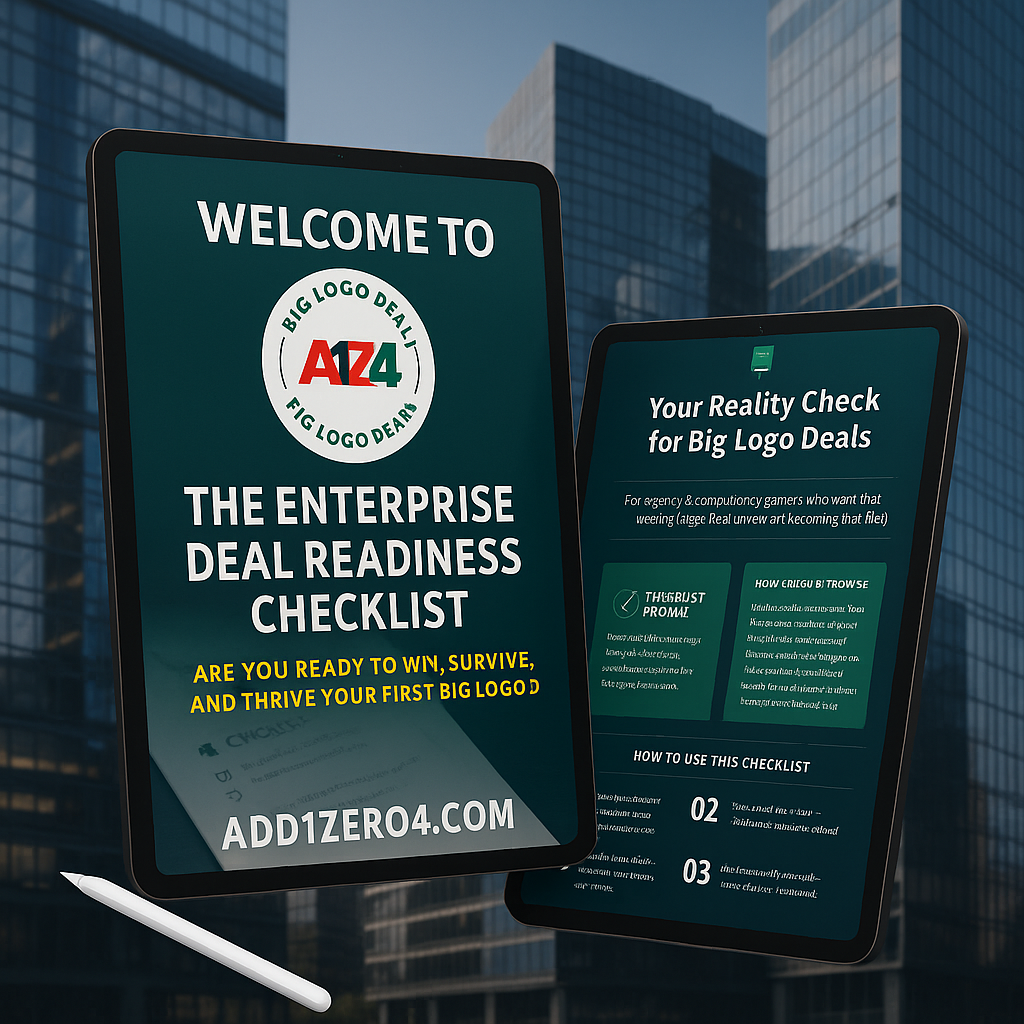
The Enterprise Deal Readiness Checklist
Skip the $100K+ learning curve. This insider’s checklist reveals if your B2B agency can win (and survive) Fortune 500 deals before you risk your stable revenue and best people chasing logos you’re not ready for.
The SMB Comfort Zone vs. The Enterprise Arena
Working with SMBs often means direct access to decision-makers, quick turnarounds, and a more informal approach. You might be dealing with the founder or a small marketing team. Decisions get made, projects move, and your creative impact is often immediately visible. It’s a rewarding space.
Enter the enterprise. Suddenly, you’re not talking to one or two people. You’re navigating a complex web of stakeholders, often referred to as “constellation decision-making.” Your main contact might be a mid-level manager who loves your work but has to champion it internally through multiple layers of approval, budget cycles, and often, a formal procurement department. Urgency can be near-zero, and timelines stretch. What worked beautifully for your $5k SMB project will likely fall flat or get lost in the corporate machinery of a $100k+ enterprise deal.
The pain point for many brilliant graphic design agencies is this operational and cultural disconnect. It’s not that your designs aren’t good enough; it’s that your business model isn’t yet enterprise-ready.
Refining Your Graphic Design Agency Business Model for Big Logos
To successfully pivot and make your graphic design agency attractive to enterprise clients, you need to look critically at several key areas of your business. It’s about more than just having a killer portfolio.
1. Mindset Makeover: Thinking Like an Enterprise Partner
Before you change any process, you need a shift in perspective. Enterprise clients aren’t just buying designs; they’re investing in a strategic partner.
- “Looking Legit” is Non-Negotiable: Your agency’s presentation matters immensely. Does your website scream “SMB specialist,” or does it project the polish and professionalism expected by a billion-dollar company? Enterprise prospects will scrutinize your online presence. Simple is fine, but it must be tight, credible, and instill confidence that you can handle their scale. Even your company’s core values, if plastered overtly on your “About Us” page, need consideration. A “fun over work” vibe might resonate with your internal team but could be a yellow flag for a corporate buyer looking for a serious, results-driven partner.
- Cultivate “Calm Confidence”: Desperation repels enterprise clients. They can smell “too thirsty” a mile away. You need to project an aura of calm confidence – the belief that your agency is the best solution, but you’re not going to push them into a sale. This doesn’t mean being aloof; it means being secure in your value and prepared to walk away if a deal isn’t right. This mindset shift is crucial. As we often say, practice saying to yourself: “It makes no difference to my life if you buy this. It might make a difference to yours if you don’t.” This internal mantra helps.
- Understand Their Real Needs: Enterprise clients, even in creative fields like graphic design, are ultimately driven by ROI and business impact. While they want beautiful, innovative design, they also need to see how it connects to their larger business objectives. Is your proposed rebrand going to help them penetrate a new market? Will your UI/UX design for their internal platform improve employee efficiency? You need to speak their language, which often involves metrics and business outcomes, not just design jargon.
2. Financial Fortitude: Can Your Agency Handle a Whale?
Landing a big logo is exhilarating, but it can also sink your agency if you’re not financially prepared.
- The Cash Flow Crunch: Big companies often mean big payment terms – Net 60, Net 90, or even longer. You’ll likely need to finance the project, paying your team and covering expenses for months before you see a dime. Do you have the cash reserves or a line of credit to float potentially half the contract value for six months? This is a hard reality that many agencies overlook. That “bet-the-company” sized deal can literally kill your company if you’re not ready.
- Pricing for Enterprise – It’s Different: Your SMB pricing model won’t cut it. A good rule of thumb we’ve seen work? “Twice the price for half the deliverables.” Why? Because enterprise clients demand significantly more attention, communication, project management, and reporting. This “overhead” needs to be baked into your pricing. They aren’t just buying your design hours; they’re buying a higher level of service and assurance.
- Know Your COGS (Cost of Goods Sold): At this new scale, a fuzzy understanding of what it actually costs you to deliver your design services isn’t good enough. Enterprise clients may want to “unwind” your packages into component parts. If you don’t know your true COGS for each service, you risk underpricing and eroding your margins.
Are you starting to see how deep this goes? Getting your agency truly ready for enterprise clients is a journey. For a structured path and deep dives into each of these areas, many agency owners find guidance like the Big Logo Deals course invaluable.
Our Probably-Too-Honest Private Podcast
Find out what REALLY happens when agencies land enterprise deals (spoiler warning: one of them lost $100K)
Brought to you by Add1Zero4 and hosted by David “Ledge” Ledgerwood
3. Operational Overhaul: Delivering Excellence at Scale
What makes your agency efficient for SMBs might break under enterprise pressure.
- Your Processes Will Break (and That’s Okay): Be prepared for enterprise clients not to fit neatly into your existing, well-oiled workflows. They have their own ways of doing things, their own approval chains, and their own (often complex) internal systems. Trying to force them into your SMB mold is a recipe for frustration on both sides. Think of enterprise work almost as a separate practice within your business, at least initially.
- Team Readiness and Skill Gaps: Can your current team handle the increased demands of an enterprise account? It’s not just about more work; it’s about a different type of work. You might need team members with experience in corporate communication, navigating complex stakeholder environments, or specific enterprise software. Sometimes, this means strategically hiring or bringing in expert contractors.
- Sales Enablement That Resonates: Your portfolio of beautiful designs is a starting point, but enterprise clients need more. They want to see case studies with clear ROI, testimonials from other (ideally large) companies, and a clear understanding of how your design solutions solve business problems. Your sales enablement materials – proposals, presentations, one-pagers – need to be tailored to this audience. Think less “flashy design deck” and more “clear, concise business document that gets straight to the value and the numbers.”
- Mastering Scope Creep: Enterprise projects are notorious for scope creep. Your team needs to be empowered to manage this artfully. This starts with crystal-clear Statements of Work (SOWs) and an internal understanding of how to say “no” constructively or escalate requests for additional scope (and budget). Remember, “free work” for an enterprise client rarely earns you the same goodwill it might with an SMB.
4. Pricing and Packaging: Beyond the Standard Rate Card
If you’re still thinking in terms of “gold, silver, bronze” packages, it’s time for an upgrade.
- Customization is King: Large companies rarely buy off-the-shelf packages. They expect tailored solutions that address their specific, often complex, challenges. Your ability to listen, understand their unique needs, and craft a bespoke offering is paramount.
- The Proposal Process Reimagined: As mentioned, enterprise proposals are less about a visual feast and more about a clear, value-driven business case. Focus on what they care about most: the solution to their problem, the expected outcomes, and, yes, the cost. We’re big fans of simple, easily digestible proposals (think Google Docs over complex PDFs) that allow for collaboration and quick understanding.
- Navigating RFPs (Requests for Proposals): You might encounter RFPs. Be warned: these can be huge time sinks, often designed to commoditize services. Our rule of thumb: only engage if you feel very close to the purchasing decision or if the opportunity is so massive it justifies the risk-weighted investment of time. Otherwise, your energy is often better spent on direct relationship-building.
- Flexible Payment Structures: Understand that enterprise clients have various ways they handle payments – upfront (rare, but ask!), milestone-based (common and good to aim for), or post-delivery (risky for you). Be prepared to negotiate terms that protect your cash flow. Don’t be afraid to push back on unfavorable terms with that “calm confidence.”
The Big Logo Deals Course
Created by experts who have closed over $50 million in revenue over the last decade who teach you everything they know about closing deals with the logos you wish were on your client list.
5. The “Boring” Stuff That Wins (or Sinks) Deals: Legal & Procurement
This is where many SMB-focused agencies hit a wall.
- Contracts, NDAs, and MSAs: Enterprise contracts can be daunting – lengthy, full of legalese, and often heavily weighted in their favor. While you might not be able to redline everything, understand what truly matters: publicity clauses (can you use their logo?), intellectual property, insurance requirements, and any non-compete or exclusivity clauses that could hamstring your agency. Seeking legal counsel with experience in corporate contracts, at least initially, is wise.
- Understanding Procurement: Many large companies have a dedicated procurement department whose job is to get the best value and ensure compliance. You’ll likely need to become an approved vendor, which involves paperwork, security audits, and navigating their supplier portals. It’s a hurdle, but a necessary one.
- Insurance & Data Security: Enterprise clients will have specific insurance requirements (like E&O or cyber liability) and may scrutinize your data security practices. Being able to demonstrate professionalism here is key.
6. The Long Game: Patience, Timing, and Sealing the Deal
Working with enterprises is a marathon, not a sprint.
- Embrace Longer Sales Cycles: Decisions take time. Multiple approvals, budget cycles, shifting priorities – it all adds up. Polite persistence is your friend.
- Mastering the Follow-Up: How do you stay top-of-mind without being annoying? Provide value in your follow-ups. Share relevant insights. Connect on LinkedIn. Use a multi-channel approach. Sometimes a well-timed, polite text can do more than a dozen emails.
- When is a Deal Really a Deal?: A verbal “yes” from your contact is a great sign, but it’s not a closed deal. The deal is closed when contracts are signed, POs are issued, and you know you can bill for the work. Don’t break out the champagne (or make major hiring decisions) based on a verbal alone. It’s a tough lesson many learn the hard way.
Are You Ready to Evolve Your Graphic Design Agency Business Model?
Transitioning your graphic design agency business model to successfully serve enterprise clients is a significant undertaking. It requires a shift in mindset, a bolstering of your finances, an overhaul of operations, and a new approach to sales, pricing, and legalities.
The rewards, however, can be transformative: larger, more strategic projects, higher revenue, and the prestige of working with industry leaders. That first big logo deal is often the catalyst, creating a snowball effect as success breeds more success.
If you’re feeling overwhelmed by the prospect but excited by the potential, you’re not alone. This is a journey, and having a roadmap can make all the difference.
The Big Logo Deals course is specifically designed to guide agency owners like you through this exact transformation, equipping you with the mindset, tactics, and execution framework needed to land and thrive with enterprise clients.
As a practical first step, download the Enterprise Deal Readiness Checklist. It’ll help you assess where your agency stands right now. For ongoing insights and real-world stories from agency owners who’ve made the leap, tune into the Big Logo Deals podcast.
The enterprise world needs great design. With the right business model, your agency can be the one to provide it. It’s time to stop dreaming about those big logos and start strategically positioning your agency to win them. The journey requires dedication, but the view from the top is worth it.