
So, your B2B service agency is humming along. You’ve mastered the SMB (Small and Medium-sized Business) landscape, delivering great work and building a solid reputation. But you’ve got that itch, right? You’re eyeing those bigger fish, the enterprise clients, the household names – the “big logos.” You dream of the prestige, the larger contracts, and the game-changing growth they represent.
Big Logo Deals
Learn how to close your first big enterprise deal and drive massive business growth.
Hold up. Before you dive headfirst into chasing those giants, understand this: it’s a completely different ocean. The strategies, communication styles, and operational muscle that made you an SMB star can actually hinder you in the enterprise world. These behemoths operate on a different wavelength, and many agencies stumble because they simply don’t know how the big league plays.
But don’t let that scare you. Landing that first enterprise client can be the catalyst for explosive growth and higher margins. This guide is your cheat sheet to navigate this transition, avoid the common pitfalls, and position your agency to not just land, but thrive with, big logo deals. Ready to level up?
Part 1: The Mindset Shift – Are You Truly Enterprise-Ready?
Winning enterprise business isn’t just about scaling your current offerings for a bigger budget. It’s a fundamental shift in how you think, operate, and present your agency.
It’s More Than Just Bigger Budgets
Enterprise clients don’t just have more money; they have more complexity. More stakeholders, intricate approval processes, different expectations for communication, and a pace that can feel glacial compared to nimble SMBs. When you step into the enterprise game, everything changes. Are you prepared to deliver 10x the attention, manage byzantine project requirements, and potentially finance a deal that could be a ‘bet-the-company’ sized endeavor?
Cultivate “Calm Confidence”
Ever heard the phrase “fake it ’til you make it”? In the enterprise world, “Calm Confidence” is your mantra. Ditch any hint of desperation or being “too thirsty” for the deal. Enterprise buyers have finely tuned BS detectors. They’re not looking for a vendor who’s just happy to be there; they’re looking for a strategic partner who exudes quiet authority and genuine belief in their value. As one CMO put it after a less experienced team fumbled, they lacked “that little swagger.” It’s not arrogance; it’s the unwavering belief that you bring immense value, and whether they buy or not, you’re providing helpful expertise.
Nail Your “Why” for Them
“What makes you different?” It’s a classic question, but for enterprise clients, a generic answer won’t fly. “We care more” or “we customize” is table stakes. You need to articulate a unique value proposition that resonates specifically with the challenges and aspirations of a large corporation. If you don’t have this crystal clear, now’s the time for some deep thinking.
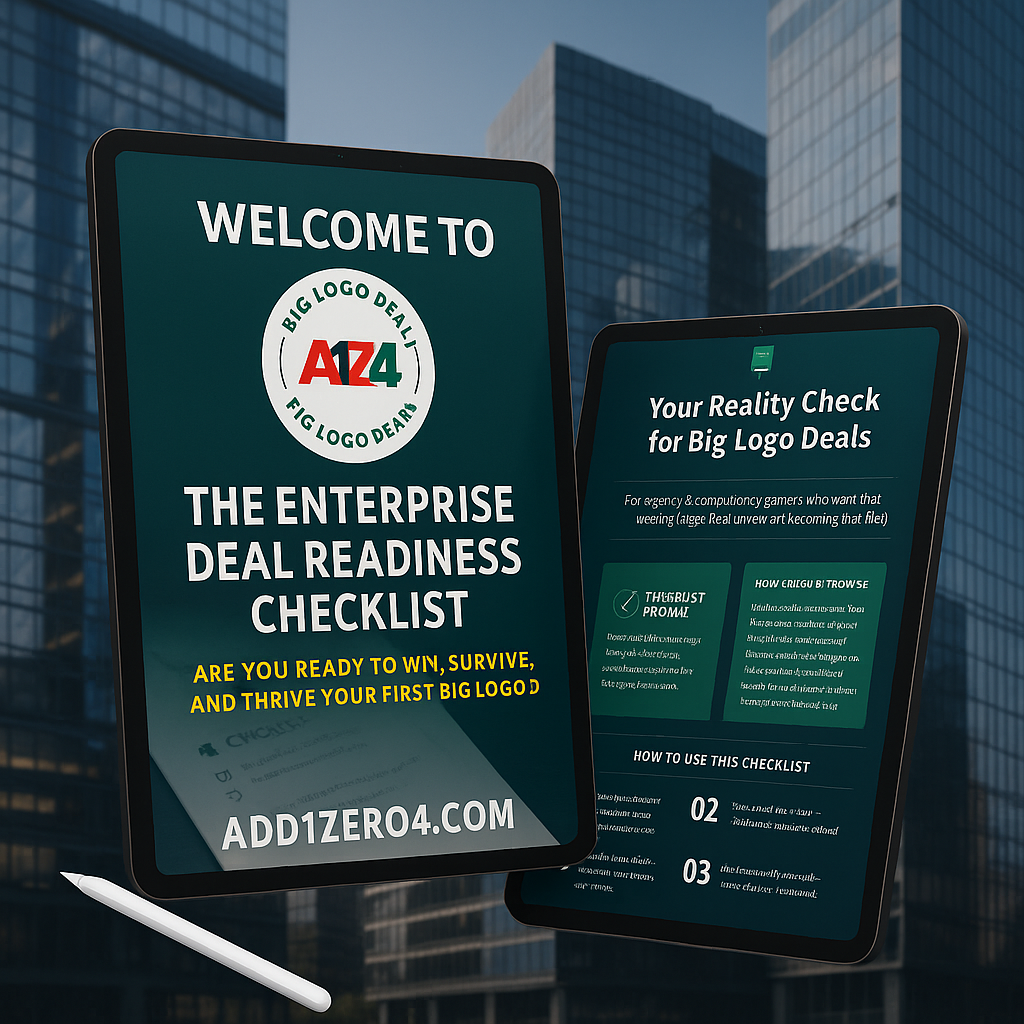
Before you even dream of sending that first proposal, take a hard look in the mirror. Assess if your agency is truly prepared for the leap. Our Enterprise Deal Readiness Checklist can be a real eye-opener, helping you spot crucial gaps in your armor.
The Enterprise Deal Readiness Checklist
Skip the $100K+ learning curve. This insider’s checklist reveals if your B2B agency can win (and survive) Fortune 500 deals before you risk your stable revenue and best people chasing logos you’re not ready for.
Part 2: Looking the Part – Your Agency’s Enterprise Appeal
First impressions are everything, especially when you’re a smaller agency wooing a corporate giant. Does your agency look and feel like it can handle their business?
Your Digital Storefront Matters
“Yeah, our website isn’t great, but we get all our business from referrals.” Sound familiar? That might work for SMBs, but enterprise clients will scrutinize your online presence. Your website, your LinkedIn profile, your case studies – they all need to project professionalism and credibility. Simple is fine, but shabby is a deal-breaker. They need to believe you can deliver on a multi-zero contract.
Subtlety in Your Core Values
Many agency founders are entrepreneurial spirits who value things like “fun over work” or “family first.” That’s fantastic for your internal culture. But plastering those on your “About Us” page when pitching a corporation whose VPs are burning the midnight oil? Be mindful. It’s okay to have those values internally without shouting them from the rooftops to potential enterprise clients.
Rethink Your Lead Funnels
Aggressive, long-form direct response funnels that convert SMBs can be an instant turn-off for enterprise prospects. They expect accessibility on their terms. Consider an “Appointment-Focused Funnel.” Make it easy for them to learn a bit and then book a call. While you might filter SMB leads heavily, for enterprise, a more open (though potentially spam-attracting) contact method might be worth it.
Mastering the Enterprise Sales Call
SMB deals might involve 2-3 stakeholders. Enterprise? Try 8-10, often appearing and disappearing throughout a long sales cycle. You’ll encounter various personas:
- The Delegated Shopper: An intern or junior staffer filling out a comparison spreadsheet. Give them what they need, but don’t expect them to be your champion.
- The Unfunded Mandate: A frazzled mid-level employee tasked with a vague project. They’re excited by solutions but have no buying power. Your goal: make them look good to their boss and get a meeting with leadership.
- The Mid-Level Owner: Has some budget and understanding, but still needs to sell upwards. This is often where deals get traction.
- The Chemistry Call: A screening to see if you’re a cultural fit before deeper engagement.
- The Leadership Presentation: Your shot with the “right people.” Be prepared to re-explain everything; they likely haven’t read your proposal as thoroughly as your advocate.
On these calls (likely video), project power (you’re a partner, not “just a sales guy”), actively listen (lean in, nod – it feels weird but works on video), and get their story first.
Part 3: The Financial Fortitude for Big League Plays
This is where many aspiring agencies falter. Landing a big logo is exhilarating, but the financial realities can be brutal if you’re unprepared.
Heed the Warning: Big Deals Can Break Small Agencies
It’s not an exaggeration. Massive deals can kill companies faster than no deals at all. Enterprise clients have exacting standards, merciless contracts, and payment cycles that can stretch your cash flow to its breaking point. If delivering on a deal means you’re thinking, “If we don’t nail this, we’re screwed,” then you’re already in trouble.
Cash Flow is Your Lifeline
You will, almost certainly, be financing a significant portion of the project before you see a dime. Our rule of thumb: assume you’ll need to float at least half the total contract value for six months just to be safe. If you don’t have adequate cash on hand or a solid line of credit, you risk insolvency. That dream client could sink your ship.
Know Your Numbers Religiously
SMBs might accept your packaged pricing. Enterprises? They’ll often want to “unwind” your services into component parts, demanding detailed breakdowns. If you don’t know your Cost of Goods Sold (COGS) and Gross Margin for every service element, you can easily underprice components and torpedo your profitability. And remember, founder time isn’t “free”—it’s COGS. Aim for a gross margin of at least 40%, ideally higher. Define your walk-away price based on these numbers and stick to it, no matter how tempting the logo. We once walked from a potential $500K deal because it fell below our margin threshold. It stung, but it was the right decision for the business.
The “Twice the Price, Half the Deliverables” Starting Point
When asked for a ballpark, a good starting point for enterprise pricing is often “twice the cost for half the deliverables” compared to your SMB rates. Why? Because enterprise clients demand significantly more overhead: more meetings, more reporting, more hand-holding. They also might not need or want the full scope an SMB would consume initially.
The Art of Enterprise Accounts Receivable
Chasing payments from big companies is an entirely different beast. Their Net terms are longer (Net 30, 60, even 90), and their Accounts Payable departments can be bureaucratic mazes. Invoice promptly (Net terms start when the invoice is received), understand their specific payment portals and processes (they all differ!), and be prepared to politely but persistently follow up. Getting paid is on YOU.
Our Probably-Too-Honest Private Podcast
Find out what REALLY happens when agencies land enterprise deals (spoiler warning: one of them lost $100K)
Brought to you by Add1Zero4 and hosted by David “Ledge” Ledgerwood
Part 4: Operational Overhaul – Delivering for the Giants
Your well-oiled SMB machine will likely need a significant retooling to handle enterprise-level demands.
Brace for Impact: Your Processes Will Break
The standardized approaches and efficient processes that serve your SMB clients so well? Expect enterprise clients to shatter them. They don’t want your standard packages; they want (and expect) bespoke solutions tailored to their massive scale and unique (often convoluted) internal workings. What got you here won’t get you there. Be prepared to create new standard operating procedures specifically for these larger clients.
Show Up as Their Expert
Enterprise clients expect you to arrive already knowing a lot about their business, their industry, their recent press, and their challenges. Your sales team should be doing deep dives, and this research needs to be shared with the delivery team. Record your sales calls; the nuances discussed are invaluable for the post-sale team. They need to sound like they do this every day, even if it’s their first big logo.
Sales Enablement for the Enterprise Buyer
Forget the generic pitch deck. Enterprise sales enablement is about “middle-of-funnel” content: modular pieces that demonstrate specific expertise and ROI. Think:
- Clean, simple, visual one-pagers or short videos explaining unique processes.
- Case studies (even anonymized initially) that speak to enterprise-level challenges and results.
- Focus on the numbers and clear ROI.
We’ve found more success with targeted emails linking to specific, easy-to-consume resources than with massive, over-designed PDFs.
Tackling Scope Creep and Mastering the “No”
With SMBs, doing a “favor” or throwing in a little extra can build goodwill. With enterprise clients, “free work” often just becomes the new expectation, and the person you did the favor for might not even be the one who can reciprocate. Train your team on the agreed-upon scope. Empower them to politely say, “That’s a great idea, and it’s outside our current scope. Let’s discuss how we can incorporate that,” rather than just giving away services.
Don’t Forget Your Existing Clients
Landing a big logo is exciting, but it will inevitably strain your resources. Your best people will be pulled in multiple directions. Be upfront with your existing SMB clients. Let them know you’ve landed a significant new client and that you’re committed to maintaining their service levels, but provide a clear escalation path (a “Bat Phone” to a senior person) if they feel anything is slipping. Transparency builds trust.
Juggling existing work while chasing giants is a common challenge for growing agencies. For more in-depth strategies on scaling your operations without dropping the ball, tune into the Big Logo Deals podcast.
The Big Logo Deals Course
Created by experts who have closed over $50 million in revenue over the last decade who teach you everything they know about closing deals with the logos you wish were on your client list.
Part 5: Navigating the Enterprise Labyrinth – Proposals, Legal, and Procurement
This is where the red tape can feel overwhelming. Stay organized and be prepared.
Proposals That Actually Close Deals
Enterprise proposals aren’t the place for a lengthy re-pitch of your agency. By this stage, they should already be sold on why you. The proposal is for closing. Keep it simple, direct, and focused on what they’re looking for: scope and costing. We often use Google Docs, allowing for comments. Be prepared for them to ask for it in Word format for redlining. And yes, you’ll likely need that Microsoft 365 license.
The RFP (Request for Proposal) Conundrum
RFPs aim to create an apples-to-apples comparison, often flattening your unique differentiators. Our rule of thumb: only respond if you feel very close to the purchasing decision or if the opportunity is so massive it justifies the significant time investment. RFPs are often written by non-experts asking the wrong questions, forcing you to sell with one hand tied behind your back. Expect a low win rate.
Legal and Contracts: Their Paper, Their Rules (Mostly)
Your standard SMB contract? They’ll likely want you to sign their Master Services Agreement (MSA), which can be a 60-page beast. Get legal counsel to review, but focus on understanding the actual risks versus trying to redline every clause (which they’ll likely ignore). Key pitfalls to watch for:
- Publicity Clauses: Can you use their logo in your marketing? This is HUGE. If not, or if it requires written permission, negotiate this. The value of a big logo is significantly diminished if you can’t showcase it.
- Insurance: They’ll often require high coverage amounts and types of insurance you don’t need (e.g., auto liability if you’re fully remote). Push back for reasonable levels. Professional liability/E&O is a must.
- NDAs (Non-Disclosure Agreements): Mostly boilerplate. Watch for unreasonable duration, non-competes, or exclusivity clauses that could hamstring your business.
- Data Security & IT Audits: Be prepared. Using major cloud providers can help, as you can often point to their security certifications.
Procurement Purgatory
Becoming an approved vendor involves forms, portals, and patience. Every large company has its own system (SAP Ariba, Coupa, Oracle, etc.), and the user experience can be… trying. Keep meticulous records of everything.
Part 6: The Long Game – Patience, Timing, and Finally Closing
Landing enterprise deals is a marathon, not a sprint. Cultivate patience and strategic timing.
Understanding “Constellation Decision-Making”
Unlike an SMB where the founder might give a quick “yes,” enterprise decisions involve a “constellation” of people. One of our clients signed a $12k/month deal with a $50M tech company via one manager. Another deal for $35k with an $80B conglomerate took four calls, three proposal revisions, and four levels of approval, plus weeks of vendor setup. That’s the norm. It’s a slog, often illogical, but part of the game.
Whose Word Actually Matters?
That initial enthusiastic contact from a big name? It’s exciting, but temper it. It’s often a junior person researching, or a mid-level manager who wants your service but has no authority to approve it. They might even need your help to sell it internally. Your job is to identify the real decision-makers and your internal champions. Ask early: “What’s the procurement process?” “Have you set up a new vendor before?” Your acumen here can make you seem more legitimate than competitors.
The Art of the Follow-Up (Without Being a Pest)
Polite persistence is key. Enterprise folks are busy; your deal isn’t their top priority. Set reminders, touch base, offer value, and ask for project status. If it’s a “no,” make them say “no.” Connect on LinkedIn. If you have their mobile (from an appointment-focused funnel), a selective, polite text can sometimes cut through the noise. But know when to let it go. You won’t win them all.
When is a Deal Actually Closed? (Hint: A Verbal Means Nothing)
I once got a verbal “yes” on a $40k deal from a VP at a huge firm. I bought champagne for the team. A month later: “Sorry, couldn’t get approval.” Painful lesson. A verbal is a good sign, but it means nothing until agreements are signed, Purchase Orders (POs) are issued, and you know you can bill. Don’t celebrate (or make hiring decisions) prematurely. Once it’s truly inked – then pop the cork and celebrate the win!
The amazing thing? Every big logo you successfully serve makes the next one easier. The social proof and your own refined expertise create a snowball effect.
Ready to Trade Up to the Big Leagues?
Transitioning your agency from an SMB specialist to an enterprise player is a significant undertaking. It demands a shift in mindset, a reinforcement of your financial foundations, an overhaul of your operations, and a new level of patience and strategic savvy.
It’s undoubtedly challenging. But the rewards – those game-changing contracts, the higher margins, the incredible brand prestige, and the exponential growth – are absolutely worth the effort.
If you’re tired of just dreaming about those big logo deals and are ready to build a systematic approach to winning them, the Big Logo Deals course is your comprehensive playbook. We dive deep into the mindset, tactics, and execution necessary to not just land your first enterprise client, but to build a thriving business around them. It’s time to add that zero (or two!) to your revenue. Take the leap.