
So, you’re running a B2B services agency – maybe marketing, advertising, design, something in that realm. You’re good at what you do, probably built a solid business serving small to medium-sized businesses (SMBs). But now, you’re eyeing the big leagues: those enterprise clients, the household names, the “big logo deals” that can transform your agency.
Big Logo Deals
Learn how to close your first big enterprise deal and drive massive business growth.
The allure is undeniable: bigger projects, larger budgets, and the kind of prestige that makes attracting even more big clients a whole lot easier. But here’s the kicker: the sales process that got you here, the one that works like a charm with SMBs? It’s a completely different ballgame with enterprise companies. Their b2b sales pipeline stages look familiar on the surface, but the reality underneath is a complex maze. They operate on a different planet, and if you don’t speak their language, you’re going to hit a wall, fast.
Let’s break down the typical B2B sales pipeline stages and see how they morph when you’re chasing those enterprise whales.
Stage 1: Prospecting & Identification – “Looking Legit” in the Enterprise World
For SMBs: You might be relying on referrals, local networking, or targeted digital ads. Your website might be “good enough” because your reputation often precedes you.
For Enterprise Clients: This stage is less about casting a wide net and more about surgical precision and, frankly, looking the part. This is where dedicated b2b outbound marketing strategies come into play, focusing on quality over quantity.
- Who Are You Really Talking To? Enterprise org charts are vast and complex. The person who initially reaches out might be a “delegated shopper” – an intern or junior employee tasked with “researching firms who do X.” They’re filling a spreadsheet, not making decisions. You need to identify and map out the actual influencers and decision-makers, which can be a constellation of people.
- Your Digital Front Door: That website you get “most of your business from referrals anyway” for? It won’t cut it. Enterprise buyers will scrutinize your online presence. They’re looking for a partner who understands their scale and complexity. Your site needs to project professionalism, expertise, and credibility. If it looks shabby or screams “small-time,” they’ll click away before you even know they were there.
- Content That Speaks Their Language: Forget generic blog posts. Think about thought leadership that addresses enterprise-level challenges. Case studies are good, but enterprise-focused ones are better. If you don’t have those yet (because you’re trying to land your first big logo), your content needs to demonstrate a deep understanding of their world.
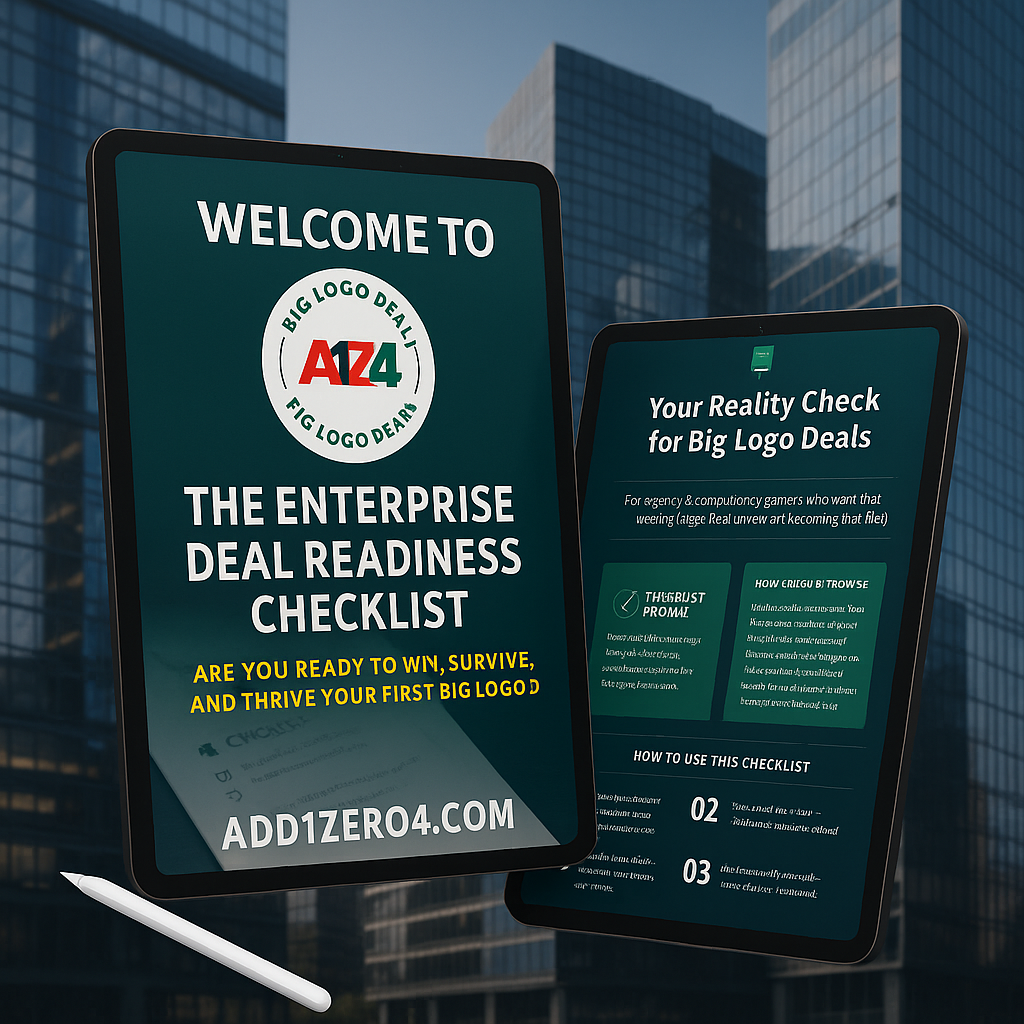
Are you truly ready for that first enterprise look? Being prepared isn’t just about your services, it’s about your entire presentation. Consider using something like an Enterprise Deal Readiness Checklist to see where you stand.
The Enterprise Deal Readiness Checklist
Skip the $100K+ learning curve. This insider’s checklist reveals if your B2B agency can win (and survive) Fortune 500 deals before you risk your stable revenue and best people chasing logos you’re not ready for.
Stage 2: Qualification – Beyond Budget, Authority, Need, Timeline (BANT)
For SMBs: Qualification can be relatively straightforward. You confirm BANT, understand their immediate pain, and you’re often talking to the decision-maker or someone very close.
For Enterprise Clients: Qualification is a deep, ongoing investigation into a much more complex ecosystem.
- The “Unfunded Mandate”: You’ll often encounter enthusiastic mid-level managers who love your solution. The catch? They might have an “unfunded mandate.” They’ve been told to solve a problem but have no official budget or authority to sign a check. Your job becomes helping them build the internal case.
- Budget Cycles & Approval Layers: Enterprise budgets are often planned quarters, even a year, in advance. If you’re not in that cycle, you’re waiting. And even if there’s a budget, approvals can go through multiple layers, each with its own priorities and potential roadblocks. Forget asking, “When do you want to start?” and start asking, “What does your company’s fiscal year and budget approval process look like?”
- Identifying the Real Power: The person championing your service might not be the one with the final say. You need to uncover the “constellation” of decision-makers. Who really controls the budget? Who are the key influencers? Whose political capital is on the line? This often involves a “chemistry call” where they’re just vetting if you’re a cultural fit before you even get to the serious talks.
Our Probably-Too-Honest Private Podcast
Find out what REALLY happens when agencies land enterprise deals (spoiler warning: one of them lost $100K)
Brought to you by Add1Zero4 and hosted by David “Ledge” Ledgerwood
Stage 3: Needs Analysis & Discovery – It’s Not Just About Your Services
For SMBs: You’re typically uncovering specific service needs. “We need a new website,” or “We need to improve our SEO.”
For Enterprise Clients: Their “needs” are often intertwined with internal politics, existing vendor contracts, massive legacy systems, and overarching corporate strategy.
- The Bigger Picture: Your service might be a tiny cog in a massive machine. You need to understand how your solution fits into their broader objectives. Is it about market share, risk mitigation, efficiency gains across departments, or shareholder value?
- ROI, ROI, ROI (Even When They Say It’s Not): Your direct contact might talk about “brand awareness” or “thought leadership.” But trust me, somewhere up the chain, someone is asking about the cold, hard ROI. Enterprise companies are accountable for every dollar spent. You need to help your internal advocate connect the dots between your services and tangible business outcomes.
- Breaking Standard Processes: What got you here (your standardized SMB offerings) won’t get you there. Enterprise clients rarely fit into neat packages. They’ll want customized solutions, and they’ll expect you to adapt to their processes, not the other way around.
Stage 4: Proposal & Presentation – “Twice the Price, Half the Deliverables”
For SMBs: You might have standard packages or proposals that you tweak slightly. Pricing is often value-based but within a relatively understood market range.
For Enterprise Clients: Get ready to throw your SMB rate card out the window. This is where many agencies stumble.
- The RFP Gauntlet (and When to Run Away): You might get hit with a Request for Proposal (RFP). Be warned: RFPs are often designed to commoditize services and are incredibly time-consuming. Unless you feel very close to the buying decision or it’s a massive, game-changing opportunity, proceed with extreme caution. You could spend weeks on an RFP only to find they were just fishing for ideas or already had an incumbent favored.
- Customization is Key: Enterprise clients expect proposals tailored to their specific, complex needs. No “one-size-fits-all.” Your proposal needs to demonstrate you’ve listened intently and understand their unique challenges. And forget flashy design; they want clear, concise business documents. Most will scroll right to the pricing page, so make sure what precedes it is impactful and justified.
- Pricing for Overhead: Here’s a mantra to consider: “Twice the price for half the deliverables.” Why? Because enterprise clients demand significantly more attention: more meetings, more reports, more hand-holding, more navigating internal bureaucracy. This “invisible” work is substantial and needs to be baked into your pricing. If you price like an SMB deal, you’ll be unprofitable before you even start.
- Payment Terms & Cash Flow: They won’t be paying by credit card on Net 30. Expect Net 60, Net 90, or even more complex milestone-based payments. This can wreak havoc on your cash flow if you’re not prepared. This financial readiness is something you need to sort before you’re deep in the sales cycle.
The Big Logo Deals Course
Created by experts who have closed over $50 million in revenue over the last decade who teach you everything they know about closing deals with the logos you wish were on your client list.
Stage 5: Negotiation & Closing – The Marathon of Legal, Procurement, and Patience
For SMBs: Negotiation might be a bit of back-and-forth on scope or price. Closing can happen relatively quickly once a decision is made.
For Enterprise Clients: This is where deals often go to die a slow death if you’re unprepared. This stage can take months.
- The MSA Shuffle: Get ready for the Master Services Agreement (MSA). These are often lengthy, dense legal documents written entirely in their favor. You’ll need to review them (ideally with legal counsel who understands enterprise contracts) and know which clauses are red flags (like overly broad non-competes or restrictive publicity clauses preventing you from using their logo) and which are just standard corporate boilerplate.
- Procurement Hurdles: Procurement’s job is often to save the company money and mitigate risk. They’ll scrutinize everything. You’ll be filling out vendor forms, dealing with supplier portals, and justifying your pricing and terms all over again.
- Insurance & Security Audits: Expect to show proof of significant insurance coverage (often more than you think you need – be prepared to negotiate what’s reasonable for your type of service). You might also face data security questionnaires or IT audits.
- “Calm Confidence” and “Feigned Indifference”: Throughout this, you need to project calm confidence. Desperation is a deal-killer. You need to be prepared to walk away if the terms are unreasonable or the deal compromises your agency’s health. Knowing your numbers and your non-negotiables is crucial.
- What “Closed” Really Means: A verbal “yes” from your contact means almost nothing. A deal isn’t closed until contracts are signed, POs are issued, and you know you can actually bill them. Don’t pop the champagne on a verbal commitment – you’ll only set yourself up for disappointment.
The Enterprise Pipeline is a Different Beast – Are You Ready to Tame It?
Navigating the b2b sales pipeline stages for enterprise clients is less about a linear sprint and more about a strategic, patient, and well-prepared marathon. It requires a fundamental shift in mindset, process, and preparedness. You need to understand how these giants think, operate, and buy.
It’s about more than just “selling”; it’s about transforming your agency to be enterprise-ready from the first touchpoint to the final signature (and beyond). The rewards are immense, but so are the challenges.
Want to dive deeper into the mindset, tactics, and execution needed to land those big logo clients? The Big Logo Deals course is designed specifically for agency owners like you, ready to make that leap. And for ongoing insights and stories from the enterprise trenches, check out the Big Logo Deals podcast.
Landing your first few enterprise clients will be tough. You’ll learn a lot (often the hard way). But each success builds momentum, making the next one easier. So, get prepared, be patient, and get ready to play in the big leagues. Your agency’s future might just depend on it.