
So, you’re running an influencer marketing agency, and things are pretty good. You’ve got a solid roster of small to medium-sized business (SMB) clients, your team’s humming, and you’re delivering results. But then you look up, and you see those household names, the big logos, the enterprise clients… and a little voice whispers, “What if?”
Big Logo Deals
Learn how to close your first big enterprise deal and drive massive business growth.
Landing those giant accounts can feel like the ultimate validation, a quantum leap for your agency. And it is. But here’s the kicker: the very influencer marketing agency business model that got you here, the one that’s so effective with SMBs, might just be the thing holding you back from snagging and succeeding with enterprise clients. It’s not about working harder or doing more of the same. It’s about a fundamental shift in how your agency operates, thinks, and presents itself.
Enterprise clients aren’t just bigger versions of your SMB clients. They’re a different species altogether. They have complex internal structures, labyrinthine approval processes, and expectations that can make your head spin if you’re not prepared. The pain point? Many agencies, yours perhaps included, simply lack the insider knowledge of how these behemoths operate compared to the nimbler companies you’re used to.
Ready to evolve your influencer marketing agency business model and play in the big leagues? Let’s dive in.
The Mindset Metamorphosis Your Business Model Needs
Before you change a single process or pricing sheet, the first transformation has to happen between your ears – and across your team. Your agency’s entire culture and approach need an upgrade.
From Scrappy Startup to Polished Partner:
Remember that “hustle and grind” vibe that served you so well in the early days? Enterprise clients appreciate professionalism and polish. Your website, your pitch decks, even the way your team conducts themselves on video calls – it all needs to scream “credible expert.” If your online presence still looks like you’re operating out of a garage (even if you are, no judgment!), big companies will sniff that out and pass. They need to believe you can handle their multi-million dollar brand, and that starts with looking legit.
Think about your agency’s core values. Are they all about “fun over work” and “family first”? That’s awesome for internal culture, but be mindful of how overtly you promote these when enterprise eyes are on your “About Us” page. They’re looking for a partner who mirrors their own (often unstated) dedication to relentless delivery.
The “Calm Confidence” Stance:
When you’re pitching SMBs, enthusiasm and a bit of “thirst” can be endearing. With enterprise prospects, it can be a red flag. They’re not looking for a vendor who desperately needs the deal. They’re looking for a confident, calm partner who knows their worth and can solve complex problems. We call this “Calm Confidence.” It’s the quiet assurance that says, “We’re the best at what we do. We’re here to help you, but our success isn’t contingent on this one deal.”
This means knowing your numbers, your walk-away points, and being prepared to say “no” if the terms aren’t right. It means not getting flustered when they ask for “ballpark” figures after giving you 20% of the necessary info. It means understanding the different types of “calls” you’ll encounter – from the “delegated shopper” intern to the “mid-level owner” who needs your help selling up the chain.
Want to dive deeper into the mindsets and strategies of those who’ve successfully navigated these waters? Tune into the Big Logo Deals podcast for regular insights.
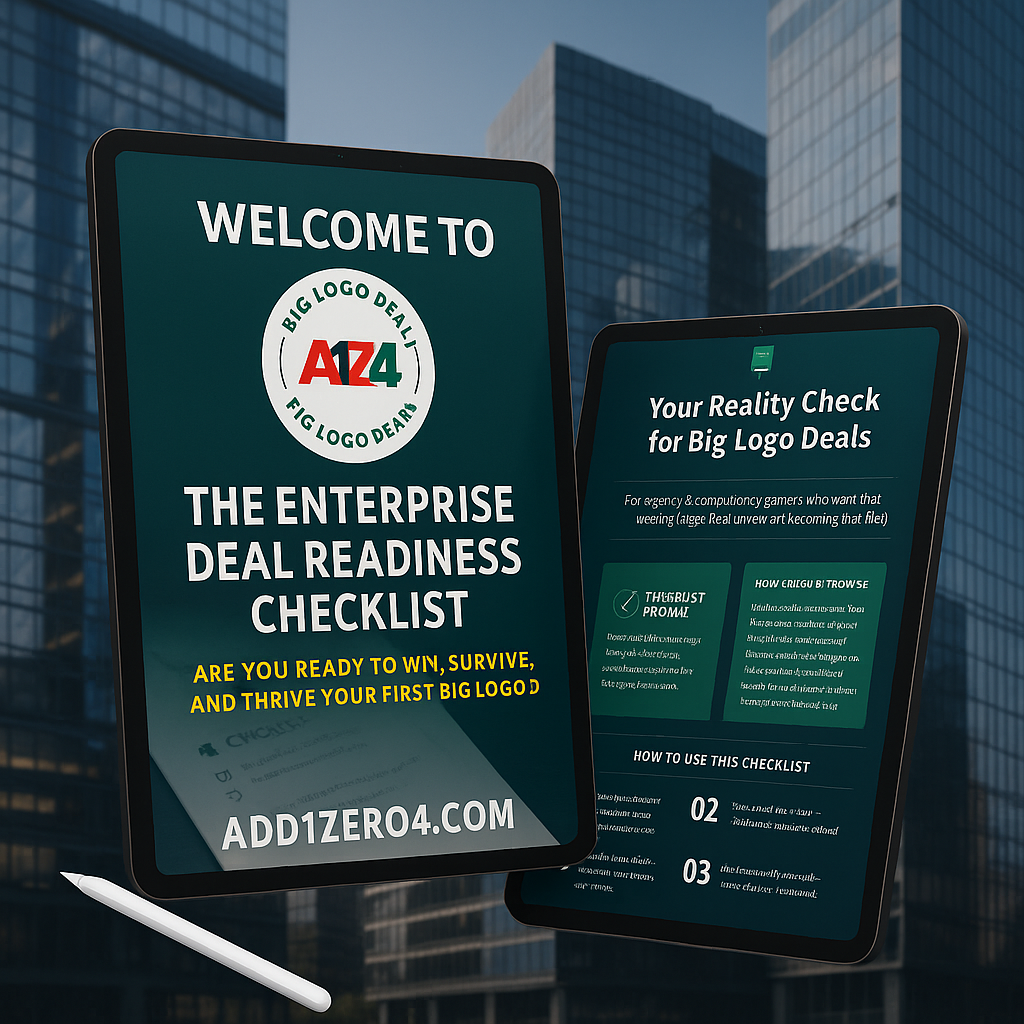
The Enterprise Deal Readiness Checklist
Skip the $100K+ learning curve. This insider’s checklist reveals if your B2B agency can win (and survive) Fortune 500 deals before you risk your stable revenue and best people chasing logos you’re not ready for.
Re-Engineering Your Operations for Enterprise Scale
If your current influencer marketing agency business model is a finely tuned machine for SMBs, get ready for enterprise clients to throw a wrench in the works. Your existing processes, team structure, and delivery standards will be stretched, if not broken.
Showing Up as The Expert (Because You Are):
Enterprise clients expect you to arrive at the first meeting already deeply knowledgeable about their business, their industry, and their challenges. The SMB approach of a standard discovery questionnaire won’t cut it. You need to have done your homework – read their annual reports, scoured their press releases, understood their market position.
And it’s not just you; your entire team needs to project this expert poise. Record your sales calls (with permission, of course!). Share these recordings and detailed notes with your delivery team. They need to understand the nuances of every promise made and every expectation set. Enterprise clients expect everyone they interact with at your agency to be on the same page and exude competence.
Team Readiness: More Than Just Bodies:
Landing a big logo deal often means a 10x increase in demands – attention, management, output. Can your current team handle that on top of their existing workload? Probably not without burning out. You’ll need to honestly assess if you have the bandwidth, the right skill sets (enterprise experience is different!), and potentially even the need to hire or bring in specialized contractors. Assuming your star SMB player can seamlessly pivot to a demanding enterprise account is a recipe for disaster.
Sales Enablement: Speaking Their Language:
What you think enterprise clients care about and what they actually care about can be two different things. Sure, they’ll talk about brand awareness and thought leadership. But when it comes time for budget renewal, their bosses will be asking about ROI, hard numbers, and tangible business value. Your sales enablement materials – case studies, process docs, ROI calculators – need to be laser-focused on these metrics. And forget flashy, over-designed decks. Think clean, simple, data-driven one-pagers or short videos that get straight to the point.
Feeling a bit overwhelmed by the operational overhaul? The Enterprise Deal Readiness Checklist can help you pinpoint areas needing attention.
Our Probably-Too-Honest Private Podcast
Find out what REALLY happens when agencies land enterprise deals (spoiler warning: one of them lost $100K)
Brought to you by Add1Zero4 and hosted by David “Ledge” Ledgerwood
Fortifying Your Financial Framework
Big deals mean big money, right? Yes, but they also mean big costs and potentially big financial risks if your influencer marketing agency business model isn’t built for it.
The Cash Flow Crunch You Didn’t See Coming:
Here’s a hard truth: massive deals can kill unprepared agencies faster than no deals at all. Why? Enterprise clients often have long payment cycles (Net 60, Net 90, or even longer). Meanwhile, you’re footing the bill for increased staff, resources, and operational overhead to deliver on their exacting standards. If you don’t have significant cash reserves or a healthy line of credit, you could find yourself insolvent before that first big check clears. A good rule of thumb? Assume you’ll need to float at least half the contract value for six months.
COGS: Not Just a Line Item, It’s Your Guardrail:
You might have a “gut feel” for your Cost of Goods Sold (COGS) with SMB clients. For enterprise deals, “gut feel” is a fast track to losing money. You need meticulous COGS calculations for every deliverable. Enterprise clients will want to unbundle your “packages” and scrutinize line items. If you don’t know your true costs, you can’t protect your margins. And remember, your team isn’t 100% billable; account for non-billable time, overhead, and the “switching costs” between complex tasks. Founders often forget to bill for their own time in COGS – don’t make that mistake.
Pricing Power: The “Twice the Price, Half the Deliverables” Secret:
It sounds counterintuitive, but for enterprise clients, a common starting point is to consider charging twice what you’d charge an SMB for half the deliverables. Why?
- Overhead: The sheer amount of communication, project management, reporting, and internal meetings required by enterprise clients is staggering. This needs to be baked into your price.
- Value Perception: Enterprise clients expect to pay premium prices for premium, tailored services. Underpricing can make you look inexperienced or less capable.
- Scope Realism: They often don’t need (or can’t consume) the same volume of deliverables as an SMB, especially initially. They want focused, high-impact work.
Packaging Your Genius Enterprise-Style
The beautifully crafted “gold, silver, bronze” packages that work wonders for your SMB clients? Enterprise buyers will likely give them a polite nod and then ask you to dismantle them.
Customization is King (But Don’t Drown in It):
Big companies expect solutions tailored to their unique, complex needs. Your influencer marketing agency business model needs to shift from productized services to bespoke solutions. This doesn’t mean reinventing the wheel every time. It means having modular service components that you can assemble into a custom package.
Your proposals need to reflect this. Ditch the generic sales pitch and focus on a clear, concise document that outlines the specific problem you’re solving, your tailored solution, the deliverables, and, most importantly, the cost. They’ve already been sold on you during the sales process; the proposal is for closing the deal. Think Google Docs over glossy PDFs – simple, editable, and focused.
The SOW: Your Shield Against Scope Creep:
A meticulously detailed Statement of Work (SOW) is non-negotiable. Enterprise clients, often without malice, are masters of scope creep. “Could you just…?” will become a common refrain. Your SOW, backed by clear communication from your delivery team, is your defense. Educate your team: doing “favors” for big companies doesn’t build the same goodwill as with SMBs; it just sets a new baseline expectation for free work.
The Big Logo Deals Course
Created by experts who have closed over $50 million in revenue over the last decade who teach you everything they know about closing deals with the logos you wish were on your client list.
The Enterprise Gauntlet: Legal, Procurement, and Patience
Welcome to the land of MSAs (Master Service Agreements), NDAs (Non-Disclosure Agreements), procurement portals, and seemingly endless paperwork. This is where many promising enterprise deals wither on the vine for unprepared agencies.
Legal Eagles and Contract Minefields:
You’ll likely be signing their paper, not yours. These contracts can be dense, confusing, and riddled with clauses that could handcuff your agency. While you don’t need to pay a lawyer to redline every comma, you do need to understand the critical clauses:
- Publicity: Can you use their logo in your marketing? This is huge. If not, your price should reflect the lost marketing value.
- Insurance: They’ll often require high coverage limits and types of insurance you might not carry. Be prepared to negotiate what’s reasonable.
- Data Security & IT Audits: Get ready for security questionnaires. Using major cloud providers for your data can simplify this, as they often have robust certifications you can point to.
- Non-Competes/Exclusivity in NDAs: Watch out. Never sign anything that unreasonably restricts your ability to work with other clients in their industry unless the compensation is astronomical.
Procurement Portals: The Digital Gatekeepers:
Nearly every large company uses a supplier portal (SAP Ariba, Coupa, etc.). You’ll upload W-9s, banking info, and invoices here. The user experience can range from decent to soul-crushing. It’s a frictional cost of doing business. Stay organized, keep meticulous records, and understand their billing process inside and out. Getting paid is on you.
The Long Game: Patience is More Than a Virtue, It’s a Strategy:
Enterprise sales cycles are marathons, not sprints. Decisions involve a “constellation” of stakeholders, many of whom you’ll never meet. Budgets shift, priorities change, and your main contact might get re-assigned. Polite persistence is key. Follow up, add value, but don’t be a pest. Understand that a “verbal yes” from a mid-level manager means very little until contracts are signed and POs are issued. My own painful lesson: I once bought champagne for the team after a verbal “yes” on a $40k deal from a VP at a huge firm. Weeks later: “Sorry, couldn’t get approval.” Don’t celebrate until the ink is dry and the PO is in hand.
The Transformation Journey
Evolving your influencer marketing agency business model to successfully court and keep enterprise clients is a significant undertaking. It requires a shift in mindset, a re-engineering of operations, a fortification of your financials, and a deep understanding of how large corporations actually work.
But the rewards are commensurate with the effort: game-changing logos on your website, significantly higher revenue per client, and the kind of industry cachet that makes future big deals easier to land. It’s a compounding effect. Every big logo you successfully serve makes you more attractive to the next.
It’s a journey, and it won’t happen overnight. But with the right knowledge and a commitment to transforming your agency from the inside out, those big league wins are within your reach.
Ready to get the full playbook on how to make this transformation a reality for your agency? Learn the proven mindset, tactics, and execution strategies in the Big Logo Deals course. It’s time to add that zero (or two) to your deal sizes.